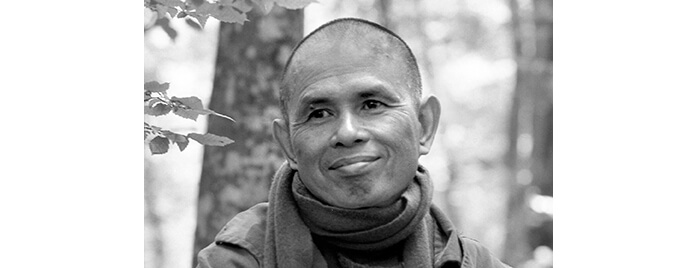
Dharma Talk: Sitting in the Wind of Spring

By Thich Nhat Hanh

Here is the first Dharma talk that Thich Nhat Hanh gave on his recent tour of Vietnam, at Phap Van Temple in Ho Chi Minh City on February 22, 2007. This excerpt presents the last part of the talk, including questions from the audience and Thay’s answers. Later in this issue we offer a story of that day along with photos from the journey. To hear this talk in full, go to www.dpcast.org and look for “Mindfulness and Healing in Vietnam.” 

Thich Nhat Hanh

While we’re sitting still, sitting peacefully, there are three elements that we need to harmonize. The first is the body, the second is the mind, the third is the breath — mind, body, and breath.

mb45-dharma2

Sometimes our body’s there but the mind has run off somewhere else. It runs off to the future, to the past. It is caught in worries, sadness, anger, jealousy, fear. There is no peace, no stillness. If we want to sit still we have to bring the mind back to the body.

How can we bring the mind back to the body? The Buddha taught in the Sutra on Mindfulness of Breathing that we need to know how to use the breath. When we breathe in, we bring the mind back to the breath. I am breathing in, and I am aware that I am breathing in. Instead of paying attention to things that happened in the past, things that might happen in the future, we bring the mind back so that it can pay attention to the breath.

This sutra has been available in Vietnam since the third century. Zen master Tang Hoi was the forefather of Vietnamese Zen and this is one of the most basic sutras in meditation practice. Breathing in, I know that I am breathing in. Breathing out, I am breathing out. This is the first exercise of the sixteen exercises in the Sutra on Mindfulness of Breathing, which I have translated from Pali to Vietnamese and from Chinese to Vietnamese; it has been published in many languages.

The day I discovered the Sutra on Mindfulness of Breathing I was so happy! It is a wonderful sutra for our practice of meditation. If we practice wholeheartedly, in a few weeks we can bring peace and happiness back to our bodies and to our minds.

The Practices of the Buddha

In Plum Village we have a gatha, a short poem that we memorize. It has only a few words.

In, out.
Deep, slow.
Calm, ease.
Smile, release.
Present moment, wonderful moment!
The first one, “in, out,” means breathing in, I know that I’m breathing in. Breathing out, I know that I’m breathing out.

The second one is “deep, slow.” Breathing in, I see that my inbreath has become deeper. Breathing out, I see that my out-breath has become slower. In the beginning our breath is very short, but if we continue to follow our breathing for a while, naturally our in-breath becomes slower, deeper, and our out-breath also becomes slower, more relaxed.

This is our practice. Just as when we want to play the guitar, we have to practice every day, or if we want to learn to play tennis, we have to practice to be a good tennis player, we also have to practice our breathing. After one hour of practice we already feel better. Then slowly we’ll be able to sit still like the Buddha, and be worthy to be his disciples.

Perhaps for a long time we have been going to the temple only to do offerings. But that’s not enough. We have to learn the teachings of the Buddha, the practices that the Buddha wanted to transmit to us.

Breathing for Our Mothers and Fathers

We practice not to be happy in the future; we practice to be happy right in the present moment. When we’re sitting, we should have happiness as we are sitting. When we are walking, we should have happiness as we are walking. We sit with our breath so that the body can be calm and the mind can be calm; that is called sitting meditation. When we know how to walk, to take steps in lightness and gentleness, that’s called walking meditation.

In practice centers that practice in the Plum Village tradition, we walk peacefully as if we were walking in the Buddha Land. We do not talk as we are walking. If we need to say something, we stop to say it, and then we continue walking. If you visit Plum Village or Deer Park or Green Mountain or Prajna or Tu Hieu, you will see that the monks and the nuns in these centers do not talk when they walk. They pay attention to each of their steps, and the steps always follow the breath.

When you come to live with the monks and the nuns, even for just twenty-four hours, you can learn how to walk and sit like the monks and nuns. Peace and happiness radiate as we are sitting, as we are walking. When we practice correctly, there’s peace and happiness today; we don’t have to wait until tomorrow. Lay practitioners who attend our retreats learn to breathe, to sit, and how to pay attention to their steps right in the first hour of orientation.

While we are here in Vietnam we will also offer these teachings during the monastic retreats and retreats for lay friends. So everybody will learn about sitting meditation, walking meditation, breathing meditation.

“In, out, deep, slow. Calm, ease, smile, release.” That’s the fourth exercise: “Smile, release.”

Breathing in, I feel calm, I feel such a sense of well-being. Breathing out, I feel light. This is what we call the element of ease — one of the seven factors of enlightenment. When we practice through the third exercise we feel calm and ease. When we breathe like that it’s not just for us, but we are continuing the career of the Buddha. We are breathing for our fathers, our mothers in us. When we practice like that it’s so joyful.

I often write these statements so that the young monks and nuns can send home a calligraphy as gifts to their parents. “I am taking each step in freedom for you, Father.” “I am breathing gently, peacefully for you, Mother.” When we practice like that we practice for our whole family, for our own ancestral lines, and for our whole country, not just for ourselves alone.

The Healing Power of Total Relaxation

We accumulate so much stress! This can bring a lot of illnesses if we do not know how to practice total relaxation. That is why the Buddha taught us: breathing in, I relax my whole body; breathing out, I smile to my whole body.

In Plum Village we have the Dharma practice called “total relaxation.” We can do total relaxation as we are sitting or as we are lying down. I ask you to learn this practice. If you practice total relaxation each day for about twenty minutes, you can avoid a lot of illnesses. If you hold in too much tension and stress in your body or your mind, it can generate illnesses in the future, such as high blood pressure, cardiac diseases, or stroke.

mb45-dharma3

If we can practice as a family each day, with a time allotted so that the parents, the children, can lie down and practice, that is a very civilized family. In Plum Village we have produced CDs that can help people to practice total relaxation, available in English, French, Vietnamese, and German. At first when we don’t know how to lead total relaxation, we can listen to the CD and the whole family can practice. After a while we can take turns leading total relaxation for our family.

In the West there are hospitals that apply these breathing exercises to save patients when there are no other ways to help them. In an article in the Plum Village magazine, Brother Phap Lieu [a former physician] wrote about a doctor who learned about the sutra and the practices of Plum Village and then applied what he learned to help his patients.

Peace and Freedom in Each Step 

There are people in the West who are from the Christian tradition yet they know how to take advantage of Buddhist wisdom to help themselves. We call ourselves a Buddhist country, but many of us only know how to worship and make offerings. We do not yet know how to apply the very effective teachings transmitted to us by the Buddha through the sutras such as The Four Establishments of Mindfulness or Mindfulness of Breathing.

We have this temple — Phap Van (Dharma Cloud) — as well as Prajna, Tu Hieu, An Quang, and other temples. We can go to these temples to learn more about the teachings of the Buddha. We learn about breathing meditation, sitting meditation, walking meditation, total relaxation meditation, so that we can apply them into our daily lives.

At the retreat for businesspeople in Ho Chi Minh City, they will also learn breathing meditation, sitting meditation, and walking meditation. We have organized a retreat like that for congressmen and –women in the United States. Presently in Washington D.C. there are congress people who know how to do walking meditation, how to coordinate their breath and their steps. A congressman wrote a letter to me, and he said, “Dear Thay, from my room to the voting chamber I always do walking meditation. I come back to my breath and my steps on my way to this place. My relationship with the voting process and with my co-workers has improved so much because I know how to apply walking meditation practice.”

We have also organized retreats to teach these practices to police officers in the United States. Imagine all these big police officers who now take steps in peace, in gentleness. Do you know that in the United States there are more police officers who commit suicide than are shot by criminals? They witness so much suffering and they cause so much suffering to themselves and to their families; they feel they had no way out. That’s why a retreat like ours benefited them so much and they suffer much less.

mb45-dharma4

In prisons there are those who know how to organize sitting meditation. Last month an American prisoner wrote to me, “Dear Thay, even though I am in prison, I’m very happy, and I see that sometimes being in prison is good for me. This is an advantageous condition for me to do a lot of sitting and walking meditation. If I were outside right now, maybe I would never have learned this practice. I am not a monastic, but I see that I am living in prison and I live according to the mindful manners and precepts in the book Stepping Into Freedom.” Stepping Into Freedom is a revision of the book written for the monastics; it contains the essential practices for the novices.

Over the centuries when people have been in deep despair and have come in touch with the wonderful teachings of the Buddha, they have been able to transform their lives. We are children of the Buddha — for many generations. Buddhism has been in our country for over two thousand years. If we have not learned these basic practices of meditation, it is a shame.

That is why I very much hope that those of you who are present today are determined to learn these basic practices. We have to be able to sit still. We have to know how to breathe in such a way that we feel comfortable, peaceful, and we need to know how to walk so that there is peace and freedom in each step. We’re not doing this for ourselves only, but for our fathers, for our mothers, for our children, and for our country.

In the Anapanasati Sutra on mindfulness of breathing, the Buddha taught us to use the mindfulness of our breathing to heal our body and our mind. When there is relaxation in the body, our body has the capacity to heal itself and medication becomes secondary. When stress is so great, we can take a lot of medication, but it’s very difficult to heal. So while we’re taking medication, the most important thing is to relax the body. When the nurse is about to give us an injection we tense our body because we are afraid there’ll be pain. When we tense up the muscles like that, if she gives an injection it will be very painful. So she says, “Now take a deep breath!” And when we’re breathing out and we’re thinking of the out-breath, then she sticks the needle into our arm.

While we’re driving, while we are cooking, while we are sweeping the floor of the house, while we are using the computer, we can also practice total relaxation. Do not think that the monks and the nuns do not work a lot. They also work a lot, but they While we’re driving, while we are cooking, while we are sweeping the floor of the house, while we are using the computer, we can also practice total relaxation. Do not think that the monks and the nuns do not work a lot. They also work a lot, but they

The Secret of Zen

After we bring our mind back to take care of the body, we can bring our mind back to take care of the mind. In our mind there’s suffering, fear, worry, irritation, anger. Often we want to suppress these feelings but each day the tension and stress grow greater and greater. Eventually they cause us illnesses of the body and mind. The Buddha teaches us to bring the mind back to the body to take care of the body and to bring the mind back to take care of the mind.

Among the sixteen exercises of breathing, there is one exercise that aims to relax negative mental formations, such as anger and worry. Breathing in, I am aware that there’s irritation in me. Breathing out, I smile to my irritation. Breathing in, I am aware that there are worries in me. Breathing out, I take care of my worries. Our irritation or worries are like our baby. We use our breathing to generate the energy of mindfulness in order to embrace our worries and our fear.

Right mindfulness means we know what’s going on. For example, I am breathing in, and I know that I am breathing in. That is right mindfulness of the breath. When we take a step and we know that we are taking the step, that is right mindfulness of the step. When we drink a cup of coconut juice, in that moment we have mindfulness of drinking. We bring the mind back to the body so that it’s present as we are sitting, standing, lying down, putting on our robe, taking off our robe, brushing our teeth. Our mind is always present. That is the secret of Zen.

When the body and mind are relaxed, we have the capacity to listen to the other person and to speak gentle words. Then we can re-establish communication between us. The other person may be our spouse, our partner, our daughter or our son, our friend, or our parents. That practice is deep listening and loving speech. If there is no peace in the body and the mind, we cannot practice loving speech and deep listening. When we are able to practice deep listening and loving speech, we can help the other person to suffer less. Joy can be re-established in the family.

I’d like to inform you that Western practitioners, after just five days of practice, can reconcile with their families, with their parents. If they practice, they invest a hundred percent into their practice because they want to succeed and not practice just for form.

mb45-dharma5

Children of the Buddha

We organize retreats for Westerners to practice with Vietnamese. In these retreats the Vietnamese see the Western practitioners practicing diligently and correctly.

We have been children of the Buddha for two thousand years. We cannot do worse than Westerners. We can do just as well or even better. We have to have deep faith in the teachings and practices of the Buddha. Buddhism is not a devotional religion, it is a treasure of great wisdom.

It’s just like a jackfruit. The devotional part is only the shell outside. When you cut it open and go deeply into it there are parts that are very sweet, very fragrant and soft. Many of us have been practicing just on the outside of the jackfruit, but when we go into it we can enjoy it very deeply. We need to learn — not in order to accumulate Buddhist knowledge, but so that we can apply it in our daily lives.

First of all, we learn to practice in such a way that we can sit still and relax our body and mind. We learn so that we can listen deeply and speak lovingly. Perhaps in only one or two weeks we can change our whole lives. We can bring happiness into our family. Many people have been able to do it. If we want to we can also do that.

This is the first dharma talk. I don’t want to speak very long, so I will leave a little time so that you can ask questions.

Dwelling Happily in the Present Moment 

Woman from audience: First of all I would like to wish Thay and the monks and nuns good health so that you can continue to transmit the teachings to us and to future generations. When we practice we can come back to the present moment and dwell happily and peacefully in the present moment, and in order to do that we have to bring together the three factors of body, mind, and breath. But what if one of these three factors, for example, my foot, has a problem and I cannot keep it still. So then would my practice yield peace or ease?

Thay: Very good! [audience applause] First of all, do not wait until you have pain in your foot, then say, “I cannot practice!” Practice when you don’t have pain in your foot. When there’s pain in the leg, first of all we take care, we try to find treatment for the leg and at the same time we find a way to sit so that there’s comfort. There are people who have problems. Instead of using one cushion, they use two cushions. Instead of sitting in a lotus position they sit in a half-lotus, or they sit on a stool or in a chair. People may sit in a chair but they can still bring their mind back to their body.

As for the breath, for example, it may be very difficult when we have asthma. So we should practice when we are not having an asthma attack, and then when we have an asthma attack we can still practice with that.

Do not use the excuse that I have this particular difficulty with my body or my mind or my breath. There are people who are victims of vehicle accidents, who were artists and now they cannot draw with their hands, so they use their feet to draw — beautiful paintings. So if we have a little pain in our feet or we have difficulties with our breath, we can still practice. We don’t use that excuse to be too lax in the practice.

Invoking the Buddha’s Name 

Man from audience: When we use the breath to invoke the name of Amitaba Buddha, breathing in, we say “Namo” [“praise”]; breathing out we say, “Amitaba Buddha.” “Namo, Amitaba Buddha.” This is the Buddha of the Pure Land, and so when you teach us, “Breathing in, I feel calm, breathing out, I feel ease,” I can say it’s somewhat equivalent to my practice. Slowly it brings me to this concentration of the breath at a higher level. When there’s concentration on the breath and on invocation of the Buddha, it can help heal us. So I would like to share that with you, and I would like to express my gratitude of your teaching today.

Thay: Very good. We can combine the practice of invoking the name of Amitaba Buddha with the practice of breathing meditation. But tonight we talk about the sutra Anapanasati, Mindfulness of Breathing, which was taught by the Buddha himself. We can use this original sutra in all different Buddhist traditions, whether Pure Land or Zen or other traditions. We did not say that this is the only method of practice, because there are many other practices. We just brought up a few exercises that the Buddha suggested to us. It does not mean that we do not affirm or recognize other practices.

mb45-dharma6Whatever Dharma practices bring us to relaxation, freedom, and peace of body, they are all best practices. We don’t want to waste time saying that this practice is better than other practices.

Some people feel comfortable with certain practices; other people may not feel that they succeed in a practice, so they try another practice. Whatever practice we do, we want to reach the fruits of that practice — freshness, happiness, calmness. There is peace and happiness right away, and we don’t have to wait until three, four months later or three, four years later to taste that fruit. It’s the same way in the practice of invoking the name of the Buddha. We invoke the name of the Buddha in such a way that there is peace and happiness right in the moment while invoking the name. If we feel fear or anxiety, it is not in the spirit of the teachings of the Buddha. So that’s what it means, dwelling peacefully and happily in the present moment.

Being in Touch with the Departed

Man in audience: In a magazine they said that today Thay would give a Dharma talk about being with my loved one, and how to practice to bring peace to myself. When you gave the Dharma talk tonight, you said that when you are able to be in touch with your breath, you have peace and happiness. Do you mean that when we have peace and happiness, we can be in touch with our loved ones who are dead?

Thay: We will go slowly, step by step. There are many different topics. We will have the three ceremonies to pray for the people who passed away during the Vietnam war, and we can pose the question: “My loved ones have died in the war. How can I bring them peace? How can I help them to be liberated?” These topics need a lot of time to understand because they are very deep.

Just like any scientific field, Buddhism needs to take steps. When we cannot take the first step and the second step, it’s very difficult for us to take further steps. That is why we should not hurry too much or be pulled away by the theoretical realm. We need to grasp the basic practices first.

When we have enough peace in the body and the mind, we have the capacity to listen. Then we can take care of more difficult situations. In us there are certain preconceptions that we have accumulated from the past. When we listen to something new, we have a tendency to fight against it. Maybe there’s this structure inside us when we first listen to a teaching. That is why the Buddha taught us how to break through these views, whatever we learned yesterday. If we cannot let go of what we studied in the past, we cannot go on to the next step. If you don’t let go of the fifth step, you cannot take the sixth step. If you want to go to the seventh step, you have to let go of the sixth step.

In this past century many scientists have found that Buddhism is very inspiring. Einstein said that Buddhism is the only religion that can go in tandem with science. That is the spirit of breaking through knowledge, through views that we have accumulated from the past. 

‘To Sit in the Wind of Spring’

We should end the dharma talk now. We will see each other tomorrow. This morning our delegation had a chance to visit An Quang Temple. We offered to the abbot of An Quang a calligraphy that said, “To sit in the wind of the spring.”

I explained to the abbot that in the old teaching, when the brothers and sisters sit together in this love on the path, when the teacher and the students sit together and exchange their experiences in the practice and teach each other and support each other, there is this happiness as if we were sitting in the spring. We benefit from the wind of the spring that is like a nourishing breeze. So that’s why this morning I wrote the calligraphy, “To sit in the wind of the spring.”

I have a feeling that tonight as the teacher and students sit here together, we also sit in the wind of the spring. We have the good fortune to meet each other to exchange our knowledge and experiences. This is a great happiness that I would like all of us to be aware of.

Interpreted by Sister Dang Nghiem
transcribed by Greg Sever;
edited by Janelle Combelic
with help from Barbara Casey
and Sister Annabel, True Virtue.
 

PDF of this article

Dharma Talk: Throwing Away

Dharma Talk by Thich Nhat Hanh

June 7 – 8, 2006

Thich Nhat Hanh

During the Breath of the Buddha retreat at Plum Village, Thây  focused on the Sutra on Mindful Breathing, which he had just  translated from the Chinese. In this excerpt from two Dharma  talks, Thây discusses exercises 11 through 14.

Exercise 11: Skillfully he practices breathing in, concentrating  his mind.  Skillfully  he  practices  breathing  out,  concentrating  his mind.   

Exercise 12: Skillfully he practices breathing in, liberating his  mind. Skillfully he practices breathing out, liberating his mind.

mb43-dharma2The practice of concentration helps us to understand the nature of affliction, and with that kind of insight, we can burn affliction away. Concentration as energy has the power of transformation. Concentration is something extremely important in the teaching of the Buddha. 

To concentrate means to concentrate on something. In the teaching of the Buddha, many kinds of concentration are proposed. According to our need, we can apply one or two of these concentrations to free us, like concentration on impermanence, concentration on non-self, concentration on compassion, concentration on interbeing, and so on. Each concentration, each samadhi, has its own name.

The Buddha spoke about the three doors of liberation, which are considered to be three concentrations: emptiness, signlessness, and aimlessness.

Emb43-dharma3mptiness is not a philosophy, a description of reality. Emptiness is a practice. Emptiness does not mean non-being, non-existence. There’s a big difference between non-existence and emptiness. Suppose we look at the glass. It is empty. The glass is empty, but the glass is not non-existent, right? In order to be empty, you have to be there. That is one thing you can learn—emptiness is not non-existence. The second thing is that when we say the glass is empty, you have to ask, “Empty of what?” It’s not empty of air. It is empty of tea, but it is full of air. So the intelligent question to ask is, “Empty of what?” The first answer may be: empty of a separate existence, empty of a separate self.

This is the simplest description in the Buddhist scriptures about emptiness, about interbeing: this is, because that is. As practitioners, we don’t just speak of emptiness as a teaching philosophy. We have to transform emptiness into a complete practice.

Signlessness is the second door of liberation. “Sign” means the appearance or the form. We are used to seeing the form that is the object of our perception. Nimita is the form. Animita is formlessness, or signlessness. The practice is not to be attached to the form, and this needs some training.

Those of us who have lost a loved one, we know grief. But if you are equipped with the concentration of signlessness, formlessness, you can overcome your grief, your sorrow, very quickly. You are capable of seeing things in the light of signlessness: nothing is born, nothing dies. Everything continues in this new form. You also! Your nature is the nature of deathlessness.

Aimlessness is the third door of liberation. Apranihita is the Sanskrit term. Apranihita means you don’t put anything in front of you as object of your pursuit. What you are looking for is already there, not outside of you. You are already what you want to become. You are wonderful just like that. Don’t try to be something else, someone else. You don’t have to go to the future in order to get what you want. Everything you are looking for, it is right here, in the here and the now, including the Kingdom of God, your immortality, your deathlessness. Your enlightenment is right here. And that is truly the third door of liberation: aimlessness.

The Concentration on Loving Kindness 

There is a concentration called maitri, karuna—love, compassion. And the contemplation on love, on compassion, can bring you a lot of relief, can bring the nectar of healing to you.

Suppose someone has made you suffer. You think of him or her as very cruel. That person has inflicted on you a lot of suffering, on your family, on your country. And because of that you want that person or that group of persons to suffer a lot for you to get relief. You are thinking in terms of punishment. That hate, that anger, that will to revenge is a kind of fire that continues to burn your body and your mind, and you are in hell. Hell is here in the here and the now.

Just before, we spoke about the Kingdom of God being in the here and the now. But that is true of hell. Hell can be in the here and the now. If we allow the flame of affliction to burn us, there are moments when lying on our bed we cannot sleep because our whole body, our whole being is burned by the fire of hate, of anger, of despair.

The concentration on maitri, on karuna, on compassion, will help you to suffer less.

With your attention focused on the other person, you can see that the other person suffers a lot also. The fact is that when someone suffers a lot and is not capable of handling his or her own suffering, she will spill her suffering all over, and you become a victim of that.

And you may be like that. You are suffering a lot, and if you don’t know how to manage your suffering, you continue to suffer and you will make others around you suffer, including the people you love.

Looking deeply, we see that the other person, as a child, did not have a chance to learn love and compassion from his or her parents. The parents have caused a lot of wounds in him, in her, as a child; and no one has helped him or her to heal the wounds in the child. And then when they went to school, the teacher did not help, and the students around did not help. The seeds of anger, suffering, and hate continued to grow.

Such a person needs help, not punishment. By looking deeply and recognizing the presence of suffering in that person, you might see the truth that that person needs help. And now if we punish him, he will suffer more.

This insight may motivate you to do something to help that person. With that kind of insight, the hate and anger vanish, because that insight brings the nectar of compassion. And the nectar of compassion is wonderful. You stop suffering right away. The fire that has been burning, stops burning. That is the effect of metta  meditation, the meditation on compassion.

Compassion for a Suicide Bomber 

Nowadays we learn that there are many young people in the Mideast, they are ready to die, to blow themselves up with a bomb in order to kill as many as possible. We call them terrorists, and we believe that in order for the world to be peaceful, you have to kill all these terrorists. So you invest a lot of money and energy into what you call the war against terror. The more you kill, the more terrorists you create, because the killing is an act of punishment. Then the family and the friends of the one who is killed burn with the flame of anger, the will to punish. In killing one so-called terrorist, you create three, four terrorists more. That is what is happening.

There are many young people who suffer so much hate and despair, not only in Iraq, but also in Europe, in America. The number of young people who kill themselves every day is enormous. When you are burned by the flame of despair, of hate, of violence, you suffer so much. And as a young person, you don’t know much about your mind, about the practice. You believe that the only way to stop the suffering, the burning, is to kill yourself.

I guess for many young people, to die is much easier than to live, because they are overwhelmed by the emotions—of hate, of despair. And then you are told that by dying you might help the cause of justice, and you can go to paradise right away after death.

These kinds of perceptions and feelings lead to the act of suicide bombing. If you look deeply, you see that these people need help. And the operation to kill them is not the right answer. We have to help them to see there is a way out of suffering, that only love and compassion and understanding can solve the problem.

One side is using violence. The other side is responding with violence. And the situation goes on without a chance to stop. The way out is shown by the Buddha. Hate cannot respond to hate. Violence cannot respond to violence. There must be another way. The meditation on compassion is essential.

During the war in Vietnam we were able—myself and many friends of ours—to see that the young Americans who came to Vietnam to kill or to be killed were also victims of a wrong policy. With that kind of insight we tried to work for reconciliation rather than supporting one side of the war.

In my experience, the concentration on compassion is a wonderful practice. You may need only fifteen minutes of breathing deeply and looking deeply to recognize that the other person is a victim of his or her own suffering. That person needs you, needs your help, and does not need your punishment. Suddenly the nectar of compassion is born, your heart is blessed with that nectar, and you don’t suffer any more. Instead, you want to do something, to say something, and if you are not capable of loving speech you can write a letter. You can say something kind in order to help that person. But you cannot help that person until you have been able to help yourself. Peace and compassion always begin with yourself.

The Reality of Impermanence 

Exercise 13: Contemplating impermanence, I breathe in. Contemplating impermanence, I breathe out.

Impermanence is a key that can unlock the door of reality. It is also a concentration, a practice. Intellectually we know that things are impermanent. We can agree with the truth of impermanence. Our scientists also agree that things are impermanent. But in reality we still behave as though things are permanent.

We have to keep the insight of impermanence alive. When we come in touch with anything, we should be able to see the nature of impermanence in it.

mb43-dharma4We have to distinguish between the notion of impermanence and the insight of impermanence. We may have the notion of impermanence, we may have understood what impermanence is, but we do not have the insight of impermanence. The insight is something alive.

Impermanence is a fact that science has to recognize. When you are able to see the nature of impermanence, you’ll begin to see the nature of non-self. Because non-self is not different from impermanence. Since everything is changing in every second, nothing can remain itself in two consecutive moments. So impermanence means non-self. They are the same thing.

Looking from the angle of time, you say, impermanence. Looking from the angle of space, you say, non-self. They are exactly the same thing.

In the Pali canon, non-desire comes next. In the Chinese canon, throwing away is next.

Throwing Away What?

Exercise 14: Skillfully, he practices breathing in, contemplating  letting go. Skillfully, he practices breathing out, contemplating  letting go.

Throwing away is a wonderful practice. You might like to ask, “Throwing away what?” What is to be thrown away?

We have learned that wrong perceptions are the ground of all afflictions— fear, anger, discrimination, despair. So it’s easy to know that throwing away here means to throw away wrong perceptions—ideas or notions—that are at the base of our suffering. It is the most important practice in Buddhist meditation. You have an idea, and you entertain that idea for a long time, and you continue to suffer.

Every one of us entertains an idea about happiness. It may be because of that idea of happiness that we’ve never been happy. So it’s very important to throw away that notion of happiness.

A nation is a community of people, and they may entertain together one idea, one ideology. Each political party—the socialist party, for instance—entertains an idea. And we might get caught in that idea. An ideology may be a trap, and your nation may be caught in it for sixty, seventy years, and during that time you create a lot of suffering. Those who do not agree with that ideology, you put them in psychiatric hospitals. The moment you release that idea, happiness begins to be possible.

So throwing away is very important. It takes insight and courage in order to throw away an idea.

The word is “throwing away.” It’s very strong; it’s not just letting go. The Sanskrit, the Pali term, is “throwing away” in a very strong way. The Vietnamese meditation master Tang Hoi, he used the word phong xa for throwing away. Tang Hoi was the first teacher of meditation in Vietnam, who lived in the first half of the third century.

Insights from the Diamond Sutra 

The Diamond Sutra advises us to throw away four notions. The first notion is the notion of self. It is by intensive training that you can throw away the notion of self.

If a couple knows how to live in a spirit of non-self, there will be no difficulty, no anger, no discrimination, no despair, because they have realized the truth of non-self. If a father and son, mother and daughter, have the insight of non-self, they look at each other as interbeing.

mb43-dharma5There is the idea that I am this body. This body is mine, belongs to me. This is a notion that does not correspond to reality. When we say the words “I am,” we say it on the ground of the notion “I am,” and still people do not believe very much in that statement. That is why they try to justify it with a kind of argument.

In order to demonstrate that “I am” is a reality, René Descartes said, “I think, therefore I am.” One day I saw a cartoon picturing Descartes touching a horse. He declared, “I think, therefore I am.” And the horse asked back, “You are what?” That is a good question. If you can answer what you are, you may have a better idea that is closer to reality.

In the scripture it is written, “This is, because that is.” This is a statement about interbeing. If you are not there, I cannot be here.

So it is very important to throw away the notion “I am,” the notion of self, because it does not reflect the truth. By looking deeply into the nature of reality, you are capable of throwing away that notion of “I am.”

The second notion that the Diamond Sutra advises us to throw away is the notion “man,” human being. This is not too difficult. When we look into the human being, we see human ancestors, we see animal ancestors, we see vegetable ancestors, we see mineral ancestors. We see that the human is made of non-human elements. We see that we are at the same time a rock, a river, a cloud, a squirrel, a rose. And if we take away all the non-human elements, the human being is no longer there.

This is the deepest teaching on deep ecology. In order to protect the human being, you have to protect elements that are not human, because these elements are our ancestors, and if you destroy them there is no way we can be here. That is why discrimination between man and nature is a wrong view. You have to see you as nature, one with nature.

That is why harmony, respect of life, is possible. So throw away the idea that the human being is the boss, man is the boss, man can do anything to nature. The key is contemplation on impermanence of non-self.

The first to be thrown away is the notion of self, the second is the notion of man. With liberation from that notion, we become less proud, less arrogant as a species. We have to respect and protect other species in order for us to have a chance. That is why we said the Diamond Sutra is the oldest text on deep ecology.

We have the notion of la matiere inerte. But if you look deeply into the notion that matter is something without soul, without life, we see that is not true.

First of all, matter is the object of our perceptions. For a long time we believed that matter exists as a separate entity, and matter is something that does not move. But now as science advances, we see that matter is not static and immobile as we thought. In fact, the atoms, the electrons, move a lot. They are very alive. And looking more deeply, we see a lot of our mind in it, and we are not sure that they are there, in the way we imagined. So the distinction between living beings and non-living beings disappears after meditation. There is no longer any discrimination.

The fourth notion to be thrown away is the notion of lifespan. We believe that there is time, and we are born at one point of time. Our birth begins here, and we shall die at another point of time—death. I’ll only spend seventy, eighty, ninety or one hundred years on this planet. After that, I’ll be gone. This is what we believe. But as we look deeply, we see that this is a notion, a wrong perception. Birth is a notion, and death is also a notion. It’s not reality.

We have spoken of the deathlessness of a cloud. The cloud can never die. It can only become rain or snow. In our mind, to die means from something you become nothing; from someone you become no one. But if you look deeply you don’t see anything like that. A cloud can never die. If we look deeply we see that the nature of the cloud is also the nature of no birth. In our mind, to be born means from nothing we become something. From no one we suddenly become someone.

The cloud does not come from nothing. It has come from the water in the river, in the ocean. It has come from the sunshine, the heat. And you know that the birth of a cloud is a poetic image. It is a new manifestation. Before being a cloud, the cloud has been many other things.

Our true nature is the nature of no birth and no death. Birth and death are notions that cannot be applied to reality, because nothing can be born from nothing, and nothing can become nothing at all. This meditation practice of looking deeply will bring about insight. It will dissipate our fear and our despair.

Those are the four basic notions that are at the foundation of our fear, our desperation, our suffering. That is why the Diamond Sutra advises us to practice looking deeply, so that we can throw them away. The practice of throwing away your notions, your views, is so important. Emancipation and liberation would not be possible without this practice of throwing away.

If we suffer a lot, it’s because we still entertain a number of ideas. The practice of meditation helps us to get free from these ideas.

Our World Needs Wisdom 

So the object of our meditation is not something alien to our daily life. The way proposed by the Buddha is to help yourself and to help the people around you. It is to practice looking more deeply in order to be liberated from these notions that are at the foundation of hate, fear, and violence.

Writing a letter to a suicide bomber is true meditation. Meditation is not an escape. It is the courage to look at reality with mindfulness and concentration. Our world needs wisdom and insight. As a teacher, as a parent, a journalist, a filmmaker, you are capable of sharing your insight so that you can wake up your nation, your people. And if your nation, your people, are awake, then your government will have to act according to the insight of the people.

Meditation is essential for our survival, our peace, our protection. In fact, it is wrong views that are at the base of our suffering, and throwing away wrong views is the most important, most urgent thing.

To come to a retreat is not to get away from it all. To come to a retreat is an opportunity to look deeper, and to see exactly where we are.

Transcribed by Greg Sever

Edited by Greg Sever and Janelle Combelic


The Sutra on Mindful Breathing

This is what I have heard at a time when the Buddha was residing in the Jeta Grove in the town of Sravasti.

On that day, the World-Honored One told the Bhikshus:

“Dear friends, let us enjoy the practice of Mindful Breathing. If a Bhikshu knows how to skillfully practice Mindful Breathing, and does so consistently, he will find his body and mind peaceful; he will acquire positive investigations and reflections; his mind will be calm and pure; and he will have perceptions leading to Wisdom and be able to bring his practice to completion.

“This is how a bhikshu should proceed:

“Whether the bhikshu lives in a village or in a town, in the morning he puts on his sanghati, holds his begging bowl, and goes into town for alms round. While doing so, he knows how to protect his body and his six senses, his mind skillfully focused on whatever is present. After the alms round, he returns to his dwelling, puts his sanghati and begging bowl away, washes his feet, goes into the forest, to an empty room, to the foot of a tree, or to an empty space in the open air, and sits down in an upright position. He restlessness, regret and doubt, his mind determined to be in accord with wholesome dharmas, leaving far behind the five hindrances that cause afflictions, weaken his wisdom and constitute an obstacle on the path of Nirvana.

1. “Skillfully, he practices breathing in, fully aware of his in-breath.
Skillfully, he practices breathing out, fully aware of his out-breath.

2. “Skillfully, he practices breathing in a long or a short in-breath, fully aware of his long or short in-breath.
Skillfully, he practices breathing out a long or a short out-breath, fully aware of his long or short out-breath.

3. “Skillfully, he practices breathing in, fully aware of his whole body.
Skillfully, he practices breathing out, fully aware of his whole body.

4. “Skillfully, he practices breathing in, relaxing his whole body.
Skillfully, he practices breathing out, relaxing his whole body.

5. “Skillfully, he practices breathing in, experiencing joy.
Skillfully, he practices breathing out, experiencing joy.

6. “Skillfully, he practices breathing in, experiencing happiness.
Skillfully, he practices breathing out, experiencing happiness.

7. “Skillfully, he practices breathing in, aware of his feelings.
Skillfully, he practices breathing out, aware of his feelings.

8. “Skillfully, he practices breathing in, calming his feelings.
Skillfully, he practices breathing out, calming his feelings.

9. “Skillfully, he practices breathing in, aware of his mind.
Skillfully, he practices breathing out, aware of his mind.

10. “Skillfully, he practices breathing in, gladdening his mind.
Skillfully, he practices breathing out, gladdening his mind.

11. “Skillfully, he practices breathing in, concentrating his mind.
Skillfully, he practices breathing out, concentrating his mind.

12. “Skillfully, he practices breathing in, liberating his mind.
Skillfully, he practices breathing out, liberating his mind.

13. “Skillfully, he practices breathing in, contemplating impermanence.
Skillfully, he practices breathing out, contemplating impermanence.

14. “Skillfully, he practices breathing in, contemplating letting go.
Skillfully, he practices breathing out, contemplating letting go.

15. “Skillfully, he practices breathing in, contemplating non-desire.
Skillfully, he practices breathing out, contemplating non-desire.

16. “Skillfully, he practices breathing in, contemplating cessation.
Skillfully, he practices breathing out, contemplating cessation.

“Bhikshus! That is how the practice of Mindful Breathing helps make our body and mind peaceful, helps us acquire positive investigations and reflections, makes our mind calm and pure, helps us have perceptions leading to Wisdom, and brings our practice to completion.”

After the Buddha had finished his teaching, the bhikshus, having listened to the Buddha, happily put the teachings into practice.


Taisho Tripitaka Vol. 2, No. 99, Tsa A Han (No. 29) 803

Chinese translated from Sanskrit by Gunabhadra, A.D. 435-443 ( Liu Song period ).

Translated from Chinese by Thich Nhat Hanh.

PDF of this article

Nothing is Lost

A Response to the Recent U.S. Election from Thich Nhat Hanh

November 7th, 2004 

For those of you who voted for John Kerry, we must look deeply to see the John Kerry elements in George Bush. In this long and difficult campaign, Bush has learned many things from Kerry and those who voted for him. We have to see that they inter-are. If there had been no election, Bush wouldn’t have questioned his positions or his approach. He would have been able to assume that his way is best. But he almost lost the election, and he is aware that at least half of the American people don’t believe in him. Now, because he almost lost, he is more humble and must realize that if he doesn’t listen to the other half of the American people, there will be a big disturbance in the country. So we have to see that now all of us are in him. Those of you who didn’t vote for him are in him, are a part of him after this very close presidential race.

We have to help our government so that a president elected by fifty-one percent of the population will not serve just that fifty-one percent but the whole country. We need to keep speaking out, daily letting our government know what we want, expressing our insight and understanding. We need to be very present, very firm, and constantly let the government know we are here. We can support them in our own way, through being present, calm, lucid, and compassionate. Being compassionate doesn’t mean we surrender and give up. It means we see clearly that our country, our government is us and it needs our help. Compassion means acting with courage and deep love to help manifest what we know our country is capable of.

Historically it has happened that the agenda of the left has been realized by the right. We have to speak out and keep speaking out, and it is possible that the Republicans will accomplish what the Democrats, what the left, had hoped to realize had they won. We also need to remember that even if Kerry had been elected, he would also have had to partly realize the wish of those who voted for Bush, and it is not certain that he would have been able to stop the war in Iraq.

Nothing is lost because we are in President Bush. There is a loss only if we respond with anger and despair. We have to continue on, to continue our practice, and remain strong in our role as bodhisattvas, helping the other half of our country by our firm, clear, and compassionate action for peace—the kind of peace in which both sides win because there is mutual understanding.

PDF of this article


Dharma Talk: Finding Our True Home

March 28, 2004 – Colors of Compassion Retreat

By Thich Nhat Hanh

mb37-dharma1On March 28th, at the end of the three-month winter retreat, Thich Nhat Hanh and the Sangha offered a three-day retreat called Colors of Compassion, for people of color. Three hundred retreatants gathered to practice mindfulness, listen to teachings, and share with one another the experiences of joy and suffering that come from being a person of color.  

This section begins with a powerful talk by Thay, given on the last day of the retreat. Following is a story of a courageous couple who escaped Vietnam as boat people, exemplifying Thay’s famous poem, Call Me By My True Names. Also included is an interview with Sister Chau Nghiem, the organizer and registrar of the Colors of Compassion retreat, and a selection of stories and poems of insight offered by retreatants. 

mb37-dharma2There are white people who live in the United States but still do not feel that they have a home here. They want to leave because they don’t feel comfortable with the economic, political, and military policies of this country. In Vietnam it’s the same. There are those who have Vietnamese nationality but who do not feel that Vietnam is their true home They do not feel loved or understood, and they do not feel that they have a future there, so they want to leave their country.

Who amongst us has a true home? Who feels comfortable in their country? After posing this question to the retreatants for contemplation, I responded. I said: “I have a home, and I feel very comfortable in my home.” Some people were surprised at my response, because they know that for the last thirty-eight years I have not been allowed to return to Vietnam to visit, to teach, or to meet my old friends and disciples. But although I have not been able to go back to Vietnam, I am not in pain, I do not suffer, because I have found my true home.

My true home is not in France where Plum Village practice center is located. My true home is not in the United States. My true home cannot be described in terms of geographic location or in terms of culture. It is too simplistic to say I am Vietnamese. In terms of nationality and culture, I can see very clearly a number of national and cultural elements in me –– Indonesian, Malaysian, Mongolian, and others. There is no separate nationality called Vietnamese; the Vietnamese culture is made up of other cultural elements.

mb37-dharma3a

There are elements of Chinese, French, and Indian culture in me. You cannot take these out of me. If you remove them, I will not be the person who is sitting here. In me there are also cultural elements from Africa, and beautiful elements of Native American culture in me. In my room I hang a dream catcher so I can contemplate my dreams just for fun.

I have a home that no one can take away, and I feel very comfortable in that home. In my true home there is no discrimination, no hatred, because I have the desire and the capacity to embrace everybody, every race, and I have the aspiration, the dream to love and help all peoples and all species. I do not feel there is anyone who is my enemy. Even if they are pirates, terrorists, communists, or anti-communists, I do not have enemies. That is why in my true home I feel very comfortable.

I heard the story of a young Japanese American man who went into a café. While he was drinking his coffee he heard two young men talking in Vietnamese and crying. The young Japanese American man asked them in English: “Why are you crying?” The Vietnamese men said: “We cannot go back to our country, our homeland. The government there will not allow us to go back.” The Japanese American man got upset and said: “This is not worth crying over. Even though you are in exile and cannot go back to your country, you still have a country, a place where you belong. But I do not have a country to go back to.

“I was born and raised in the United States, and culturally I am American. But I feel uncomfortable because Americans do not truly accept me; they see me as foreigner. So I went to Japan and tried to make it my home. But when I arrived the Japanese people told me that the way I speak and behave are not Japanese and I was not accepted as a Japanese person. So, even though I have an American passport and even though I can go to Japan, I do not have a home. But you do have a home.”

Like the Japanese American in the story, there are many young Asian Americans who have been born and raised in the United States, who are American in their way of thinking and acting, and they want to be seen as true Americans, immersed in this culture. But other Americans do not accept them as Americans because their skin color is yellow. They feel sad and want to go back to Japan, Korea, or Vietnam to find their home. They think: If it’s not in America, my home has to be somewhere else. But they don’t fit in with the culture of their ancestral country either. Other Asians call them “Bananas” because though their skin is yellow, inside they are white, completely American. This also happens to African Americans who go to Africa but aren’t accepted there.

This is not to say that white people have found their home and feel comfortable in the United States. Just like Vietnamese people in Vietnam, many people do not feel comfortable in their own country and want to go elsewhere. Very few among us have found their true home. Even though we have nationality, we have citizenship, and a passport that allows us to go anywhere in the world, we still do not have a home.

Life Is Our True Home 

In the Colors of Compassion retreat we have learned and practiced to be in contact with our true home, the true home that cannot be described by geographical area, culture, or race.

Every time we listen to the sound of the bell in Deer Park or in Plum Village, we silently recite this poem: “I listen, I listen, this wonderful sound brings me back to my true home.” Where is our true home that we come back to? Our true home is life, our true home is the present moment, whatever is happening right here and right now. Our true home is the place without discrimination, the place without hatred. Our true home is the place where we no longer seek, no longer wish, no longer regret. Our true home is not the past; it is not the object of our regrets, our yearning, our longing, or remorse. Our true home is not the future; it is not the object of our worries or fear. Our true home lies right in the present moment. If we can practice according to the teaching of the Buddha and return to the here and now, then the energy of mindfulness will help us to establish our true home in the present moment.

According to the teaching of the Buddha, the Pure Land lies in the present moment; nirvana and liberation lie in the present moment. All of our spiritual and blood ancestors are here if we know how to come back to the present moment. My true home is the Pure Land, my true home is true life, so I do not suffer or seek, I do not run after anything anymore. I very much want all of you who have come here for the retreat, whether your color is black, white, brown, or yellow, to also be able to practice the teaching of the Buddha in order to come back to the present moment, penetrate that moment and discover your true home. I have found my true home. I do not seek, I do not worry, I do not suffer anymore. I have happiness, and I want all of my friends, students, and disciples to be able to reach your true home and stop trying to find it in space, time, culture, territory, nationality, or race.

The Buddha offers us wonderful practices so we can end our worries, our suffering, our seeking, our regrets, and so we can be in contact with the wonders of life right in the present moment. When we have the mind of nondiscrimination, we can open our arms to embrace all people and all species and everybody can become the object of our love. When we can do this, we have a true home that no one can take away from us. Even if they occupy our country or put us in prison, our true home is still ours, and they can never take it away. I speak these words to the young people, to those of you who feel that you have never had a home. I speak these words to the parents who feel that the old country is no longer your home but that the new country is not yet your home. Perhaps you can grasp this practice so you can find your true home and help your children find their true home. This is what I wish for you.

Civilization Is Openness and Tolerance 

If you have only one way of thinking, one way of behaving, then you are confined to the limits of your culture. With your habitual way of thinking, you imprison yourself and you cannot understand the suffering, the difficulties, the dreams of people of other races or other nationalities. You have a view about freedom, about happiness, about the future, and you want to force that view upon other cultures, other nations, other groups of people, and you create suffering for them. You think that everybody has to follow a certain economic model, a certain way of thinking, and only then are they civilized. When you think in this way, you have tied yourself up with a rope, and you cause danger and suffering for yourself and others.

We need to learn to let go and be open to other ways of thinking and behaving. We should not think of ourselves as superior in terms of race, science, or ideology. We have to practice to open our hearts, to learn about other cultures and other ways of thinking and behaving, so we can establish communication with people of other nations. If you were born and raised in the United States you should not let the American culture imprison you. Try to learn about the country your parents and ancestors came from. This will help you develop good communication with your parents and your ancestors; otherwise you may be cut off from the cultural stream that is one of your deepest roots.

Do not think that the culture and education you received growing up in the United States is superior; this is narrow-minded. We have to open our hearts to learn about the cultures of Asians, Africans, Europeans, and others. Europeans think and behave differently than Americans, even though many Americans have European ancestors. When we have a stubborn attitude, caught in the values, culture, and way of thinking of our own civilization, we are narrow-minded and isolated. The United States right now is isolated politically and militarily, and in the way Americans think and respond to violence and terrorism. It is not the same as the way Europeans think and respond. We need to listen to the Europeans and to people of other nations. We need to learn to let go of the view that our way of reacting and behaving is the best. When we are able to practice the Buddha’s teaching and come back to the present moment, we are in contact with our true home. Then we are not narrow-minded, we are not discriminating, and our hearts are open to embrace all races, all cultures.

Tomb37-dharma4 be civilized means to be open-minded, to offer space to others to live according to their views. Civilization is opening our arms to embrace all races, all people, all species; it is not thinking that our race or our culture is superior to all others. If young people can open their hearts wide to learn about their own and other cultures, they will begin to have rich insights. They can help those who are still isolated and caught in their own culture to come together with those from other cultures. This will allow understanding and acceptance to grow, remove boundaries, and heal conflicts.

Speaking to Young People 

If you have a great aspiration to learn about other cultures, to go to other countries and to help people accept and understand each other, you have a very great ideal. With that ideal you will not get stuck in despair, blaming others for your difficulties; instead your life will be very meaningful. I am sharing these words with the young people. Many young people have no path and don’t know what to do with their life each day. So they turn to drugs or alcohol and waste their lives. This is such a pity, because each young person can become a great bodhisattva, a great enlightened being whose deepest desire is to help people and bring together those who are separated by hatred or cultural difference.

Dear Sangha, I don’t want to be narrow-minded. I don’t say that Vietnamese culture is the best. Vietnam has many good things, but also many negative things. Buddhism has many good things, but also many negative things. One shortcoming of Buddhism is that we just talk, talk, talk about Buddhism but we do not practice. We can talk beautifully about nonself but we have a big sense of self, a huge ego.

mb37-dharma5

I have the capacity to see the good and beautiful things in other cultures and spiritual traditions. My true home is vast, immense. And my two arms can embrace all nations and all religions. I do not hate, I do not have any enemies, even the terrorists and those who wage war on terrorism. I only love them. I just want the opportunity to come close to them, listen to them, and help them to let go of their wrong perceptions, hatred, and violence. I do not hate dictators, communists, or anti-communists. I want to come close to them, help them understand, and let go of the views they are caught in.

There is no hatred in my true home; therefore I have happiness. Even though there is discrimination, violence, and craving in life, I use these things as nourishment for my practice. It is just like a garden: wherever there are flowers there has to be garbage. If you leave flowers for five or ten days they will become garbage. An intelligent gardener will collect all the garbage to make compost and so bring forth an abundance of fruits and flowers. It is not a matter of not having garbage, it is a matter of knowing how to transform garbage into flowers.

Surrounding us are many wonders: the blue sky, the white clouds, the blossoming flowers, the singing birds, the majestic mountains, the flowing rivers, countless animals and birds, the sunlight, the fog, the snow; innumerable wonders of life. The Kingdom of God is here in the present moment, but because we have hatred and discrimination we are not able to be in touch with the wonders of life.

The Buddha teaches us not to be foolish, not to run after the objects of desire: riches, fame, power, sensual pleasure. There are people who have a lot of money, power, fame, and sex, but they suffer endlessly; some even commit suicide. When we listen to the Buddha and come back to the present moment to be in touch with the wonders of life, we become rich, we become free—free from objects of craving—and we have the opportunity to recognize our wonderful true home. If we have found our true home then we will have enough love and understanding to help transform and heal the wounds caused by violence, hatred, and discrimination.

No Enemies 

When I ask: “Do you have a home yet?” you might say: “Not yet. But with this teaching and this practice I can have my home.” It’s true. The teaching of the Buddha is the teaching of dwelling peacefully and joyfully in the present moment. If we know how to come back to the present moment and generate the energy of mindfulness, concentration, and insight, then we will be in touch with the wonders of life. We will have happiness immediately. We will have insights. We will no longer discriminate, no longer be narrow-minded. And we can open our arms to embrace all species, all peoples, and we have no enemies. To have no enemies is a wonderful thing. When we have no enemy, no reproach, no blaming, then our mind is light like a cloud. I have no discrimination or hatred, so my mind is light and I have great happiness. I want you to be able to practice like that so that you have your true home, so that you do not accuse and judge the people who have caused you suffering. Do not look at them as your enemies, but see them as people who need understanding and compassion, so that you can help them. That is the bodhisattva’s way of looking.

We can all have this way of looking: when we are able to look in this way, we can call ourselves the children of the Buddha. To call ourselves children of the Buddha, we need to have the eyes of the Buddha, the eyes of compassion, the eyes of love. “Looking at life with the eyes of compassion” is a phrase from the Lotus Sutra. We use the eyes of compassion to look at all people and see that they are all our loved ones. We can help Saddam Hussein, Osama bin Laden, anyone. Nobody is our enemy.

What Is Your True Name? 

Now I want to ask you a second question: “What is your true name?” Tell me. What name do you feel most comfortable with, most happy with? What are your true names? I have written a poem on this contemplation called “Please Call Me By My True Names.”

mb37-dharma6This poem was based on a real event. There was an eleven-yearold girl escaping from Vietnam with her family and other people. She was raped by a pirate, right on her boat. Her father tried to intervene, but the pirate threw her father into the sea. After the child was raped she jumped into the ocean to commit suicide. We received the news of this event one day in our Buddhist Association office in Paris. It was so upsetting to me that it kept me from sleeping; I felt anger, blame, despair. But if we are practitioners we cannot let blame and despair drown us; we have to practice walking meditation, sitting meditation, mindful breathing, and deep looking.

That evening in sitting meditation I saw myself being born as a baby boy into a very poor fishing family on the coast of Thailand. My father was a fisherman. He had never gone to the temple, he had never received any Buddhist teaching or any education. The politicians, educators, and social workers in Thailand never helped my father. My mother was also illiterate, and she did not know how to raise children. My father’s family had been poor fishermen for many generations —my great grandfather and my grandfather had been fishermen too. And when I turned thirteen I became a fisherman. I had never gone to school, I had never heard of the Buddhadharma, I had never felt loved or understood, and I lived in chronic poverty, persisting from one generation to the next.

Then one day another young fisherman said to me: “Let’s go out onto the ocean. There are boat people who pass near here and they often carry gold and jewelry, sometimes even money. Just one trip and we can be free from this poverty.” I accepted the invitation. I thought: We only need to take away a little bit of their jewelry, it won’t do any harm, and then we can be free from this poverty. So I became a pirate. The first time I went out I did not even know that I had become a pirate. But once out on the ocean, I saw the other pirates raping young women on the boats. I had never touched a young woman, I had never even thought about holding hands or going out with a young woman. But on the boat there was a very beautiful young woman, and there was no policeman to forbid me, and I saw other people doing it, and I asked myself: Why shouldn’t I try it too? This may be my chance to try the body of a young woman. So I did it.

If you were there on the boat and you had a gun, you could shoot me. But shooting me would not help me. Nobody ever taught me how to love, how to understand, how to see the suffering of others. My father and mother were not taught this either. I didn’t know what was wholesome and what was unwholesome, I didn’t understand cause and effect. I was living in the dark. If you had a gun, you could shoot me, and I would die. But you wouldn’t be able to help me at all.

As I continued sitting, I saw hundreds of babies being born that night along the coast of Thailand under the same circumstances, many of them baby boys. If the politicians and cultural ministers could look deeply, they would see that within twenty years those babies would become pirates. When I was able to see that, I understood. When I put myself in the situation of being born in a family that was uneducated and poor from one generation to the next, I saw that I would not be able to avoid becoming a pirate. When I saw that, my hatred, my resentment, my reproach vanished, and I felt that I could love that pirate.

When I saw those babies being born and growing up with no help, I knew that I had to do something so that they would not become pirates. The energy of a bodhisattva arose in my mind, the energy of love. I did not suffer anymore, but I had a lot of compassion and I could embrace not only the eleven-year-old child who was raped, but also the pirate.

When you address me as “Venerable Nhat Hanh,” I answer “yes,” but when you call the name of the child who was raped, I also answer “yes.” And if you call the name of the pirate, I would also answer “yes.” Because they are also me. If I had been born in that area under those circumstances I would also have become the pirate. I am the young girl who is raped by the pirate, but I am also the pirate that rapes the child. And so I could embrace both of them, in order to help not only that young girl but also the pirate. I am the child in Uganda, all skin and bones, my two legs as thin as bamboo sticks. And I am also the arms merchant, selling deadly weapons to Uganda. Those poor children in Uganda do not need bombs, they need food to eat. But here in America I live by producing bombs and guns. And if we want others to buy guns and bombs, then we have to create wars. If you call the name of the child in Uganda, I answer “yes.” And if you call the name of those who produce the bombs and guns I also answer “yes.” When I am able to see that I am those people, my hatred is no longer there, and I am determined to live in a way that I can help the victims, and I can also help those who create the wars and destruction.

So, when people call us African Americans, we answer, “yes.” When they call us Africans we answer,“yes.” When they call us Americans, we also answer “yes.” When people call the names of those who are discriminated against, we answer “yes.” And when they call the names of those who are discriminating, we also answer,“yes”—because all of them are us. Within us are the victims of discrimination as well as the perpetrators of discrimination. When we know that we are all victims of ignorance, violence, and hatred, then we can love ourselves and also love others. We have to practice in such a way that we free ourselves from thinking and feeling that injustice has been done to us, that we are inferior, that we are without value. The teaching of the Buddha can help us to attain the wisdom of nondiscrimination that can free us from our inferiority complex. Only when we are free can we help others in the same situation, as well as those who discriminate and exploit. We do not look at them as our enemies anymore, but we see that they need our help because they are also victims of ignorance and of the narrow-minded aspects of their traditions.

In 1966 I gave a Dharma talk at a church in Minneapolis, and afterward I was very tired. I walked slowly in meditation back to my room so I could enjoy the cold, fragrant night air and be nourished and healed. While I was walking, taking each step in freedom, a car came up from behind and, braking loudly, stopped very close to me. The driver opened the door, looked at me and shouted: This is America, this is not China. Then he drove away. Maybe he had thought, This is a Chinese person who dares to walk in freedom in America, and he could not bear it. This is America, only white people can live here. And Chinese people, how dare you come here and how dare you walk with such freedom? You have no right to walk in this way. This is America, this is not China. That is discrimination against nationality, against race. But I was not angry—that was the good thing about it—I thought it was funny. I thought: If he would just pause for a moment, I would tell him, “I agree with you one hundred percent, this is America, this is not China: why do you have to shout at me?”

We know that the seed of discrimination lies in all of us. Once in New York a black woman shouted at me, even though I am also a person of color—only a different color. But because I wore a brown robe and I walked in freedom, she could not bear it. So don’t say it is only white people who discriminate. The oppressed and the oppressors are inside all of us, and our practice is to attain the wisdom of nondiscrimination.

So when somebody calls me Nhat Hanh, I answer “yes”; when you call me Bush, I answer “yes”—because Bush is also my name. If you call me Saddam Hussein I will answer “yes”—because I am all of them. I don’t want Mr. Bush to suffer; I don’t want Saddam Hussein to suffer. I want everyone to be happy and free because they are my beloved ones. Right now, living the life of a bodhisattva, I have no enemies because I have no discrimination.

I want all the practitioners who come to Deer Park to practice so you can have this mind of nondiscrimination, so you can rebuild your life and become free. In this way you can help young people, whatever their color, to reach this freedom. Then they will be able to help build their community, and help everyone around them.

Please Call Me By My True Names 

Don’t say that I will depart tomorrow—
even today I am still arriving.

Look deeply: every second I am arriving
to be a bud on a Spring branch,
to be a tiny bird, with still-fragile wings,
learning to sing in my new nest,
to be a caterpillar in the heart of a flower,
to be a jewel hiding itself in a stone.

I still arrive, in order to laugh and to cry,
to fear and to hope.
The rhythm of my heart is the birth and death
of all that is alive.

I am a mayfly metamorphosing
on the surface of the river.
And I am the bird
that swoops down to swallow the mayfly.

I am a frog swimming happily
in the clear water of a pond.
And I am the grass-snake
that silently feeds itself on the frog.

I am the child in Uganda, all skin and bones,
my legs as thin as bamboo sticks.
And I am the arms merchant,
selling deadly weapons to Uganda.

I am the twelve-year-old girl,
refugee on a small boat,
who throws herself into the ocean
after being raped by a sea pirate.

And I am also the pirate,
my heart not yet capable
of seeing and loving.

I am a member of the politburo,
with plenty of power in my hands.
And I am the man who has to pay
his “debt of blood” to my people
dying slowly in a forced-labor camp.

My joy is like Spring, so warm
it makes flowers bloom all over the Earth.
My pain is like a river of tears,
so vast it fills the four oceans.

Please call me by my true names,
so I can hear all my cries and laughter at once,
so I can see that my joy and pain are one.

Please call me by my true names,
so I can wake up
and the door of my heart
could be left open,
the door of compassion.


PDF of this article

Please Call Me By My True Names

by Thich Nhat Hanh

Don’t say that I will depart tomorrow— even today I am still arriving.

Look deeply: every second I am arriving to be a bud on a Spring branch, to be a tiny bird, with still-fragile wings, learning to sing in my new nest, to be a caterpillar in the heart of a flower, to be a jewel hiding itself in a stone.

I still arrive, in order to laugh and to cry, to fear and to hope. The rhythm of my heart is the birth and death of all that is alive.

I am a mayfly metamorphosing on the surface of the river. And I am the bird that swoops down to swallow the mayfly.

I am a frog swimming happily in the clear water of a pond. And I am the grass-snake that silently feeds itself on the frog.

I am the child in Uganda, all skin and bones, my legs as thin as bamboo sticks. And I am the arms merchant, selling deadly weapons to Uganda.

I am the twelve-year-old girl, refugee on a small boat, who throws herself into the ocean after being raped by a sea pirate.

And I am also the pirate, my heart not yet capable of seeing and loving.

I am a member of the politburo, with plenty of power in my hands. And I am the man who has to pay his “debt of blood” to my people dying slowly in a forced-labor camp.

My joy is like Spring, so warm it makes flowers bloom all over the Earth. My pain is like a river of tears, so vast it fills the four oceans.

Please call me by my true names, so I can hear all my cries and laughter at once, so I can see that my joy and pain are one.

Please call me by my true names, so I can wake up and the door of my heart could be left open, the door of compassion.

PDF of this article

Dharma Talk: Taking Refuge in Your In-Breath

Commentary on the Teaching of Master Linji

By Thich Nhat Hanh

mb36-dharma1

In the fall and winter of 2003–2004, Thich Nhat Hanh (Thay) taught from the Records of Master Linji, a Buddhist monk from ninth-century China. Our lineage descends from Master Linji, so we can consider ourselves his spiritual grandchildren. He is well-known for his use of the stick to wake up students who were ripe enough for such liberation. The stick was used to skillfully remove the notions and ideas the person was carrying with him or her, or anything else that was an obstacle to living a simple, free life.  

The teachings are often given in the form of interactions between Master Linji and those who came to learn from him. The moment of human relationship is thus the moment of waking up, of realizing our blindness and also our capacity to live with freedom and joy. In these interactions there is a fierceness, the punch, and also a tenderness, the willingness to engage, to commit oneself to another for the sake of liberation, for the sake of becoming a real human being.  

The original language of Master Linji’s teachings can be confusing, but Thay explains their essence in a way that makes them accessible and meaningful. Thay shows us how to bring them down to earth with the concrete practices of mindful breathing and walking. 

The ideal person, our ancestral teacher Linji tell us, is a free person, who lives a simple, authentic life. This person is free from pretention, free from busyness or business—a businessless person. His teachings were medicine for people of his times and they are medicine for us too. Like good medicine, these teachings kill the disease, yet leave the person whole. 

mb36-dharma2

Good morning, dear Sangha, today is October the 12th in the year 2003 and we are in the Loving Kindness Temple of the New Hamlet during our autumn retreat.

There is a sutra that was translated into Chinese around the second century. It is called the Sutra of the Forty-Two Chapters. Each chapter is very short and as a novice I had the opportunity to learn the sutra during my first year of studying classical Chinese. In that sutra there is one sentence that says: “My practice is the practice of non-practice.” It reads like this: “My practice is to practice the action of non-action, to practice the practice of no practice and to attain the attainment of no attainment.” When we hear the teachings of our patriarch Linji we hear the same thing. We should be an ordinary person, we should not try to be a saint. If you are seeking for holiness you lose it. Holiness is right there before you but when you begin to seek it you lose it. You begin to run and run and run and you can never catch it. What we learn from the patriarch Linji is not a set of ideas. That is what he hates the most—a set of ideas, especially abstract ideas about the absolute that symbolize the ultimate, the perfection that you are running after. This is what he is always trying to tell us. His teaching is that we should live a simple life properly and become a person without business.

What is your business? You may describe your business as trying to transform yourself, trying to reach enlightenment, trying to save human beings. Throw it away. Don’t consider it to be your business. If you run after that kind of business you cannot be yourself. You are a wonder of life and you are surrounded by wonders of life. A person without enterprise, without any project, without any business—that reflects the practice of non-attainment. There is nothing to obtain.

mb36-dharma3

Our practice is to take refuge in the present moment because the present moment is always available. The present moment is full of life, full of wonders. We don’t have to run towards the future to get it. You are already a wonder and surrounding you are wonders you can experience, if you know how to stop and to become fully present.

Taking Refuge in Your In-Breath 

How can you come fully into the present moment? One way is to take refuge in your in-breath. Is this possible? Some may say that our in-breath has a very short life span, perhaps only lasting ten seconds. Why should you take refuge in such a temporary thing? I remember when we held a retreat in Moscow for the first time. Some Protestant teachers from Korea were there, and said, “You should not take refuge in the Buddha because he was a mortal. You should take refuge in Jesus because he is immortal.” Taking refuge in our in-breath is very short and ephemeral. When we talk about taking refuge we think we want something that is very solid and long-lasting so that we can have peace and safety for a long time. If we are to choose between something that is short-lived and something that is long-lived for our place of refuge we may choose the long-lived refuge. Yet the question is, who are you to take refuge? As Master Linji said, you are looking for the Buddha—but who are you who is looking for the Buddha? Are you something that lasts very long? Or do you only last for a second?

We have the tendency to think that we are something that lasts longer than our in-breath, but that is not true. We are just like our in-breath. In the Sutra of the Forty-Two Chapters there is a chapter in which the Buddha asked his disciples how long a human life lasts. One person said, one hundred years; one said, fifty years; one said, one day and one night. Then one person said, it lasts for the length of your in-breath. And the Buddha said to that person, Yes, you have seen the reality of the human life—it lasts for only one in-breath. And it may even be shorter than that because as you breathe in you become another person. The you who is there before the in-breath is no longer the same you after the in-breath. You think that you are something that lasts for a long time so you try to take refuge in something that always remains the same and lasts forever. But if you know that the one who takes refuge and that which we take refuge in are one, you can understand why we can speak of taking refuge in one in-breath. This is very concrete. As we breathe in we can be with our in-breath and we become alive. If we know how to take refuge in our in-breath we can take refuge in our out-breath also.

We feel that we don’t have solidity, stability. We are not ourselves. We are pulled away by so many things, so many ideas, so many projects, so much fear, and so many afflictions. We don’t have peace. That is why we need to take refuge. To take refuge is to be yourself again. It is possible. Taking refuge in your in-breath, you suddenly become yourself right away. You are safe, you are solid. You are fully present right here and now. You are aware that you are a wonder of life and you can get in touch with many wonders of life surrounding you. Oh wonderful in-breath—it makes me feel at home. It makes me feel that I have arrived. It helps me not to run. That is why taking refuge in your in-breath is a very wonderful practice. We breathe in and out anyway, so we don’t have to invent the in-breath before taking refuge in it. It is already there. Bring your mind back to the present moment and enjoy. You suddenly become alive. You suddenly become yourself and you cultivate your solidity and your freedom. You are no longer a victim. You have your sovereignty. Mindful breathing is very important, and it is a non-practice because you breathe in and out anyway. You are sitting there enjoying your in-breath. You don’t seem like you are a practitioner, but you are a true practitioner. You are not trying hard, you are just enjoying your in-breath. That is what our ancestral teacher Linji wants us to do. Not to do anything, just be yourself. Sitting there enjoying your in-breath you become everything, you become immortal.

Taking Refuge in Your Steps 

You are always walking, going from your room to the restroom, to the office, to the kitchen. So why don’t you enjoy walking? Why don’t you go home to the present moment and enjoy taking refuge in your steps? Why do you allow yourself to be pulled in many directions? When you are distracted, you are not yourself, you are a victim. But you can change this by taking refuge in your steps right now, right here. It is wonderful to combine your in-breath with one, two, or three steps. In that moment you are truly yourself. You have your sovereignty; you are no longer a victim. You are no longer pulled away by the waves of birth and death. You are no longer drowning in the ocean of afflictions.

Pemb36-dharma4ople like to say, take refuge in the Buddha, take refuge in the Dharma, take refuge in the Sangha. But, I like to say, take refuge in your in-breath, take refuge in your out-breath, take refuge in your steps. The Buddha may be an abstract idea, but your in-breath is a reality, your steps are a reality. You are looking for the Buddha, you are looking for the Dharma. You are not truly taking refuge in them because you have not found them. But you don’t have to look for your in-breath; it is right there in front of your nose. You don’t have to look for your steps; they are right there in your feet. That is why taking refuge in your in-breath, taking refuge in your steps is very concrete. When you are doing that the Buddha, the Dharma, and the Sangha become concrete also. You don’t have to run after the Buddha; the Buddha will run to you. You don’t have to look for the Dharma; the Dharma will come to you. That is what Master Linji tried to say: You do not need to look for the ultimate —the ultimate will come to you.

Although you do not look like a practitioner, you are a true practitioner because you are practicing the practice of non-practice. You practice in such a way that life becomes a reality in every moment of your day. We are looking for a spiritual path because we don’t have peace, solidity, and freedom. That is what a spiritual path is supposed to bring us. But in the market of spirituality you may be fooled by so many people, so many paths, and so many teachers because what they offer you is just ideas—ideas about the Dharma, about God, about the Sangha. There are so many people selling spirituality because there are so many spiritual seekers. Our ancestral teacher Linji was aware of this. He told us not to be fooled by these teachers, even if they are monks and nuns. Do not believe them because they are not really monks and nuns if they have not truly renounced the worldly life, if they are still looking for such things as fame, profit, and power.

Linji’s Teacher 

The teacher of Linji was Master Huang-Bo. When Master Linji was a young monk and had been in the temple for some time he was very eager to learn something directly from his teacher. An elder brother said, “Why don’t you ask the master to teach you something?” Master Linji said, “What should I ask?” His elder brother said, “You can ask: What is the essential idea of Buddhism?” So the young monk Linji went to his teacher and asked: “Dear teacher, what is the main idea of Buddhism?” And his teacher punched him. He asked again: “But teacher, please tell me what is the main idea of Buddhism?” And he got a second punch. But he still persisted and asked a third time: “Dear teacher, it is okay to hit me, but please tell me what is the main idea of Buddhism?” And he got a third punch. He was very disappointed. After some time he left the temple because he thought that his teacher was not very kind to him. After leaving his temple, while on a pilgrimage, he met another teacher called Da-Yu. He asked the young Linji, “Where have you come from?” Linji said, “I come from Master Huang-Bo.” “Why have you left him?” “Because three times I asked him what is the main idea of Buddhism and three times he hit me so I had to leave.” Da-Yu said, “You are a fool. You do not see that he has been extremely compassionate to you. Go home and bow to him.”

mb36-dharma6The young Linji went home and bowed to his teacher. His teacher said, “Where have you come from?” The young Linji said, “I met a teacher named Da-Yu and I told him that I asked you the question three times and you gave me three blows. He looked at me and he said, ‘You are foolish, you don’t see that your teacher is compassionate.’” And Master Huang-Bo asked, “What did you do after he said that?” In fact, when the teacher Da-Yu told him that he had not seen the compassion of his teacher the young Linji woke up and he said, “Oh, I see, there is not much in the teaching of my teacher.” He realized that these three hits were the real teaching of Buddhism and he laughed and laughed. The teacher Da-Yu shouted at him, “You just told me that your teacher was not kind to you and now you say that there is not much in his teaching. What do you want!”

Do you know how the young Linji reacted? He gave Da-Yu a punch. Da-Yu said, “Well, anyway you are his disciple, not mine. I don’t want to have any more to do with you.” And he left. So when the young Linji went back to his teacher Huang-Bo he told the whole story. Master Huang-Bo said, “If that guy comes here I will give him a punch.” And Linji said, “Don’t wait, here it is.” and Linji punched his teacher. Then Master Huang-Bo called his attendant and said, “Take this fool out of here!” That is the story of our patriarch Linji and his teacher. Do you want to try? Do you dare?

Removing the Object 

Linji told us that sometimes you have to remove the object and not the subject. If you come to Thay with your question, with your object then you may get a blow from him. Thay’s style is different, but it is very much in the same spirit. Very often Thay practices removing the object so that the questioner will find him or herself alone without his object. In the teachings of Master Linji there is a passage saying, “In the last twelve years I have not seen anyone coming without an object. Everyone has come to me with an object. As they begin to show it by way of their eyes, I hit their eyes. If they try to show it with their mouth, I hit their mouth. If they want to show it with their hands, I hit their hands.” That is removing the object without removing the subject. If someone comes to you with a question and you spend a lot of time explaining this and that and you are drawn to him, you are not practicing the way of Linji. You have to remove that object of his right away. It may be a very false problem. You have observed Thay doing that with many people. When someone asks a question Thay always tries to remove the question, to give it back to him or to her.

In the market of spirituality you are always looking for something and there are many people who are trying to fool you, presenting you with this or that idea. But Linji is not one of them; he denounced them all. Linji said you should not look outside; you should look inside because God is in you, Buddha is in you, the Dharma is in you. If you have enough faith in that understanding, you have a chance. But if you only look outside you cannot get anywhere. This is the true teaching of Linji. They are selling things because you need them. But if you don’t need them anymore they will not sell them. And that is a chance for them because they spend all their time selling things. If they stop selling they may go home to themselves and get enlightenment, transformation, and healing. If you allow them to continue to sell things like that they will never have a chance. That is why it is very important to stop buying.

You have not come to Plum Village to buy things or ideas, but to have a chance to go home to yourself and to realize that what you have been looking for is already within you. If you want to show your kindness to Thay and the Sangha, take refuge in your in-breath and become fully yourself. Take refuge in your steps and right in that very moment you will have solidity and freedom, you will have the capacity of getting in touch with the wonders of life.

Where do you look for the Kingdom of God? Where do you look for the Pure Land of the Buddha? Where do you look for salvation, for enlightenment? It is in your in-breath and your steps that you can find these things. Don’t do anything, just be an ordinary person. Live your life in an authentic way. Don’t try to use the cosmetics that are provided in the market of spirituality.

Have Faith in Yourself 

In the Records of Master Linji the term that our ancestral teacher used for “teacher” is “a good friend” or a “friend who knows about goodness.” We should look upon our teacher as a friend who knows goodness through his or her own experience. That friend should embody stability, solidity, compassion, and understanding. Because he is your friend and has had his own experience of goodness, he can help you. Help you to do what? He can help you to do the same as he has done—to go home to yourself and to get in touch with the seed of goodness that is in you, the seed of solidity and freedom that is in you, the seed of the Kingdom of God that is within you. Don’t have the notion that you have nothing within yourself and that you have to depend only on your teacher. Your teacher is only a friend who can support you to go home to yourself. That is what our ancestral teacher called faith.

In the Records of Master Linji it says, “The practitioners of our time do not succeed because they do not have faith in themselves. They are always looking outside.” They think that they can get compassion and wisdom from the Buddha, from the Dharma, from the Sangha outside of themselves. They don’t know that they are the Buddha, they are the Dharma, and they are the Sangha. They should allow themselves to become the Buddha, the Dharma, and the Sangha. They should allow the Buddha, Dharma, and Sangha to become themselves. This is the teaching of Master Linji.

Thay can tell you that there is not much in the teachings of Master Linji. We know that the first expression of enlightenment by our ancestral teacher Linji was, “Oh I see, there is not much in the teaching of my teacher.” If you can tell that to Thay, you are a good student. Thay only teaches breathing in and breathing out.

PDF of this article


Dharma Talk: Brotherhood = Reunification

mb34-dharma2

Thich Nhat Hanh was invited to address the audience of a monthly Peace Forum on March 19th, 2003 held for leaders and representatives of various religious communities in South Korea on the topic of “Spiritual Reflections on War and Peace.” The following introduction was given:

Since the winter of 2002, the North Korean nuclear issue has created conflict between the North and the U.S. Since the terrorist attack that occurred in the U.S. on September 11th, 2001, many countries have tightened up their security policies. During this crisis, the people of North Korea continue to suffer from famine. Threats between the U.S. and the North have not resulted in any progress towards a workable solution. The economic blockade and nuclear tension continue. Neither North Korea nor the U.S. is ready to make any concessions. Koreans are concerned about the possibility of military conflict on the peninsula. Meanwhile, there is also a potential war in Iraq. The Peace Forum of January 28th made a national declaration that went along with the international wave of appeal for peace. People desire a world without war. The Peace Forum with Thich Nhat Hanh will address these complex issues. Based on his personal memories of the Vietnam War, Thich Nhat Hanh will share his beliefs and practice to lead Korea on the path of peace.

We are invited to enjoy our breathing. Our breath is a bridge that connects our body and our mind. When we go back to our breathing, our mind goes back to our body and we become fully alive, fully present. Breathing in, I feel I am alive. Breathing out, I smile to life.

Dear friends, peace is something that we can cultivate in our daily lives. It is possible to cultivate peace in every moment of our daily lives, while we walk, while we talk, while we sit. I know that peace is made of two elements. The first is understanding and the second is compassion. Cultivating peace means cultivating understanding and cultivating compassion. Every time we go back to ourselves we have the opportunity to do the work of cultivating peace. Every time I breathe in or I make a step I have an opportunity to go back to myself and become fully present in the here and the now.

mb34-dharma2

When you drink water, mindfulness helps you to see that the glass of water that you hold in your hand is real. In that moment of mindful drinking, you have no other thought, you are present just for the act of drinking. Mindfulness is the kind of energy that helps us to be aware of what is happening in the present moment. What is happening in the present moment is that I am breathing in or I am making a step or I am drinking water. The energy of mindfulness brings the energy of concentration, and with mindfulness and concentration you have the opportunity to understand reality deeply.

My definition of the Kingdom of God is not a place where there is no suffering. I would not like to live in a place where there is no suffering. I know very well that without suffering there is no way for us to cultivate understanding and compassion. It is by getting in deeply touch with suffering, it is by understanding suffering that compassion arises in our hearts.

Understanding is the Basic Work for Peace 

The Buddha advised us not to run away from suffering. Instead we have to confront suffering and look into the heart of suffering. Understanding the nature and cause of suffering is our practice. Suffering is the first Noble Truth; understanding is the second Noble Truth. Without understanding of suffering, the fourth Noble Truth, the path leading to the cessation of suffering, would not be possible.

Suppose we talk about terrorism as suffering. Looking into the nature of terrorism we see fear, we see anger, we see wrong perceptions. If you want to wage a war against terrorism you have to identify the causes of terrorism, namely fear, anger, and wrong perceptions. With fear, anger, and wrong perceptions in you, you become an instrument of terrorism, of war. Your action is motivated by that fear, that anger, and that wrong perception but you think you are acting in the name of truth, the name of justice, and the name of God.

The people who destroyed the twin towers in New York City on September 11th believed they were acting in the name of justice, in the name of God. The people who have gone to drop bombs in Afghanistan, who are going to drop bombs in Baghdad think they are acting in the name of justice, of civilization, of God. But the fact is that we cannot remove fear with fear, we cannot remove anger with anger, and we cannot remove violence with violence.

Imagine you are a citizen of Baghdad and you feel that your country is surrounded by troops and guns ready to attack your country at any moment. Sleeping in Baghdad for just one night with that kind of fear and despair is very damaging to our physical and mental health. Imagine our children who have to live in that situation of fear and despair for several months. In the last few months the people of Iraq have lived in such a situation of anguish, of fear, and of anger. Although the United States of America has not dropped any bombs, the damage can already be seen. It is the U.S. army that is terrorizing the people of Iraq.

If the population of America understood that the people in Iraq are living in anger, in despair, and fear they would not support their government starting a war there. I have many friends who are U.S. citizens who are enlightened, who know that waging a war against Iraq is a wrong thing, but they belong to a minority. They are doing their best to wake up their fellow citizens and they need our help. It is not by shouting against the American government that we can help the cause of peace. It is by doing whatever we can to help the American people to understand what is really going on – that is the basic work for peace.

Reducing Fear 

We know very well that the cause of terrorism is fear and wrong perception. I don’t think that the bombs and the guns can identify the cause of terrorism. I don’t think that the military forces can remove wrong perceptions; in fact they can strengthen wrong perceptions. The only way to remove wrong perceptions is to establish a dialogue. The two instruments that you need to use to restore communication are deep listening and loving speech.

mb34-dharma3

The government and the people of the U.S. can say, “Dear people, we don’t know why you have done such a thing to us. You must have suffered a lot, you must have hated us a lot in order to have done such a thing to us. Have we done s o m e t h i n g wrong? Please tell us of your suffering, of your anger, of your despair so that we understand and we will be more skillful in the future. If you tell us about your suffering, your difficulties, maybe we shall be able to do something to help. Now it is our deep desire to listen to you, to understand your suffering, your difficulties. We want to understand why you have done this to us.” The government of the United States of America has not used the peaceful methods of deep listening and loving speech. Every time there is a problem, right away they think of using armed forces to solve the problem.

Our political leaders have been trained in political science but not in making peace, inner peace and outer peace. We have to support them to bring a spiritual dimension to our political life. The United States of America may ask this question: Why, when the people of North Korea do not have enough to eat, do they spend money to make nuclear weapons? If we ask this question with all our heart we will find the answer. The answer may be something like this: We are hungry but we have to spend a lot of money and time to make weapons because we are afraid that you will attack us someday. If the Republic of Korea makes it very clear that they are not going to attack North Korea, that declaration will transform fear into brotherhood. I think that the path of peace can be seen clearly if we make some effort to look deeply into the situation. We have to make efforts to help people realize that North and South Korea are brothers, sons of the same mother.

The government and the people of South Korea might like to use an instrument of peace called loving speech. “Dear people in the North, we know that we are brothers and we do not want to see you suffer. As your brother in the South we will make the commitment not to attack the North. It is based on the realization that you are our brother and it would not be correct for a brother to attack a brother. If anyone makes an attempt to attack you, as your brother we will try to protect you.” The people and the government of South Korea can make such a pledge and that will reduce the amount of fear in North Korea. The Government and the people of South Korea can do better; they can convince the United States of America to make the same kind of commitment. I am sure that after the commitment is made, the people of North Korea will not spend more money on armaments but will use that money to better the lives of the people in the North.

mb34-dharma4


A Proposal for Peace and Reunification 

I propose that the Buddhist communities, the Christian communities, and other spiritual communities in South Korea come together and make this proposal to the government and the parliament. You may want to buy a portable telephone and send it to the president of North Korea as a gift. The people of South Korea can request, “Mr. President, please use this phone to talk to our president in the South for ten minutes. We have also sent our president in the South a portable telephone and we have urged him to talk to you for ten minutes every day.” If communication is restored then fear will diminish and the hope for peace will grow. This is an example of skillful means to promote the cause for peace. This is an act of watering the seed of brotherhood that is in everyone, North and South. If we follow this practice of peace then peace will be possible in just a few weeks. This proposal is something that we can do. Religious communities in the South can come together and offer the presidents of North and South Korea one portable telephone and urge their presidents to talk to each other every day about peace, about the hope for reunification.

Dear friends I would like to leave time for some questions and discussion.

Questions and Answers 

Q: I am Sister Kim Sunan and I am a Catholic sister. About ten years ago I learned walking meditation from you when you came to Korea. Since then I have been practicing and I have taught some of my students; Christian, non-Christian, and Buddhist and they really appreciate it.

This evening you said that you don’t want to live in a place where there is no suffering because suffering is one way we can learn compassion. I agree and I try to accept suffering and to find meaning in it. In Christianity we have the mystery of the cross, but I have never thought about not wanting to live where there is no suffering. I agree but at the same time I wonder about those people who are not able to bear their suffering, and are deeply hurt by it. What would you suggest for them?

Thay: This is a very good question. First of all, suffering and happiness go together. Without suffering there is no happiness; without happiness there is no suffering. They inter-are. If you don’t know the suffering of separation it is impossible for you to realize the joy of reunification. If you don’t know what hunger feels like, you don’t know the joy of having something to eat. It is against the background of suffering that we can recognize the existence of happiness.

Happiness is made of nonhappiness elements. Suffering is made of non-suffering elements. It is like a flower – a flower is made only of non-flower elements. Nonflower elements are the sunshine, the clouds, the seed, and so on. A flower is made only of non-flower elements; it does not have a separate self. I always remind my students that Buddhism is made only of non-Buddhist elements. If you return the non-Buddhist elements to their source there is no longer such a thing as Buddhism. That is what we call the non-self of Buddhism.

If there is no garbage there cannot be flowers, because garbage is used to make compost which will bring the flowers to us. If you can look deeply, then when you look into a flower you can see the garbage that has helped to make the flower possible. If you look into a heap of garbage you can see cucumbers, lettuce, and tomatoes because you know that it is possible to transform garbage into vegetables.

There is garbage in us, namely violence, jealousy, and anger. But if we are good gardeners we will not be afraid of this garbage because we know how to transform the garbage in us into flowers, the flowers of understanding and compassion. The practice of spirituality is not one of running away from suffering. It is the practice of learning how to transform suffering into well-being. A good practitioner knows the exact amount of suffering that she or he needs. If we allow suffering to overwhelm us we will die; that is why we need the exact amount of suffering that will help us to understand and to love. If the amount of suffering is huge in our society, it is because not many of us know how to transform the garbage back into flowers.

My definition of the Kingdom of God is a place where there is understanding and compassion. And it is thanks to the amount of understanding and compassion that we have that we can transform suffering into well-being. I think that a healthy spiritual tradition dispenses the teaching and the practice that can help us to transform suffering with the instruments of understanding and compassion.

Restoring Communication, Restoring Harmony

Q: Thay, I would like to make a very honest, heart-felt confession to you. When I listened to your Dharma talk, I felt deep shame, guilt, and humiliation as a Korean religious person. Our president called Mr. Bush and said, Korea supports American policy on Iraq and we will send soldiers in case you start war against Iraq. The U.S. government told us, if Korea does not support the U.S., we will pull our soldiers from the Korean peninsula. I feel a deep shame because people all around the world protest against war in Iraq, but my government supports it. I feel guilty when I think about the Iraqi people and what is happening to them. I also feel humiliation because when the U.S. says they will pull out of Korea, this is a hidden threat.

mb34-dharma5

In South Korea we have fifty years of suffering due to the division of our country. We have had this contract of military support with America because they helped us during the Korean War and we are very afraid of future war and violence. After fifty years of meditation and practice you have attained liberation and enlightenment. But we don’t have long years to practice. Within fifteen to twenty days we have to make a decision in our congress whether we will send our soldiers to Iraq and I don’t know whether we Korean people have enough courage to oppose sending soldiers to Iraq if it results in the American soldiers leaving Korea. Please advise us Korean people who have only fifteen days to make a decision. Teach us what to do.

mb34-dharma6

Thay: Enlightenment is not a matter of time. You cannot talk about enlightenment in terms of months or years because enlightenment can come in an instant. We call that sudden enlightenment. Enlightenment to me is a deep understanding of our true situation. There is division, discrimination, and suffering in our countries. That is true everywhere. Even in the United States of America there are many people who feel they are victims of discrimination and injustice. Separation, hatred, and anger are present within the population of America. This is because there is a lack of understanding and compassion, based on the lack of communication. Even in a tradition like Buddhism there is separation, there is misunderstanding, there is anger. The same is true in the Christian religion. There may be separation, anger, and hatred between members of the same family. That is why restoring communication is the most urgent practice for peace.

If there are feelings of shame, of unhappiness, that means there is not true communication within ourselves. We don’t understand ourselves; there is no harmony between the elements of our body and our mind. Restoring harmony within our body is very important for a good practitioner. Restoring harmony in the realm of our feelings and emotions is a very important practice. Without communication, there is no harmony and no well-being. In this state, you cannot do anything to help your family or society. If we know how to bring peace within ourselves, then we know how to bring peace to our family. Once we have restored harmony and communication within ourselves, we will be able to help society. That is why it is very important that different factions of our community should try to communicate with each other. If there is harmony within the people of the South then communication to people of the North will be much easier. If there is harmony and mutual understanding between people of the North and the South, no country in the world can be a threat. Thank you for the question.

Can There Be Peace Without War? 

Q: You have mentioned that there is no happiness without suffering. When I change these words we might consider that there is no peace without war. Does this mean that we cannot avoid war; we should just accept it as unavoidable karma? Should we just keep silent and breathe in and out mindfully? What would you do when there is war?

Thay: This is an excellent question. War is not just the bombs falling on us. Every time you have a thought that is full of anger and misunderstanding – that is war. War can be manifested through our way of thinking, our way of speaking, and our way of acting. We may be living in war, not knowing that we are fighting with ourselves and the people around us. With the war in yourself and the war that you inflict on other people, there is suffering within you and there is suffering around you. Maybe in your daily life there are a few moments of ceasefire. But most are moments of war.

Suppose there is a couple who quarrels all the time except when they are very tired; these moments of not quarreling are not exactly peace, they are a ceasefire. Then suppose a friend comes to visit and asks, “Why are you living in war twenty-four hours a day? Why don’t you try living in peace?” And the couple says, “We don’t know. Tell us, what is peace? What can we do in order to have peace?” And the friend tells the couple how to practice in order to bring back harmony into their bodies and into their emotions and feelings and they begin to have a taste of peace. Supported by the friend, the couple’s peace grows every day until one day they say, “It is wonderful, we know what peace is now.” But if there had been no experience of living at war, then how could they experience peace?

Thanks to the mud, the lotus flower is able to grow. The feeling of well-being and peace is possible only when you have experienced the feeling of war. As someone who has lived many decades in the midst of war, I know what war is. And elements of suffering in war have helped me to arrive at the state of being in peace today. If I did not know some practice of peace I would have died in the war of suffering.

We know that we are co-responsible for the situation of our society. By the way we live our daily life we contribute to peace or to war. It is mindfulness that can tell me that I am going in the direction of war and it is the energy of mindfulness that can help me to make a turn and to go in the direction of peace. That is why I have translated mindfulness and concentration as the Holy Spirit; it can transform your life.

The Light of Compassion 

Q: Today you told us to imagine we are living in Baghdad and to understand the hearts of the people there. Yesterday I read that Mr. Bush wants to start the war in Iraq, and I couldn’t sleep. I went up into the mountains and I walked all night. I did not have fear; I did not have anger; I did not have misunderstanding. I was frustrated and sad. I have a strong feeling that I want to send a word of consolation and encouragement to the people in Baghdad, but I cannot find any words. I want to hear your consolation and encouragement to us and to the people in Baghdad. I also want to hear what is your action of consolation and encouragement to us and to people in Baghdad?

mb34-dharma7

Thay: It is very important to maintain compassion in your heart and not to allow anger and frustration to take over. On that foundation you will find things to do to help the cause of peace. You can write a love letter to your congressman and to your president, urging them to help with the cause of peace. You can contact a friend and urge him or her to do the same. Allow the light and the compassion in your heart to go out to many people around you. In the Bible it says, “If you have the light, display it in a place where many people can see it.” That light is the light of understanding and compassion. Live your daily life in such a way that understanding and compassion can be shared with as many people around you as possible. Cultivating peace is not a matter of days; it should be cultivated generation after generation. Your children and your grandchildren will be your continuation as practitioners of peace. The question is not how much you can do; the question is whether you are doing your best. If you are doing your best then you are in the Pure Land of the Buddha, in the Kingdom of God. You don’t have to worry anymore.

PDF of this article

Dharma Talk: Armfuls of Poetry, Drops of Sunshine

by Thich Nhat Hanh on Poetry and Interbeing

Offered  to Social Workers  from Vietnam Visiting Plum Village  in May,  2002

Sunshine rides on space and poetry on sunshine.
Poetry gives birth to sunshine, and sunshine to poetry.

Every time we use the expression armful it is usually used to refer to an armful of hay or an armful of logs but rarely do we say an armful of poetry.   When people speak about drops they speak of drops of rain or drops of dew or a drop of soy sauce but no one says a drop of sunshine.  This poem is an invitation to look deeply in an awakened way and to see poetry as an armful and sunshine as a drop.

Without sunshine how can we have poetry?  Without sun- shine we would die.  How can we make poetry?  We feel sunshine also comes from poetry.  Poetry is not only pleasant and sweet, it can also be explosive, like thunder.  In sunshine there is not only the pleasant image, there is also a strong aspect.  Some- times sunshine is also dry and burning.  When we read poetry we feel something sweet and it can also be like a shout denouncing  injustice.    In  these  two  sentences we  can  see  the interdependence of poetry and sunshine.

Sun treasured in the heart of the bitter melon,
poetry made of steam rising from a bowl of soup in Winter.

I wrote this poem during winter.  In the previous summer we grew many bitter melons, more than we could eat.  We put them in the freezer and in the midst of winter we took them out and made soup.  The bitter melon stores so much sunshine within it. In the winter we could not see the sun at all, it was only gray and cloudy with a cold, sharp wind.  We took a log of wood and put it into our stove.  At that time in Plum Village we did not have any central heating.  We only used wood stoves.  We could not see  the sunshine outside, but we could  touch  the sun  in  the wood log and in the bitter melon in a hot bowl of soup.  Even in the depths of winter you know that the sun has never left you. In the warmth inside your home you see the sun in your bowl of soup; you feel the sunshine is still there.

We are eating but we don’t know that we are consuming sunshine.  The sun is our father.  Without the sunshine not a single being can survive on this planet.  All the animals, vegetables and humans on this planet are children of the sunshine. When we eat the bitter melon we are also eating the sunshine. Our father  is nourishing us.   Without  the sun our father we cannot have the Earth our mother and we cannot have food. The sun is our father and the Earth is our mother.

The wind is lurking outside, swirling.
Poetry is back to haunt the old hills and prairies.
Yet the poor thatched hut remains on the river shore, waiting.

When I heard the howling wind outside I thought of Vietnam with many poor thatched roofs.  Of course there are also many good houses in Vietnam, but I thought of those families who are most destitute.  I thought of the poor thatched roofed hut by the river shore waiting for our support.  My mind is in touch with the wood log; my mind inter-is with the material things, the phenomenal world.  At the same time, when I heard the sound of the wind, it touches my store consciousness and I remembered the images of our country.  When I left Vietnam, over thirty-five years ago, there were so many poor people living in huts like that.  My mind is in touch with the bitter melon and then hearing the howling wind my mind touches the image of the day I left Vietnam, with many people suffering under the bombs and now they are still poor and waiting for help.

Spring carries poetry in its drizzle.
The fire sparkles poetry in its orange flame.
Sunshine stored in the heart of the fragrant wood,

Today it is May and we can see poetry everywhere.  But in this poem it is not yet Spring, it is Winter and everything is dark, yet I am still in touch with sunshine and poetry in the bowl of bitter melon soup.  There is poetry in each drop of rain in Spring- time.  The poetry is stored in the fragrant wood.  If you are practicing, you bring a piece of wood and put it in the fire and you are aware that you are putting sunshine into the stove. 

warm smoke leading poetry back to the pages
of an unofficial history book.

An unofficial history book is the book Hermitage Among the Clouds about the true story of Tran Nhan Tong, a Zen teacher in the fourteenth century.  During that Winter I wrote that book and I ate the bitter melon soup.  My poetry is what I have truly lived.  You need to read that book; it is very beautiful.  Poetry is everywhere.

Sunshine, though absent from space,
fills the now rose-colored stove.
Sunshine reaching out takes the color of smoke;
poetry in stillness, the color of the misty air.

It seems that sunshine is absent from space, outside it is so dark and gloomy, but sunshine fills the woodstove.  When you prepare the stove the heat that radiates out is poetry.  The bitter melon soup is also poetry.  That is the deep look that is not caught in the form.  We have to learn to see things free from the form.  When the person that you love is not there you think that he has died but when you look deeply you see that he or she is still there.  We complain that there is no sunshine, but sunshine is there in the bowl of green vegetables, sunshine is there in piece of wood.

Spring rain holds poetry in its drops
which bends down to kiss the soil,
so that the seeds may sprout.
Following the rain, poetry comes to dwell on each leaf.

Every drop of rain in Spring enters into the leaf.  In a drop of rain there is also sunshine.  During the Summer there is a lot of sunshine evaporating the water from all the ponds and lakes, forming clouds.  Thanks to the cold air the clouds will become Spring rain.  We can say that the rain is kissing the Earth, but we can also say that the sunshine is kissing the soil because the sunshine is in each drop of rain.  We see the deep connection between the sun and the Earth.  In Plum Village there are so many stinging nettles.  In winter you do not see this wild plant. But in spring all you need is the drops of rain and you will see it everywhere.  Here in France they call them weeds but they are very good for eating.

Sunshine has a green color and poetry a pink one.
Bees deliver warmth to the flowers from the sunshine
they carry on their wings.
On sunshine footsteps to the deep forest,
poetry drinks the nectar with joy.
With the excitement of celebration,
butterflies and bees crowd the Earth.
Sunshine makes up the dance, and poetry the song.

Usually people  say  that  sunshine  is golden yellow, but nobody says that sunshine has a green color.  But with deep looking we can see that the sunshine is green.  In the poem “Cuckoo telephone” I said that snow is also green.  Why?  When snow melts and becomes water it makes the plants very lush and green.  If we see in a superficial way we only see that the snow is white.  But if we look deeper we can see the snow is also green.

When we look at butterflies or bees you can see plenty of sunshine.  What do they carry on their wings if not sunshine? Bees deliver warmth from the sunshine to the flowers.  The flower has plenty of sunshine.  When the bees come and visit the flower the bees bring back honey.  Bees deliver warmth to the flowers.  If you look deeply you see poetry everywhere; it happens every second and every minute of our life.  Things are happening in every moment in May.  If you have the time to lie down on the grass you will hear the excitement of spring.  Every little being is inspired to sprout.  The Earth is crowded with butterflies and bees and many other things.  Don’t miss your appointment.

Drops of sweat fall on the hard ground.
Poems fly along the furrows.
The hoe handily on my shoulder,
poetry flows from my breath.
Sunshine wanes away down the river,
and the silhouette of the late afternoon lingers reluctantly.
Poetry is leaving for the horizon
where the King of Light is blanketing himself in clouds.

After being in touch with the beauty we are also invited to be in touch with the suffering.  We see the sweat of the farmer who works so hard to grow vegetables for us to eat and we see poetry in that beautiful act of the farmer.  The King of light means the sun is going to sleep and he uses the clouds as a blanket.  The sun going to sleep is a beautiful atmosphere.

A green sun found in a basketful of fresh vegetables,
a tasty and well-cooked sun smells delicious in a bowl of rice.

If you look at the basket of vegetables but you cannot see the sunshine you are not a good practitioner.  Without the sun- shine how can you have green, fragrant vegetables?  In Vietnam there is a variety of rice called, “eight fragrances rice.”  When you taste that delicious rice you know you are tasting the sun. You can see poetry everywhere.

Poetry looks with a child’s eyes.
Poetry feels with a weather-beaten face.
Poetry stays within each attentive look.
Poetry – the hands that work the poor and arid land somewhere far away.

When you are far away from your homeland and you eat some delicious rice you can see the hard work of the farmer; you can see the eyes of children, thin and malnourished.  We have seen so many children without enough  food.   When we eat some delicious rice we see right away the hard work of the peas- ant and the poor children who don’t have enough to eat.  While eating I can see the look of these children.

I remember one day when I was at Kim Son Monastery in San Jose, California there was a friend from the local newspaper, the Mercury News, who came to interview me about mindful- ness.  The editor wanted to publish an article about mindful- ness.  This journalist was of Vietnamese origin but she was also very good in English.  She asked me, “How can I help you?  I am a journalist; maybe I can help you with my talent as a journal- ist.”  That day I was sitting under a redwood tree.  She sat next to me and I said, “Please do in such a way that every child in Vietnam will have one cup of soymilk to drink every day.  That is my only wish.”  There are many of children in Vietnam who cannot grow up healthy and strong for lack of proper nourishment.  This morning I received a photo of many toddlers from three to five-years-old taken in Do Linh village, the hometown of my mother which is in a very poor area.  I see each child as my mother.  My mother was a toddler, poor and undernourished like that.  If these undernourished children can grow up properly, as my mother did because she had a good family, they can become a healthy person and give birth to someone like me.  If I am a bit thin and small-boned it is because when I was a child I never had a cup of milk to drink.  If you can help me every child will have a cup of milk.

Do Linh is just an illustration, but everywhere in Vietnam the poor hungry children could become good mothers if they have a chance like my mother had.  Every child in every poor country could be my mother.  If you give five dollars per month you can offer a child a cup of milk every day; cow’s milk or soymilk are both helpful.  I look at every child in Do Linh as my mother, every child in Vietnam is my mother; every child in Thailand is my mother.  I see that every child in Africa and everywhere could be my mother.  I wish that every child would have a cup of milk to drink.  When you look deeply you can see like that.  That is what we call,  “attentive  look.”   Poetry  stays within each attentive look.  With an attentive look you can see the toddler and you can also see the past and the future of that child.  That child can be- come a strong mother who gives birth to a healthy child or a weak mother who gives birth to handicapped children.

mb33-dharma1

There are farmers that work so hard but it is not enough to feed their own children.  You dwell in the present moment  but  you  see  far  away  all  over planet.  You dwell in the present moment, but you can see the past and the future.  Dwelling in the present moment doesn’t mean that you are limited to the present moment.

The smiling sun brightening up the sunflower;
the ripe and full sun hiding itself in an August peach;
poetry follows each meditative step,
poetry lines up the pages.

A person who walks mindfully and beautifully looks like a poem.  When you write a compassionate line that is poetry.

Discreetly,
within closed food packages,
poetry nurtures love.

At the time that I wrote this poem it was impossible to send money to Vietnam.  It was impossible to reach the poorest children, the elderly people.  The government forbid our social work and charity work.  The work of the School of Youth for Social Service, that we had set up in Vietnam to help mend the wounds of war, was stopped and the director was in jail.  Many social workers were prevented from doing anything.  Yet we found a way  to provide  food  to  the poorest people  in Vietnam.   We bought ordinary French medicine.  At that moment all Western medicine was blocked from entering Vietnam.  So we bought French medicine and each family received one kilogram that they could exchange into 300 kilos of rice to nourish the children.  Sister Chan Khong and myself and others wrapped the medicine and sent it everywhere in Vietnam.  If the person had the family name “Nguyen” for example, then we would give ourselves that name also.  If we put our own names, Thich Nhat Hanh and Sister Chan Khong, the recipients would have been arrested.  So we addressed each package as if a family member had sent it.  The communist government did not have the ability to check if that person was really in France.  We sent thousands of parcels like that to thousands of families.  A parcel like that was like a gift from heaven; it could nourish the whole family. We did that work in the wintertime nineteen years ago.  We had to use many different handwritings or else the communist government would have been suspicious and arrested the recipients.  We gathered twenty persons to write in twenty different handwritings.  We included instructions on how to consume the medicine: like that is aspirin or multivitamins do not take more than a certain amount and also how many kilos you can exchange it with for rice.  We did that work with a lot of love.  We brought a hundred packages to the post office every day.  The post office workers said, “You are Santa Claus.  But why does Santa Claus come every day and not just at Christmas time?”

With the deep look of a practitioner every moment can be poetry, you can see very deeply and very far while dwelling in the present moment.

Today if I read that poem it is because there are a number of social workers who have come to Plum Village from Vietnam. They have helped me to transmit all of this to the poor people in Vietnam.  They have worked in very difficult situations and they have encountered many dangers to be able to do that work.

Translated from Vietnamese by Sister Chan Khong.

PDF of this article

Dharma Talk – The Different Faces of Love

by Thich Nhat Hanh

Teachings on the Dimension of Action of Avalokitesvara, the Bodhisattva of Great Compassion from the Universal Door Chapter of the Lotus Sutra

mb32-dharma1

When the bodhisattva named Inexhaustible Mind heard the name Avalokitesvara, he asked the Buddha, “Why did that bodhisattva get such a beautiful name?” The Buddha replied, “Because the actions of Avalokitesvara can respond to the needs of any being in any circumstance.” Then Bodhisattva Inexhaustible Mind asked, “How does this bodhisattva enjoy being on this Earth? How does he enjoy walking and contemplating and going about this planet?” The word used in this question is a verb that means you relax and enjoy yourself Answering that question, the Buddha talked about the way Avalokitesvara spends his or her time on this planet.

We all have time to spend on this planet and the question is whether we enjoy it or not. What are we doing? Do we really enjoy our time sojourning on this planet? Do we carry a lot of luggage, making it feel too heavy to enjoy our time here?

Avalokitesvara is a manifestation and any manifestation has to be situated in time and space in the historical dimension. The Buddha Shakyamuni manifested himself as a prince, as a practitioner, as a monk, and as a teacher. His manifestation lasted eighty years. We are also manifestations. We manifest ourselves in the historical dimension and there are things we want to do and we want to enjoy what we do.

The Interbeing of the Historical and the Ultimate Dimensions 

Everything has its historical dimension as well as its ultimate dimension. In the ultimate dimension we are in touch with the essence, the substance, the ground of a person or a thing. In the historical dimension we get in touch with the appearance or the form of something or someone. If we speak about a bell, the substance that makes up the bell is metal. The form of the bell is a manifestation from that ground. So in the historical dimension you can see the ultimate dimension. We also carry with us our ground of being. It’s like a wave that manifests herself on the surface of the ocean. The wave is also the water and touching the historical dimension of the wave deeply, you touch the water, her ultimate dimension.

Yesterday there was a question about God. Our friend asked, “I thought that there is no God in Buddhism. Why is Thay speaking about the Kingdom of God?” It’s true that in Buddhism we do not talk about God but we do talk about nirvana, the ultimate dimension. If God means the ultimate dimension, the foundation of all manifestations, then there is God in Buddhism. Our ground of being is the nature of no birth and no death, no coming and no going. We call that “nirvana”, the ultimate. If you understand God to be the ultimate, to be the foundation of every manifestation, then we can speak about God. If by God we mean an old man with a beard sitting in the clouds and deciding everything for us, we don’t talk about that God.

The Dimension of Action 

What is the purpose of a bell? How does the bell serve? The bell offers sound for us to practice. That is the function of the bell This is called the dimension of action. We all have this third dimension. Although we carry within ourselves our true nature we also enjoy manifesting ourselves through our jobs and activities. The Buddha Shakyamuni wanted to do something, that is why he manifested himself The bell wants to do something, that is why she has manifested herself as a bell. There is something we want to do, in our current manifestation. The dimension of action is connected to the dimension of history, and the dimension of history is very much linked to the dimension of the ultimate.

Our body in the historical dimension may have a beginning and an end but our body in the ultimate dimension is indestructible. It is our Dharma body. Our body in the historical dimension is the body of retribution. The form and manifestation of our physical body is a result or retribution of the lives of our ancestors and our own way of living and being in the world. While using this body of retribution we can practice touching our Dharma body. Everyone has a Dharma body and if you can touch your Dharma body you are no longer afraid of birth and death. The moment the wave realizes that she is water, she is no longer afraid of being and nonbeing, birth and death. As water she doesn’t mind going up and going down. She can ride freely on the waves of history without fear. The role of the bodhisattva in the dimension of action is to help people to touch deeply their ultimate dimension because once you have touched your ultimate dimension you lose all fear of birth and death. You realize that this manifestation is just a continuation. Before this manifestation you were already there in your ancestors and after this manifestation disintegrates you will continue in your descendants and in all forms of life.

The Universal Door 

The twenty-fifth chapter of the Lotus Sutra is called “The Universal Door Chapter.” This chapter is about the dimension of action of the bodhisattva Avalokitesvara. The Universal Door refers to the kind of practice that can respond to all situations of suffering in every place and in every time. This chapter is about love, and Avalokitesvara is the bodhisattva of love and compassion.

Amb32-dharma2valokitesvara is translated as Quan Tu Tai or Quan The Am in Vietnamese. Quan means to observe, to look deeply or to recognize. In Sanskrit this word is the same as vipasyana, to look deeply. Vipasyana goes together with samatha, or stopping and concentrating. You select a subject, you stop and concentrate on that subject and you look deeply into it. It may be your anger, your despair or a difficult situation you find yourself in. Tu Tai means freedom. Thanks to looking deeply you get the freedom you need. In the Heart Sutra the bodhisattva Avalokitesvara found out that everything is empty of a separate existence. Upon having that realization he became free from all afflictions. The Am means the sounds of the world. Quan The Am is the one who looks deeply into the sounds of the world.

Living beings express themselves in different ways. Whether they express themselves well or not, the bodhisattva Avalokitesvara can always understand them. If a child doesn’t have enough words to express herself the bodhisattva is still able to understand the child. If the person expresses himself in spoken language or in bodily expression the bodhisattva also understands.

Avalokitesvara has the power of manifesting herself in so many forms, and she is capable of being present everywhere at the same time. When you go to a temple, whether it is in Vietnam or Tibet or China you might have a chance to see a statue of a bodhisattva with 1,000 arms. Each arm holds an instrument. One of her hands is holding a book; it may be a sutra or a book on political science. Another hand is holding a bell. Another hand is holding a flute or a guitar. And a bodhisattva of our tin1e may hold in one hand a computer. In the Plum Village Chanting and Recitation Book there is an English translation of the verses of this chapter made by Sister True Virtue. In this translation the bodhisattva is called a she. And in Asia many people think of Avalokitesvara as a she. But in fact the person can be a he as is explained in the sutra. The bodhisattva can manifest herself as an artist, a politician, a musician, a Dharma teacher, a gardener, a little boy, a little girl, even as a millionaire or the head of a big corporation. If the situation needs his or her presence she will be there in the appropriate form to respond to the situation. Compassion can take so many forms.

Cultivating Compassion 

“Whoever calls her name or sees her image, if their mind is perfectly collected and pure, they will then be able to overcome the suffering of all the worlds. When those with cruel intent push us into a pit of fire, invoking the strength of Avalokita, the fire becomes a refreshing lake.” 1

Calling the name of Avalokitesvara may give rise to something in your mind. Your mind becomes concentrated, mindful, calm, and lucid. If you call her name in such a way that your mind becomes still then you will be able to overcome your suffering. Evoking the name of Avalokitesvara is one of the ways to allow understanding and compassion to be born in our hearts. When something or someone can offer you freshness, joy, and loving kindness, the image of that person becomes the object of your contemplation. Every time you think of her or of him, suddenly the elements of compassion and understanding are born in your heart and you can overcome the suffering you are experiencing at that moment.

A place can also embody compassion and understanding. Suppose you come to Plum Village and you enjoy the beauty of the nature and the lifestyle. When you leave, every time you think of Plum Village you have a pleasant feeling. That is the meaning of mindfulness or contemplation. The object of mindfulness is the image or the sound that can inspire us and can produce the element of understanding and compassion in us. It is not just devotion. We should not invoke the name of Avalokitesvara or visualize the form like a machine; doing that will not provoke any calmness or mindfulness. To evoke the energy of Avalokitesvara is the practice of calming and concentrating our mind to bring back the nectar of compassion and understanding in us. That practice can help us avoid all kinds of dangers.

Avalokitesvara can also manifest himself in many names. The message of Jesus is love. Jesus said, “I am the Way.” Avalokitesvara may say, “I am the Universal Door.” We all have our Avalokitesvara, of different names and forms. What is essential is that that name can help us to calm down and to make understanding and compassion possible.

mb32-dharma3

“When those with cruel intent push us into a pit of fire, invoking the strength of Avalokita, the fire becomes a refreshing lake.” How can we understand this statement? If you are pushed into a pit of fire and you know how to be mindful and to recollect the powerful energy of Avalokitesvara then the pit will be transformed into a cool lake. The cool lake is inside and it is also outside.

In the same chapter of the Lotus Sutra we read, “If there is a person who is a victim of ignorance and that person knows how to be mindful of the great compassion of Avalokitesvara then he will free himself from ignorance. If a person is a victim of anger and she knows how to practice mindfulness of the great energy of Avalokitesvara then she will be free from her anger.” We have to understand all of these verses in that spirit.

Sometimes a whole nation is plunged into a pit of fire made of anger. Imagine how big that pit of fire must be. If you know how to be mindful of compassion, and of Avalokitesvara who is the symbol of compassion and understanding, then you will calm yourself down. You will be able to see more clearly and your anger will subside. After September 11th, I recommended that America engage herself in the practice of stopping, calming and looking deeply to see what to do and what not to do to respond to the situation with compassion and lucidity. This is the action of Avalokitesvara.

Drawing Dangers into Ourselves 

In the Universal Door Chapter we read about many dangerous situations such as: caught in a fire, caught in a flood, caught in a war, caught in a situation where we suffer so much. Usually we believe that dangers come from the outside. We do not realize that most of the dangers we are afraid of come from within us and not from some objective situation. When you do not have a clear view, a right understanding of reality, you create a lot of fear, misunderstanding, and danger. When you have the element of anger, delusion, and craving within yourself, you draw danger into yourself. You create your own suffering. The practice of compassion, the practice of deep looking helps you to be lucid, to be loving, and that lucidity and that loving kindness is a protection from all kinds of dangers.

It is clearly stated in the sutra that if you are caught in a situation of anger and you know how to produce mindfulness of love then you will be free from that situation. If you are caught in the situation of delusion and you know how to practice mindfulness of compassion then you can get out of that situation. That is the Universal Door.

The Fierce Bodhisattva and the Gentle Bodhisattva 

Is it possible to carry a gun and yet remain deeply a bodhisattva? This is possible. When you enter the gate of a temple, you see the statue of a very gentle bodhisattva on your left, smiling and welcoming. But looking on your right you see a figure with a very fierce face, holding a weapon. His whole face is burning. Smoke and fire are pouring out of his eyes and his mouth. He is the one who has the capacity to keep the hungry ghosts in order. Every time we organize a ceremony to offer food and drink to the hungry ghosts, to the wandering souls, we need to evoke the bodhisattva with the burning face (Dien Nhien Vuong) to come and help. The hungry ghosts only listen to him because he has that fierce, “You behave, otherwise you will get it!” look. He is a kind of Chief of Police bodhisattva. That is a manifestation of Avalokitesvara. So when you see someone carrying a gun, you cannot necessarily say that he or she is evil. Society needs some people to carry guns because there are gangsters, there are people who would not behave if there were no one embodying strict discipline. It is possible that someone carrying a gun can be a real bodhisattva because the bodhisattva of the burning face is a real bodhisattva, a manifestation of Avalokitesvara. It is possible for the director of a prison or a prison guard to be a bodhisattva. He may be very firm with the prisoners but deep inside of him there is the heart of a bodhisattva. Our job is to help prison guards and police officers to have a bodhisattva heart.

Today there is a police officer here; she took the Five Mindfulness Trainings in 1991. She knows a lot about the suffering of members of the police force in America. You are supposed to be a peacekeeping force but sometimes you are looked upon as the oppressors, as a symbol of violence. There is violence, there is suppression in society and you have been appointed to keep the peace. It’s very hard to do be your son, your daughter, your job if you don’t have enough skillful means. If you don’t have enough understanding and compassion, a lot of anger, frustration, and despair may grow within you. Then it is possible that you can become the oppressor. The door of your heart is closed. No one understands you; they look upon you as an enemy. There is no communication between you and the world outside that you are supposed to serve. So the suffering of the police may be immense, the suffering of prison guards may be immense. They don’t enjoy their job and yet they have to continue. Avalokitesvara must appear in their midst and try to open their hearts. Avalokitesvara says that you can carry a gun, you can be very firm, but at the same time you can be very compassionate.

mb32-dharma4

If you play the role of a tender bodhisattva, you have to have real compassion and understanding in you. Usually the First Lady, the wife of the Prime Minister, the wife of the President or the Queen, should play the role of the tender bodhisattva, the figure of a mother, a gentle sister caring for the sick and the poor. While her husband is doing things like conducting the army, conducting war, the First Lady plays the role of a tender bodhisattva. But if she is a real bodhisattva her action will not be just a decoration, she will manifest real compassion and real understanding.

If you have to play the role of the fierce, burning face bodhisattva, even if you carry a weapon and demonstrate your firmness, you have to have a tender heart and deep understanding. If you look for Avalokitesvara only in a nice appearance, you will miss her, because she can manifest herself in all kinds of forms. She can manifest herself in all kinds of bodies: as a child, as an adult, as a judge, as a mother, as a king, as a schoolteacher, as a businessman, as a politician, as a scientist, as a journalist, or as a Dharma teacher. So you have to look deeply in order to recognize Avalokitesvara.

The Eye of Understanding 

The ten thousand arms of the bodhisattva are needed because love can express itself in many forms with many kinds of instruments. That is why every arm is holding a different instrument. But if you look closer, you see that in each hand there is an eye. The eye signifies the presence of understanding. Very often by loving someone we make that person suffer because our love is not made with understanding. The other person may be your son, your daughter, or your partner. If you don’t understand the suffering, the difficulty, the deep aspiration of that person, it is not possible for you to love him or her. That is why you need an eye for your arm to really be an instrument of compassion. It is important to check whether your loving has enough understanding and compassion in it. You can ask for help. “Darling, do you think I understand you enough? Do I make you suffer because of my love?” A father should be able to ask his son, a mother should be able to ask her daughter that question. “Daughter, do I make you suffer because of my lack of understanding? Please tell me so that I can love you properly.” That is the language of love. If you are sincere, your daughter will tell you about her suffering and once you have understood you will stop doing things that you thought would make her happy but really make her suffer. Understanding is the substance with which you can fabricate love.

Transformation Bodies of Avalokitesvara 

Several of us are acting like bodhisattvas with several arms. We are taking care of members of our family, and we also participate in the work of protecting the environment and helping the hungry children in the world. We think we have only two arms but many of us are present a little bit everywhere in the world. You can be at the same time here and in a prison. You can be at the same time here and in a far away country where children suffer because of malnutrition. You don’t have to be present with this body because you have other transformation bodies a little bit everywhere. And that is why it is very important that you recognize your transformation bodies. When I write a book I want to transform myself into thousands of me in order to go a little bit everywhere. Every book of mine becomes one of my transformation bodies. I can go to a cloister in the form of a book; I can go to a prison in the form of a cassette tape. Each of us has many transformation bodies. That is what the bodhisattva Avalokitesvara does. She can manifest herself in so many bodies. Being a bodhisattva is not something abstract; it’s something concrete that you can do.

mb32-dharma5

When I was young I read a book written by a French tourist who went to Africa and enjoyed hunting tigers in the jungle. He didn’t believe in God. One day, late in the afternoon, he got lost in the jungle. He didn’t know how to get out; he began to panic. He wanted to pray for help but because he didn’t believe in God he had never prayed before. In his panic, he said, “God, if you really exist, then this is the time to come and rescue me!” There was some arrogance in his way of praying. Right after he said that, there was some noise in the bush and an African gentleman appeared wearing nothing but a loincloth and thanks to that person the Frenchman was saved. Later in his book he wrote an ironic sentence that showed he was not very grateful. He said, “I called for God but only a Negro came.” He was not able to recognize God in the person of a native African. He didn’t know that the “Negro” who came to him was God, was Avalokitesvara, the bodhisattva of compassion. You have to be very awake in order to recognize the beautiful bodhisattva in an unfamiliar form.

Bodhisattva Avalokitesvara might be very close to you. You may be able to recognize her in the here and now and yet you are looking for him or her in the clouds. Compassion does exist; understanding does exist. It is possible for us to cultivate the energy of compassion and understanding so that the bodhisattva can be with us all the time in our daily life. Then we will be well protected.

Four Skillful Means for Embracing Living Beings

How does the bodhisattva act in order to help living beings to overcome their suffering and to realize their ultimate dimension? We speak of four skillful means used by the bodhisattva, in the dimension of action, to embrace living beings. They are: (1) making offerings, (2) using loving speech, (3) doing things to benefit the other person, and (4) “doing the same thing” or becoming one with the people you want to help.

Offering the Gift of Non-fear 

There are three kinds of gifts spoken of in Buddhism: material gifts, the gift of the Dharma, and the gift of non-fear. When you offer things to people, you are practicing compassion and you also open the way for reconciliation and healing. Giving her some beautiful music can help her to relax while listening. Giving him a book on the Dharma may help him to deal with his difficulties. The Buddha said when you are angry with someone and you are capable of giving him or her something, then your anger will die down.

The most precious gift that Avalokitesvara can offer us is the gift of non-fear. People are afraid of losing their identity, of dying, of becoming nothing. When you give the kind of teaching and practice and insight that helps people touch their ultimate dimension, they lose all their fear. But you need to have that gift of non-fear within you in order for you to be able to offer it to others.

Perhaps as a child you have played with a kaleidoscope, a very simple, wonderful toy. I have a few in my hut. In it there are loose bits of colored materials and two mirrors at one end that show many different patterns. Each pattern is a beautiful manifestation. If you turn it a little bit, that manifestation will be replaced with another manifestation. Every manifestation is beautiful. As a child, you don’t regret when one manifestation replaces another. The manifestations also, no matter how beautiful they are, do not feel sorrowful when they give their place to the next manifestation. The child just enjoys the changes without any regret because the next manifestation is as beautiful as the current one. There is no fear, no regret because all manifestations have the same ground, the little bits of colors in the kaleidoscope. The ground of all manifestations is always there. If you can touch the ground, you don’t mind the changes. You are not caught by this body, you know this is just one manifestation. You are ready to manifest in another form as wonderful as this one.

The Loving Speech of a Bodhisattva 

The second skillful means is to use loving speech. You can be very firm and uncompromising, and still use loving speech. Loving speech can convey your feeling and your idea to the other person better than shouting at them, blaming them, or being sarcastic and sour. A bodhisattva should be able to use loving speech.

mb32-dharma6

I would like to return to the example of the police bodhisattva. Seeing the way people react to the police, the police officers ‘ hearts harden every day. They feel very isolated; they feel they are victims of society. So the police bodhisattva can propose that the community of police officers organize an open house. They will prepare food and beverages and will invite the neighborhood to come and hear the story of the life of a police officer. You can tell them, “When I set out in the morning carrying my gun and going to the street, my spouse does not know whether I will come home safely because there is so much violence in society. Although we carry guns we can be killed or maimed by other people. So we start our day with fear, with uncertainty; we don’t know what will happen to us during that day. Our task is to impose order, but maybe we will be victims of violence on the street. If we do our job with anger and fear in us, we cannot do it well. That is why we suffer as police officers. We really want to help but we suffer very much. When we go home we cannot offer joy and compassion to the people in our home because it was so hard during the day. If there is no happiness in our home, we are not nourished.”

Then members of the community will have more understanding and compassion for you. Communication is possible. There can be collaboration between the police officers and community members. There must be a way out of even the most difficult situations. The way out is through listening with compassion and using loving speech. Once communication is restored we have hope and suffering will be lessened.

The third skillful means is to do things that benefit the other person. From your actions the other person feels safer and has more opportunities for a happy life. Showing people how to receive training to obtain a job, how to increase their family ‘s income, how to improve their health or have more security, are examples of the kinds of action that benefit people.

The Skillful Means of “Doing the Same Thing”

The fourth skillful means is, you become one of them. You look like them, you wear clothes like them, and you do exactly what they are doing, in order for them to have a chance to learn the path of understanding and love. That is the action of the bodhisattva.

Nowadays there are so many youngsters who belong to gangs. Each gang may have thirty or forty members, each with a leader. In order to help transform their hearts and minds, you have to transform yourself into a gang leader. You look like a delinquent but you are really a bodhisattva because that is the only way to approach them. You have to talk like them, you have to behave and wear clothes like them in order to be recognized and accepted, then you can begin to help transform their hearts. That is called the practice of “doing the same thing.” That is what Bodhisattva Avalokitesvara can do. So in the prisons you can manifest yourself as a fellow prisoner and you become the bodhisattva among prisoners. In the police force, you have to manifest yourself as a police officer, and you play the role of bodhisattva in order to bring about relief, understanding, and compassion.

A Bodhisattva in Prison 

There is a nun who is a student of mine who has spent a lot of time in prison. When she was young she had the opportunity to study English literature in a university in America. She ordained as a nun in Vietnam. She was imprisoned because she participated in activities to promote human rights. During the time she was in prison she practiced walking meditation and sitting meditation every day, although her cell was very small. Thanks to the practice she remained calm and fresh; anger and despair were not able to seize her. She was able to help the other prisoners. Other prisoners had a lot of anger that showed on their faces when they interacted with the prison guards. But she was treated well by the prison guards, not because she was a nun, but because she had the compassionate look of a practitioner. She was smiling and fresh that is why they didn’t worry about her.

The fact is that while being in prison she was not a victim of anger and despair. She was able to make use of her time there, like a retreat. She didn’t have to do anything ,just enjoy the practice. She grew up spiritually during her time in prison. Instead of transforming her prison cell into a pit of glowing embers, she transformed her dwelling into a cool lotus pond because she knew the practice of mindfulness, compassion, and understanding. If we find ourselves in a situation like hers and we know how to practice the Universal Door of mindfulness and compassion, then we will not suffer and we can help people who are in the same situation. We can also help people like the administrators and prison guards.

Praising Avalokitesvara 

“From the depths of understanding, the flower of great eloquence blooms: the Bodhisattva stands majestically upon the waves of birth and death, free from all afflictions. Her great compassion eliminates all sickness, even that once thought of as incurable. Her wondrous light sweeps away all obstacles and dangers. The willow branch in her hand, once waved, reveals countless Buddha lands. Her lotus flower blossoms a multitude of practice centers. I bow to her, to see her true presence in the here and now. I offer her the incense of my heart. May the Bodhisattva of deep listening embrace us all with great compassion. Homage to Bodhisattva Avalokitesvara.” – Verses of Praise from the Plum Village Chanting and Recitation Book.

mb32-dharma7

In this chant praising Avalokitesvara you begin to see that the bodhisattva Avalokitesvara has a deep understanding of your situation, of the situation of the world. And she is able to convince you with her great eloquence to follow the path of understanding and love. She is free from the dust of craving, anger, and delusion. Her nectar of compassion can heal all kinds of sickness whether it is depression or cancer. The best kind of medicine is compassion. Without compassion it is very difficult to heal. You need compassion from the inside and from the outside. The light emitted by him or her sweeps away all kinds of dangers. You draw dangers into yourself by your craving, hatred, and delusion. But because you have the light of compassion, you can dissipate and be free from all of these dangers.

The bodhisattva holds a willow branch in her hand. When she waves it she reveals countless Buddha lands. The Buddha land is right here, right now, but because we are deluded and caught in our anger we don’t see the wonders of life, the wonders of the Pure Land in the present moment. We need her to use a willow branch in order to reveal it to us. She dips the willow branch into the nectar of compassion and as she spreads it, she transforms suffering into joy. With the nectar of compassion you can do everything. You can transform death into life, despair into hope. It is possible for you to cultivate the nectar of compassion like a bodhisattva. With her pink lotus flower she creates a multitude of practice centers. There are many practice centers in Germany, in England, in America, and in Israel. You are an arm of the bodhisattva; you are establishing by Francoise Pottier Mindfulness Practice Centers everywhere. I bow my head; I praise her, I praise compassion, and I offer the incense of my heart. Please manifest yourself in the here and the now for us.

The Ten Virtues of Avalokitesvara: The Five Contemplations and the Five Sounds 

“Look of truth, look of purity, look of boundless understanding, look of love, look of compassion, the look to be always honored and practiced.”

If you want to know the nature and the practice of Avalokitesvara, you should be aware that she practices five kinds of contemplations: of truth, purity, great wisdom, compassion, and loving kindness. The first contemplation comes from the definition of her name, Quan, meaning looking deeply into the truth of reality. You have the capacity to distinguish the true from the false, the beautiful from the ugly.

The second contemplation is the contemplation on purification. Like a cloud in the sky, she has to purify herself so that when she becomes the rain, the rain will be pure for the sake of the world. To be a cloud floating in the sky is wonderful, but it is also wonderful to be the rain falling on the mountains and the rivers. To become the snow on the top of a mountain is also wonderful. To be a drink in a glass of water for a child is also wonderful. So water can manifest herself in many forms and every form is wonderful. That is why bodhisattvas are not caught in one form of manifestation, in one body. We Imow that this manifestation is linked to the next manifestation in terms of cause and effect.

If the cloud is polluted then the rain will be polluted also. That is why, while being a cloud you purify yourself so that when you become the rain you become very pure, delicious water. You know that there are many clouds that carry within themselves a lot of dust, a lot of acid. The clouds that hang over big cities are quite polluted. When they become snow the snow is not clean; when it becomes rain, it can carry a lot of acid and destroy the forests. So while you are a cloud try to practice self-purification so that when you are transformed into snow and water you will be more beautiful. By self-purification, you help with the purification of the world.

We know we draw dangers to ourselves because of the way we look at things and because we have craving, anger, and delusion in us. That is why self-purification, learning to look deeply to remove our anger, our craving, and our delusion is to remove danger. Especially when you touch the ultimate, you are no longer afraid of anything.

The third contemplation is the contemplation on the great wisdom, maha prajna paramita. The object of your contemplation is not just knowledge, but the great wisdom that has the power of bringing you to the other shore, the shore of safety, the shore of non-fear, the shore of well-being.

The fourth contemplation is the contemplation on compassion, the energy with which we can embrace all beings whether they are sweet and lovable or unkind and cruel. The fifth contemplation is the contemplation on loving kindness, the energy that is the opposite of what we feel towards an enemy. When we contemplate on loving kindness we feel our association and friendship towards all beings. We should practice contemplation of these five objects.

The Five Sounds of a Bodhisattva

“Sound of wonder, noble sound,
sound of one looking deeply into the world,
extraordinary sound, sound of the rising tide,
the sound to which we will always listen.”

This verse in the Universal Door Chapter speaks about five kinds of sounds that characterize the bodhisattva Avalokitesvara. The five sounds are the sound of wonder, the sound of he or she who understands the world, the noble sound, the sound that is powerful like the sound of the rising tide, and the sound that surpasses all sounds in the Locadhatu, the mundane world.

First is the sound of wonder: you yourself are a wonder, the tree in the front yard is a wonder, the Earth is a wonder, the sun is a wonder, and the galaxy is a wonder. You should listen in such a way that you can hear the sound of the wonders. Otherwise you are living in a dream. You are in the kingdom of wonders and yet you are not in touch. That is why you have to listen. You listen to the mountain, you listen to the flower, you listen to the birds, you listen to yourself, and you become aware that everything is a wonder.

The second sound is the sound of he or she who practices looking deeply into the world. The Buddha is described as “he who deeply understands the world.” All of us who are friends, disciples, continuations of the Buddha, do the same. We try to look deeply into the world in order to understand better. That is the meaning of meditation. To meditate is to have the time to look deeply at what is there. And looking like that we come to understand the world, to understand ourselves, and we are free from afflictions, from making mistakes.

The third sound is the sound of nobility. There are sounds that are heavy, that carry a lot of craving, a lot of despair. But when you are a practitioner you are on a path of self-purification and the sound you emit every day becomes finer and finer, because every cell in your body, every mental formation in you is on the way to self-purification and transformation. That is why the sound emitted by our cells becomes more and more noble. That is what happens with the bodhisattva; her sound is a wonderful sound, that is high and noble. If you are mindful and concentrated, you can tune in to that sound for your pleasure, for your transformation, and for your healing.

The fourth kind of sound is the sound of the rising tide. When I was a student at the Buddhist Institute I invited other students to produce a newsletter for the students of the seminary and I proposed the title, “The Voice of the Rising Tide.” But because we wrote so many radical thoughts, later on we were forbidden to continue with our publication. The sound of the rising tide is very powerful. If you can tune in to that sound, you receive transformation and healing. That sound can embrace and take away the sounds that are vulgar, that are low. The fifth kind of sound is the sound that can transcend all the other sounds of the world. The Locadhatu emits the sound of the world, while the sound emitted by the bodhisattva reveals to us the Dharmadhatu, the realm of ultimate reality, the Pure Land.

When you practice being aware of Avalokitesvara, you get in touch with these five kinds of sounds and these five kinds of contemplations. This is the essence of Avalokitesvara. Avalokitesvara is not the name of a god. Avalokitesvara is a real person having real qualities characterized by these five contemplations and five sounds.

Compassion Like Thunder

“Strength of Thunder, Calmness of Clouds
Heart of compassion like rolling thunder,
heart of love like gentle clouds,
water of Dharma nectar raining upon us,
extinguishing the fire of afflictions.”

The element of karuna, of compassion, is like thunder. Compassion is not something soft, it is very powerful, like thunder. The element of maitri, of loving kindness, is like a wonderful great cloud causing the rain of the Dharma to fall down like nectar, extinguishing all the fire of afflictions. You have two images, the thunder and the cloud. When these two things come together, it produces the compassionate Dharma rain falling down, extinguishing all kinds of afflictions.

Taking Refuge in Holiness

“Contemplation on Holiness:
With mindfulness, free from doubts,
in moments of danger and affliction,
our faith in the purity of Avalokita
is where we go for refuge.”

In every moment, dwelling in mindfulness without any doubt, we have great confidence in the power of compassion and understanding. Avalokitesvara becomes the object of our mindfulness, of our recollection. Even in danger or dying, you maintain that kind of aware ness because Avalokitesvara is a holy entity, a saint. Wherever there are the elements of mindfulness, concentration, and insight, there is the element of holiness. Avalokitesvara is a holy person and if we make hin1 or her into the object of our mindfulness, we get the element of holiness in us. That is why we don’t have to be afraid of dangers anymore, even prison or death. She is the element of holiness and she is our refuge and our protection. That is the next to the last verse.

mb32-dharma8


Looking at All Beings with the Eyes of Compassion

“We bow in gratitude to the one
who has all the virtues,
regarding the world
with compassionate eyes,
an Ocean of Well-Being
beyond measure.”

The last verse says, fully equipped with all kinds of merits, she is capable of looking at living beings with compassionate eyes. I think this is the most beautiful sentence in the whole Lotus SUt/-a. Use the eyes of compassion to look at living beings. When you understand the suffering of the other person, you can accept him or her and suddenly compassion flows out of your eyes and you will help that person to suffer less. Using compassionate eyes to look at living beings is the most beautiful practice. You have a compassionate eye; the Buddha eye has been transmitted to you. The question is whether you want to make use of that eye.

The merits are accumulating into an infinite ocean. Merits can also be translated as happiness or well-being. You cannot describe the great ocean of happiness. Happiness is made of one substance, called compassion. That is why in cultivating compassion you cultivate happiness for yourself and for the world. Happiness is described not in terms of pounds or kilograms but in terms of oceans. Our happiness accumulates and becomes an infinite ocean. We touch the feet of the bodhisattva with our forehead to express our deep gratitude and respect.

On the Gridakuta Mountain where the Buddha delivered the Lotus Sutra, Shakyan1Uni was playing the main role, the role of the Buddha, and Avalokitesvara played the role of a bodhisattva. But in many sutras we have learned that Avalokitesvara became a Buddha a long time before and is a fully enlightened person. Yet coming to the Gridakuta Mountain, he played the role of a disciple of the Buddha. This is a kind of play because ifthere is a teacher, there must be students. If there are students, there must be a teacher. So you take turns in order to be a teacher or a student. Some time later you will become a teacher and I will be your student. This is the tenth door of the Avatamsaka Sutra. It’s like a formation of wild geese in the sky. If the leader gets tired, he slows down and lets another lead. Sometimes you play the role of the leader, sometimes you play the role of a follower and you don’t discriminate at all, you are equally happy. With that we can conclude the Universal Door chapter and we know that Avalokitesvara has played the role of the student very well. But if we look deeply into her personality, her action, her wisdom, we know that no one can surpass her in terms of compassion and understanding.

From Dharma talks by Thich Nhat Hanh on June 9th, June 14th, and June 15th, 2002 during the twenty-one day Hand of the Buddha Retreat in Plum Village, France. Transcribed and edited by Barbara Casey and Sister Steadiness.

PDF of this article

1 “Discourse on the Lotus of the Wonderful Dharma: Universal Door Chapter” found in Plum Village Chanting and Recitation Book (Berkeley: Parallax Press, 2000). All following quotes in this article are from the same source unless noted otherwise.

Dharma Talk: The Power of Visualization

by Thich Nhat Hanh

From talks given June 11 and June 14, 2004, at The Feet of the Buddha Retreat, Plum Village

Thich Nhat Hanh

mb38-dharma3In June, 2004, Thich Nhat Hanh offered teachings on the nature of consciousness at The Feet of the Buddha Retreat in Plum Village. Expounding on the material published in Transformation at the Base, Fifty Verses on the Nature of Consciousness (Parallax Press, 2001) Thay offered methods of practice that will deepen our understanding of ourselves and of reality. 

Here, Thay speaks about the practice of visualization, explaining how it can enhance our mindfulness through such diverse examples as recent information from nuclear science and a marvelous story about the mother of the Buddha. 

Also included in this section is Learning to Speak the Truth, an excerpt of a talk given at the same retreat by senior student and Dharma teacher, Thay Phap An, who shares stories of some of his difficulties as a young monk in the early days at Plum Village. 

The practice of visualization is very important in Buddhism, but practitioners of other disciplines need imagination and visu¬alization too. In order to learn, in order to create, we need the capacity to imagine and to visualize. For example, studying mathematics takes a lot of visualization. If your power of visualization is weak you cannot learn a kind of mathematics called projective geometry. If you are an architect, you have to visualize in order to create new forms of architecture. Many scientists have to visualize a lot, because they have to see molecules and atoms with their mind, since they cannot see them with their eyes. Theories concerning the elementary particles of the cosmos come from visualization.

While scientists use instruments and tools to empower their vision, practitioners use visualization to purify their minds so they can look deeply at the nature of reality.

Visualization While Walking 

Using the techniques of visualization during walking meditation can bring us love, wisdom, and joy. When we study the levels of consciousness, we see that the sixth––mind consciousness, also called the gardener––has the power to imagine, to visualize.

When you make a step, you might visualize that your mother is taking the step with you. This is not difficult to do, since you know that your feet are a continuation of the feet of your mother. As we practice looking deeply, we see the presence of our mother in every cell of our body. Our body is a continuation of our mother’s body. When you make a step you might say, “Mother, walk with me,” and suddenly you feel your mother walking with you. Perhaps during her lifetime she did not have a chance to walk in the here and the now, and to enjoy touching the earth like you have. So, suddenly compassion is born in you, because you can see your mother walking with you. Not in your imagination, but as a reality. You can invite your father and other people you love to walk with you, and you feel they are present in the here and the now. You don’t have to be with them physically in order to touch their presence.

If we know that all our ancestors are fully present in every cell of our body, then when we make a step, we know that they are all taking that step with us. Your mind can see the feet of all your ancestors, millions of feet, making a step with you. Using visualization in that way will shatter the idea that you are a separate self. You walk, and they walk too.

Our Perceptions are Mental Constructions 

There are many incorrect things on the screen of our consciousness, and if we know how to focus we can erase them. We bring our wisdom to that view of illusion projected on our screen, and we recognize it as an illusion. Then we press on the mouse, and it is erased from our screen.

When illusion is erased, something appears. The disappearance of ignorance (avidiya) helps the light, the wisdom to arise. So when you use your mind to erase the illusion, the truth appears. Thanks to our practice of looking deeply, we know that what appears in our consciousness is the collective construction of our mind. With practice, we are no longer sure of our perceptions. We become more careful. We know that what is perceived is very much the collective construction of our consciousness.

mb38-dharma4

Parakalpita means collective mental construction. In the past, when we did not practice, we believed that the world of mental construction is a solid, objective world. But now as we begin to practice, we learn that what we touch, what we see, what we hear, is only a collective mental construction. We begin to understand that what we perceive is very much the construct of our consciousness. To recognize parakalpita as a mental construction is a step toward wisdom. And our practice will help us to see that the nature of the world as we see it is the nature of parakalpita, the nature of mental construction.

So with the practice of mindfulness you become more alert. Anything you hear, you touch, you see––you know that it has the nature of mental construction, and you do not consider it as reality. The world of representations may carry some substance of the world, of things in itself, but it mostly consists of representations. And it is collective in nature; for example, the person sitting next to you will see and hear almost the same things that you see and hear. Because you are made similarly, you perceive in the same way.

The Process of Seeing and Hearing 

We know that the images we see are projected onto our retina, and our brain translates them into electrical impulses, which forward them to the center of sensation in the occipital lobe. We don’t see with our eyes; our eyes only receive images which are translated into the language of electrical signals. And an image does not come as a whole; it comes as millions of dots, received and processed by more than thirty different regions of the cortex.

mb38-dharma5

The same happens with sounds. A sound is received and translated into electrical signals, then goes to an area just below the occipital lobe, and then is transferred to many areas of the cortex, and finally sent to the parietal lobe. Then we become aware of it.

Whether it is sound or image or touch or smell, all are translated into electrical signals so that the mind can receive and process. It is very, very complicated. That is why the teacher Vasubandhu said that the processing of store consciousness is not something that mind consciousness can access. And that is why we agree with what the Buddha said in the Diamond Sutra: All conditioned dharmas are like a dream, are like magical performances, are like water bubbles, are like reflected images, are like a drop of dew, are like lightning. The Buddha said, “Dear one, you have to train to look at them like that.”

Because of what we know, we don’t believe that what we perceive is objective reality. It is the mental construction of our consciousness, and we know that is the nature of our perceptions. What we conceive to be personalities, people, atman––what we conceive to be entities, dharmas––are just mental constructions. They are evolving in many ways, but they are all manifestations from consciousness. That is the first verse of The Thirty Verses on consciousness, offered by Vasubandhu.

Touching Interbeing

Knowing that we live in the world of parakalpita, we should practice looking deeply in order to discover the nature of interbeing, because if we look deeply into the world of mental construction, we can touch the nature of interbeing, the nature of paratantra. Paratantra means “leaning on each other,” depending on each other in order to manifest. You cannot be by yourself. You have to inter-be with everything else.

For example, a flower has to rely on many non-flower elements in order to manifest. That is why when we look at a flower we don’t see a separate entity. If we see a flower as an entity, then we are still in the parakalpita world. And when we see another person as an atman, a separate self, then we are still in the world of parakalpita. That is why using mind consciousness, we are not focused on these so-called selves and dharmas in order to discover the nature of paratantra. Empty inside, empty as a self, empty as an entity: for that you need the energy of mindfulness and concentration. You live your day mindfully. You look deeply at anything you come in touch with, and you are not fooled by appearance. You are not caught in a world of parakalpita; you are capable of seeing that those you meet are devoid of any solid entity, any solid selves.

Looking into the son, you see the father and the mother and the ancestors; you see the son is not a separate entity. Looking into yourself––your suffering, your happiness––you don’t see you as a separate self, you see a continuation. This is to learn how to see everything in the light of interdependence, interbeing. Everything is based on everything else in order to manifest. Slowly the notion of one and of many vanish.

Training to See the True Nature of Reality 

The nuclear scientist David Bohm practiced looking deeply, and he said that an electron is not a separate entity; one electron is made of all the other electrons. He seemed to understand that the one is made of the all, and just touching the one deeply, you touch everything.

So touching the nature of paratantra, we understand that there are no separate entities. There are only manifestations that rely on each other to be possible, like the left and the right. The right is not an entity that can be by itself. Without the left, the right cannot be. Everything is like that.

The first verse of Vasubandhu’s thirty verses is that the metaphor of selves and dharmas are evolving in several ways. They are creations of consciousness, mental creations. The sixth, the seventh, and the eighth levels of consciousness create.

The Buddha offered us the insight of impermanence and the insight of no-self, as tools for us to touch the world of parakalpita so that we can discover the nature of interbeing, the nature of interdependence, which is devoid of any solid, separate self. One day the Buddha told his beloved disciple, Ananda: “Whoever sees interbeing, that person sees the Buddha.” If we touch the nature of interdependence, of interbeing, we touch the truth, we touch wisdom. We touch the Buddha.

During the day, while walking or sitting, eating or cleaning, you dwell in the concentration of paratantra, so that you can see things as they are, not as selves, not as entities, but as mental constructions that rely on each other in order to manifest. This is the process of training. And finally, when the training is complete, the nature of parinispanna will appear, will reveal itself entirely, and what you touch is no longer a world of illusion, but the world of thing-in-itself. These are the principles of the practice.

First of all, we should be aware that the world in which we live is being constructed by us, by our mind, collectively. That if we look deeply, if we know how to use mindfulness and concentration, we can begin to touch the nature of interdependence. And when our practice is deep, we can erase the illusion of parakalpita so the true nature of reality can be revealed: the nature of parinispanna.

mb38-dharma7

Visualizing Before Touching the Earth 

Visualization can be very helpful. When I was a young novice in Asia, this practice was taught to us, but most of us could not do it. We memorized very well, we chanted very beautifully, but we could not do this visualization for the first ten or fifteen years. The moment you can do it, you feel wonderful. You can erase the notion of self through this practice.

mb38-dharma6If you are an intelligent practitioner, you do not touch the Earth with the intention of begging the Buddha to give you something, or to forgive you for having done something. That practice is still based on the notion of separate selves: the belief that you and the Buddha are different; that you are almost nothing, and the Buddha is everything; that you need him to give you a little bit of wisdom or happiness. With that kind of intention, you still live in the world of parakalpita. So before touching the Earth before the Buddha, you have to visualize that you are empty of a separate self, and also that the Buddha is empty of a self. The one who bows and the one who is bowed to are both by nature empty. It’s difficult to find another tradition with a similar practice. For instance, you cannot stand in front of the deity you worship, and say, “You, my God, you are empty!”

Before you bow, you say something like this: “Dear Buddha, I am bowing to you, but I know deeply that I am empty and you are also empty, because you are in me and I am in you. When I am touching the Earth before you, it may look ridiculous. But looking deeply, I see that I bow like this in order to touch you in me, and so that you can touch me in you also.

Then you visualize countless Buddhas appearing, like the image of Indra’s net. This is a net made of jewels, and in each jewel you see reflected all the other jewels. Looking into the one you see the all. Suppose you build a hall made of mirrors, and then you enter holding a candle. Looking into a mirror you see you and the candle, and when you turn around you see that each mirror reflects you and the candle in the mirror too. You just need to look into one mirror to see all the reflections of you and the candle. Countless yous and countless candles are reflected in just one mirror.

So you are standing there, about to touch the Earth and get in touch with the Buddha. And you have to visualize countless Buddhas appearing around you, and in front of each Buddha there is one you who is touching the Earth. You touch the Earth in such a way that the barrier between you and Buddha is no longer there. You use the tool of your mind to erase the distinction between you and the Buddha, so that you can touch the nature of interbeing, and you can be free of the notions of one and many, the same and different. And that is the purpose of visualization––to erase the duality between you and Buddha. Before you can wipe out that kind of separation, the practice of bowing is not deep. You have to see the nature of interbeing between you and Buddha before the bowing can bring a deeper result.

So touching the Earth before a Buddha is not an act of su¬perstition. You develop your wisdom by doing so, and you realize freedom. You transform your suffering, your loneliness, by this kind of practice.

The Mother of the Buddha

In the Avatamsaka Sutra there is a delicious portion describing the young man Sudhana looking for the mother of the Buddha. Sudhana’s teacher is the great boddhisattva Manjushri, who encouraged his disciple to go and learn from many people. Not only old teachers, but also young teachers; not only Buddhist teachers but also non-Buddhist teachers. And then one day he was told that he should go and meet the mother of the Buddha, that he would learn a lot from her. So he looked hard for her, but he couldn’t find her.

Then someone told him, “You don’t have to go searching, you just sit down and practice mindful breathing and visualization, and then she will come.” So he stopped searching. He sat down and he practiced. Suddenly he saw a lotus with one thousand petals come up from deep in the Earth. And sitting on one of these petals he saw the mother of the Buddha, Lady Mahamaya, so he bowed to her! And suddenly he realized that he was sitting on one of the petals of the same lotus, and then each petal became a whole lotus with one thousand petals.

You see? The one contains the all. The lotus has one thousand petals, and Lady Mahamaya was sitting on one petal when suddenly that petal became a whole lotus with one thousand petals. And he saw himself sitting on one petal. And suddenly he saw that is petal had become a whole lotus with one thousand petals. And he was so happy. He joined his palms and looked up, and a very nice conversation began between the mother of the Buddha and the young man Sudhana. Lady Mahamaya said, “Young man, do you know something? The moment I conceived Siddhartha was a very wonderful moment! There was a kind of bliss that made my whole body and mind feel wonderful. The presence of a Buddha within yourself is a wonderful thing! You cannot be happier than that.

mb38-dharma8

“You know something, young man? After Siddhartha came to my womb, countless boddhisattvas coming from many directions came and asked my permission to pay a visit to my son in my womb, to make sure their friend was comfortable in there. And before I had a chance to say yes, they all entered my womb. Millions of them. And yet I had the impression that if there were more boddhisattvas who wanted to come into my womb, there was still plenty of room for them to enter.

“Young man, do you know something? I am the mother of all Buddhas in the past. I am the mother of all Buddhas in the present. And I shall be the mother of all Buddhas in the future.”

That is what she said. Beautiful, very deep. And that is the work of visualization: to show you the nature of interbeing, to show you the truth that one contains the all. The smallest atom can contain the whole cosmos.

mb38-dharma9

We all Carry Buddhas Within 

You know that the human body is made of cells, and now science has declared that cloning is possible. From one cell they can duplicate the whole body. How is it possible? Because one cell contains the totality of the genetic heritage of that person. If not, how could we, from one cell, bring the whole body into full manifestation? So current science has proved not only in theory but in practice that, in the one you touch the all.

And we all have all our ancestors fully present in every one of our cells. We carry all of them while we walk, while we eat, while we do things. Without visualization you cannot see it. That is the power of the sixth consciousness, called the gardener.

Who is Mahamaya, the mother of the Buddha? Is that someone outside of you? Or is she you? Because all of us carry in our womb a Buddha. Mahamaya is very careful because she knows that she carries a Buddha within. Everything she eats, everything she drinks, everything she does, every film she watches––she knows that it will have an effect on her child. The Buddha Shakyamuni said, “You are a Buddha. There is a baby Buddha in each of you. Whether you are a lady or a gentleman, you carry within yourself a Buddha.” We also carry a Buddha but we are not as careful as Mahamaya in our way of eat¬ing, drinking, smoking, worrying, projecting and so on. We are not responsible mothers of the Buddha.

Like Mahamaya, there is plenty of room inside of us, not only for one Buddha but for countless Buddhas. We can declare, like Maha-maya, that we were the mother of all Buddhas in the past. We can be the mother of all Buddhas in the present. And we shall be able to be the mother of all Buddhas in the future. Mahamaya is hope. Is she outside in objective reality or is she inside ourselves?

So if you visualize like that, all negative feelings, all complexes will vanish. All doubt that you can behave with the responsibility of a Buddha’s mother will disappear and the Buddha in you will have a chance to manifest for yourself and for the world. And that is why visualization is a very important tool of meditation, of transformation. With a mind that is polluted by greed, by anger, you cannot do it well; that is why the purification of our thinking, of our mind, is very important. The practice of the Mindfulness Trainings, the practice of mindfulness of walking and sitting, the practice of samadhi to help purify the mind and to bring the fire of concentration to burn away the ignorance, the delusion. Through these practices, we erase all the wrong perceptions in us so that reality can reveal itself very clearly to us.

When mind has become true mind, when mind has become beautified in true mind, the world parakalpita is no longer there. Instead, the world parinispanna reveals itself completely. There is no longer any fear, any craving, any sorrow, any anger, because all these have been created by our wrong perceptions and our complexes.

Transcribed by Greg Sever; edited by Barbara Casey.

PDF of this article

Dharma Talk: Our Vietnamese Spiritual Ancestors

By Thich Nhat Hanh

Thich Nhat Hanh Speaks to Communist Party Officials at the Ho Chi Minh Political Institute, Hanoi March 17 and 18, 2005

Thich Nhat Hanh

Buddhism can help us see the truth, reestablish communication, and bring happiness to ourselves and our families. The religious element of Buddhism is hope, faith, and prayer. But Buddhism is not just a religion. Buddhism has insight and concrete methods to help us resolve our difficulties, calm our emotions, transform our suffering, reestablish communication with others, and bring happiness. Methods like breathing mindfully and walking mindfully produce the energy of mindfulness. With that energy we recognize the pain that is coming up in us, and embrace it and calm it down. With mindfulness, we can look deeply and see the roots of our suffering. We are able to shine the light of understanding and transform our suffering.

In us we have anger, sadness, anxiety, and we also have love and understanding. We are like an organic garden. When flowers die they become compost, and from that compost, beautiful new flowers grow. Our suffering is our compost—our sadness, our grief, our despair, our jealousy, our discrimination. But we also have flowers—understanding, love, forgiveness, self-sacrifice – and both things are organic.

Buddhism teaches that the afflictions are the awakening. Awakening means happiness. We use the rubbish to make com-post and then to grow flowers. If we know how to embrace and transform, we can turn anger into happiness and wisdom. This is called the insight of non-duality. Afflictions can become awakening. And awakening, if we do not look after it properly, will become afflictions. If we are not afraid of the rubbish, we will know how to turn it into flowers.

Hungry Ghosts 

When children cannot trust their parents, then they cannot trust their ancestors, and that is why each day our society creates thousands of hungry ghosts. These hungry ghosts feel lonely and alienated. They have suffered because of their family, school, church, temple, and society, so they deny the basic structures of society.

There are a lot of hungry ghosts both in the West and in the East. What are they hungry for? They are hungry for understand-ing; they feel no one understands them. They are hungry for love; they feel no one can love them. But even if we offer them love and understanding, they cannot receive it, because they have great doubt and great suspicion. So in order to help them, we have to be very patient. Hungry ghosts are not spirits in the clouds, they are people of flesh and bone around us. We have helped many hungry ghosts to return to their home and their tradition.

In Touch with My Father

One day I talked to my father and said, “Father, the two of us have succeeded.” I was successful because in that moment of sitting meditation, I felt completely free. I didn’t have any more dreams or wishes, any more projects I wanted to pursue. I felt completely free, completely relaxed; there was nothing that could pull me anymore.

When I talked with my father, I knew that he is not separate from me. Please understand that if someone who prays does not yet have the wisdom to know that the object of prayer and the subject of prayer are one, that person still has a good chance of deepen-ing their understanding in the future. And what they are doing is valuable because communicating with their ancestors keeps them from feeling rootless.

How to Connect with Our Ancestors

Based on the treasury of Buddhist literature, in Plum Village we have developed practices that can help people to reestablish their connection with their ancestors. The practices of the Five Touch-ings of the Earth and the Three Touchings of the Earth have helped Westerners to heal a lot of their loneliness and agitation. Imagine five thousand Westerners touching the earth, guided to understand that all the characteristics of their ancestors are circulating in their body. When they stand up, they are different people, because they have let go of their despair, their hatred, and their anger. I would like to suggest that you look further into these practices.

We have also written a prayer for the New Year, vowing to our blood and spiritual ancestors to love, forgive, and accept each other in the coming year. If every Vietnamese family would maintain an ancestral altar, and each day take one minute to come together and light a stick of incense in silence, that moment would be enough to help us not fall into alienation. We are the trees that have their roots, we are the river that has its source, and we carry our ancestors into the future. Anyone can do this, including a businessman or a politician. In the West people have begun to do this.

Our parents have transmitted to us their whole self, according to genetic science. We cannot remove our parents and ancestors from us, because every cell contains in completion all the previous generations of ancestors. You cannot take your father or your mother out of yourself, because you are your father, you are your mother. If you are angry with your father or your mother, you are angry with yourself. If you are angry with your children, you are angry with yourself. Our children are our continuation and they are taking us into the future. If we want to be beautifully continued, we have to do the most beautiful things that our life can produce.

mb39-dharma2When a father is not happy, he will make his whole family suffer. If the children can look deeply, they will see that their father is the victim of his own suffering. Maybe when he was a child, he was not cared for, so he was wounded. When he was growing up he had no teacher to help him transform his suffering. He passed on all his suffering to his children, so they are angry with their father, and blame him. They are determined that they will not be like him, but if they do not practice, they will be just like him, because they are his continuation. Therefore, the intervention in our life of the spiritual and moral dimension is absolutely essential.

We all have received transmission from both our blood family and our spiritual family. Our teacher is our spiritual father; he gives birth to our spiritual life and transmits the whole of himself to his disciples. If we do not have a spiritual lineage transmitted to us, we have no means to recognize our suffering, or ways to transform it. We will pass on our suffering to our children, and that is a great shame. Only by having a spiritual life can we become a free person, free from our suffering.

A Question of Superstition

Question: Worshipping the ancestors is very good for our country. But when people make an offering and then make a prayer asking for something, it’s a kind of exchange: if I make an offering, then you will give me something. That is superstition.

Thay: The key to this very important question is education. The superstition of today can become the non-superstition of tomorrow. When we go to the temple, we light the incense and bow before the statue of Buddha. It may look like superstition, but Buddhist insight tells us that Buddha is the capabil­ity of under­standing, of compassion, of love. Of course that statue is just a representa­tion, a sym­bol. When people start practicing, they think that Buddha is outside of them. Butwhen they become good practitioners, they see that they have Buddha nature within them, and they see it in others. We have to help people go to a higher level of understanding. We also have to see the cultural value in this practice and that our love for the deceased is our motivation.

Lighting Incense on the Ancestral Altar

We accept that the tree has its roots and the water has its source. The ancestral altar shows us that the value of our life comes from its source. Every day you light a stick of incense at your ancestral altar. While we are lighting the incense, we can be in touch with the ancestors in each cell of our body. My teacher taught me to put the energy of mindfulness, concentration, and insight into lighting the incense. When your body and mind are together fully in the moment, that is the energy of mindfulness. And when you are completely attentive to what you are doing, that is the energy of concentration. Then there will be communication between you and your ancestors in every cell in your body. Saluting the flag is not superstitious, because you know that the flag is a symbol for your country. If you say lighting incense is superstition, then you are also saying that the flag is superstition.

Our ancestors have the right to know what’s going on in our lives. When we have child who is sick, we can light a stick of incense and ask the ancestors to help the child. We say, “Oh, the child is so sick, I ask the ancestors to protect the child,” and wake up the presence of our ancestors in each of our cells and in the cells of our child. If we listen deeply, we will hear a response from the ancestors in each of our cells.

Cloning

Whatever has insight and understanding is scientific; whatever doesn’t is superstition. In cloning, you take a cell from one body and you make another body. We can take any cell, starve it for two or three days, and it will become a germ cell. Then you can remove the contents of an ovum from a woman, put it with the germ cell and insert it in the womb of a woman. After nine months the child born will be the exact replica of the cell donor. That is called clon­ing. This works because every cell of our body contains all the other cells. The teachings of the Avatamsaka Sutra are now being proved by science. According to Buddhism, religion and science are complementary.

King Tran Thai Tong 

When King Tran Thai Tong was twenty years old, his uncle declared that his nineteen-year-old queen was too old to give birth. The uncle wanted a successor to the king, so he forced Tran Thai Tong to divorce his wife and marry his wife’s pregnant elder sister, who was already married to Tran Thai Tong’s brother. The king was forced to abandon his beloved wife, so he decided to abdicate, and he went to Yen Tu Mountain. What suffering for a twenty-year-old man to go through! His elder brother also suffered a lot from losing his wife, so he tried to organize opposition to the regime. This could have created a lot of conflict within the family. But when King Tran Thai Tong went to Yen Tu Mountain, he met the National Teacher living there, who showed him how to overcome his suffering. The teacher taught the king to be a politician and a practitioner at the same time.

The king went back and continued his duties, and he also practiced sitting meditation and beginning anew six times a day. Thanks to his moral virtue he was able to be persuasive with the kings of adjacent countries who wanted to invade. He became a very important king, the first king of the Tran dynasty.

When King Tran Thai Tong’s older brother was dying, he asked his three children to take revenge against the king, but the compassionate king dissuaded them. The eldest child was Tue Trung Thuong Si, a layman who became a great Zen master. His younger brother Tran Hung Dao was important in driving the Mongol invad­ers out of the country. Their younger sister married the second Tran king. King Tran Thai Tong’s practice of Buddhism transformed his family, and they all cooperated to build the country. If King Tran Thai Tong had not had a teacher to help him develop a spiritual and moral dimension, he would never have become a great politician. On both the material side and the spiritual side, we have to take root in a lineage.

Deep Listening and Loving Speech 

In the past forty years Thay has taught many young people and intellectuals in America and Europe to understand that we are the continuation of our father and mother. Once children understand that, they can forgive their parents and transform their suffering, and then go back and help their parents to do the same.

Listening deeply and loving speech are wonderful practices of transformation. When the child knows how to practice loving speech and deep listening, he will say, “Father, I know that in the past few years, you’ve been suffering a great deal. I’m sorry that I haven’t helped; instead I’ve made things worse. I want you to tell me all your difficulties so I can understand you better, and then I won’t do or say things that make you suffer. It’s only because I am stupid that I made you suffer. Please help me.” When you have opened your father’s heart and he has begun to tell you his suffer­ing then you have to practice deep listening, like the bodhisattva Avalokitesvara.

We listen with compassion, with only one aim: to give that person a chance to say everything that is in their heart so they will suffer less. Even when the other person uses words of blame and bitterness, we just listen with an open heart. These two methods are very important. Loving speech: to speak using words that express everything in our heart in a way that the other person can hear and accept. Listening deeply: to listen with the heart of compassion.

At retreats in the West, everyone learns these practices. We have helped numberless parents and children to resolve their dif­ficulties through these concrete methods. Restoring communication and bringing happiness to our family is done through concrete, scientific methods. 

Conditions for Happiness

Buddhism is a source of insight that can bring us happiness right away. When I bring my body and mind together through con­scious breathing or walking, I’m able to be in touch with so many wonders of life that are in the present moment: the sky, the clouds, the birdsong, the sound of the wind in the trees. These wonders of life nourish us and make us see that life is worth living.

According to Buddhism, our basic error is believing that hap­piness is only possible in the future. We think, “Oh no, there’s not enough here for me to be happy. I need a couple more conditions to be happy.” And so I sacrifice the present for the future. But when we are fully in the present moment we see that we have far more conditions than we need to be happy. Sit at the foot of a tree and write down all the conditions for happiness you presently have. You will be surprised; you will need five or six pages.

When we are nourished by dwelling happily in the present moment, then we can begin to recognize the difficulties that are manifesting in our lives, and we can embrace and calm them. We have turned our community into a happy spiritual family. Each summer 2,000 or 3,000 laypeople come to practice with us, from at least forty countries. Everyone learns the methods of deep listening and loving speech to reestablish communication. Every retreat has miracles of reconciliation among couples, parents, and children.

This is What We Do 

We are monastics and laypeople trained in this way of practice, offering retreats and teachings so people can transform their suf­fering into happiness. Each day we learn more, because we only do this one thing.

The monk or nun in the local temple has to help families rees­tablish communication and become happy again. The monks should practice living together harmoniously, developing brotherhood. Then they can help the families in that area to do the same thing through offering retreats and teachings. The temple should have a file on each family; the Buddhist families, the families that are not yet Buddhist, and the families that are not Buddhist at all, but who can still benefit from Buddhist practices. I believe that within six months or a year the situation in that district will change.

Without a spiritual direction, our path of modernizing the nation will fail. People fall into drug addiction, gangs, crime, or sexual misconduct because they are not happy and they don’t have good communication with their parents. They are hungry ghosts, without roots in their family or in their culture. We have to take care of the problem at the roots by helping families reestablish communication and share love and happiness. This is the work that Buddhism can do.

mb39-dharma3

Meeting with the Buddhist community in the past two months, I see that at all levels, our learning is still too theoretical. We have to be practical, to know how to immediately apply what we learn. That is my advice to the leaders in different areas of study and training. In Plum Village our learning is very practical. If we are not able to practice reconciliation ourselves, then how can we help others do these things? We need to establish an institute where we can learn and practice at the same time, where we can train monastic and lay people who will help build beautiful, harmonious, and loving communities.

We are the Communists 

mb39-dharma4Wrong perceptions are the cause of ninety percent of our suffering; in Buddhism we call this ignorance. Ignorance in the Vietnamese language is vo minh, meaning lack of light, without the light. We all love our nation, but we suspect each other: “Does he really love the nation, the people? Or does he want to eliminate me?” These thoughts come about because we have a lot of fear and suspicion. The practice of dissipating wrong perceptions and establishing happiness and communication is not religious. When we suffer, we can go to the church or the temple to pray, but that only soothes some of our pain. If we want to heal, then we have to use concrete practices like those that Buddhism offers.

We are those who are truly without possessions, we are the true Communists. I think if you can generate brotherhood, then you will not want to eliminate each other or compete with each other anymore, and you can truly have that paradise of Communism right now. We already have it if we know how to generate brotherhood and sisterhood, and if we can understand and love each other. The practice of Buddhism is to recognize and acknowledge the pres­ence of suffering, such as poverty, sickness, illiteracy, and lack of organization, and then to eradicate it. If our foundation is based not on individual power, but on brotherhood and sisterhood in a community, then we can overcome these four difficulties.

 Corruption 

Before returning to Vietnam, we heard that corruption in the Communist Party in Vietnam is severe, and that the government wants to fight this corruption. In Buddhism it is said that no animal can kill the lion, the most powerful animal. The only killer of the lion is the bacteria that reproduce themselves within the body of the lion. We can fight difficulties and obstacles outside of us, but if we let bacteria manifest within us, then we will die. That is why we agreed not to participate in corruption in order for things to go easily for us. For example, if we wanted to get our books through customs at the airport, we might need to bribe someone. We told the Vietnamese embassy in France that we didn’t want to feed the system of bribery and corruption; that we have come to Vietnam to offer our contributions, and if we use these methods, we go opposite to our intention. They agreed with us completely. During the past two months we have not practiced bribery, even though we have met many difficulties. If we engage in bribery, then we cause the bacteria within to grow and we will die. If we choose the easy way out, then we betray the people who have sacrificed their lives before us.

Engaged Buddhism

If the Communist Party supports this work, then we can change the situation in our country quickly. If a young person fails in the family, he still has a chance to succeed in school; so the teachers should learn these methods of practice too. Temple, the family, and the school need to work together to help the young people. If we can do this we can move thirty years ahead of China on this path of modernization. I have taught in several Asian countries, and I see that we have a chance. Our practice is engaged Buddhism––it takes care of the things that are actually happening in life. It’s not the Buddhism that floats in the clouds.

I know that Vo Nguyen Giap led the army in the war, and now he’s doing sitting meditation each day. I also know that Prime Minister Pham Van Dong has taken the Three Refuges. I hope that if you in the government, in the Communist Party, wish to go in a spiritual direction then you will do it. If a politician cannot communicate with his or her own family then we cannot trust that politician. Vietnamese history proves the importance of the spiritual dimension. Whether we are business or political leaders, by living a spiritual life, a moral life, we are actively, positively contributing to the fight against the problems in the society, such as corruption. We teach not with our words, but with our daily life.

In Buddhism our tradition is to live simply and know that we have enough. In the developed countries, even though they consume a lot, the suffering is great. So, if we think that happi­ness lies in the direction of power, of sex, of fame, of money, then we are mistaken. There are people who are going in that direction who suffer so much in their body and in their mind. It is only love that brings happiness. Without love, without time to be present for our loved ones, how can we be happy? Buddhism is only to teach people to love in such a way that we can offer happiness to each other each day.

Marxism 

Question: How can we establish a dialogue between Marxists and religious people? I agree that Buddhist humanist philosophy contains a lot of deep understanding. Marx and Engels were very scientific, and I agree that the Buddha taught what are seen as modern developments in science. Now we need a dialogue between religion and Marxism. Marxists see that the nature of religion can be very destructive, but we also see the valuable aspect of religion which you have talked about today.

According to my understanding of Marxism, material strength is important, but spiritual strength is the strength of our people, so it is also very important. We have to create conditions to encourage the spiritual aspect. I hope there will be many dialogues like today, in this open spirit between the Party and the government and the religious leaders. 

Thay: These are very interesting points. Thay sees that Marx had a deep spiritual dimension. Buddhists are a continuation of Buddha, and must develop the wisdom of Buddha to satisfy the needs of the people of today. And you are the continuation of Marx, so you have to keep developing what Marx taught. If that doesn’t happen, Marxism will die. That is true of all traditions, not only Buddhism and Marxism.

In Buddhism, there is the expression namarupa, name and form, that means body and mind together. Sometimes things manifest as body, sometimes as mind. It is the same thing, but it manifests in two different ways. Just like when physicists look at an elementary particle of matter, they sometimes see it manifesting as a wave and sometimes as a particle. So is it a wave or is it a particle? Now scientists are agreed that they will call it a wavicle. The same is true with material and spiritual. We could think that spirit is one thing and matter is another thing. But in fact matter does not exist outside of spirit, and spirit does not exist outside of matter. 

The Heart of the Practice 

Meditation is the capacity to recognize suffering, to look deeply into it, and to use the wisdom of interdependence, of non-self, and impermanence to transform it. The purpose of Zen is to generate mindfulness, concentration, and insight, so we can live deeply each moment. Mindfulness is to be aware of what’s hap­pening in the present moment. For example, when we are aware of our in-breath, that is called mindfulness of breathing. When we are aware that we are taking a step on this planet Earth, that is mindful­ness of our step. When we drink tea with our mind and body completely present, then we are drinking tea in mindfulness. When we live each mo­ment of our life deeply in that way, that is meditation.

Concentration is present when we focus on one thing and our mind is not dispersed. With mindfulness and concentration, we can discover the insight that can transform our suffer­ing. This insight can completely cut off the roots of ignorance and wrong perceptions.

mb39-dharma5

The past has gone, the future has not yet come, life is only truly available in the present moment. So we let go of regrets about the past and worries about the future, and we come back to live deeply in the present moment. Each breath, each step, each smile, each look of our eyes can help us to live deeply and bring happiness to ourselves and our loved ones. If we train like this, within just a few days we can begin to see the fruits and the joy of Zen practice.

Buddhism is inclusive, not dogmatic. In the old days Buddhism was able to live with Confucianism and Tao­ism, and Buddhism can now live with Marxism. Buddhism and Marxism both have to develop to respond to the people now. If we can do that, then what difficulties do we have?

The Vietnamese culture has a great capacity to transform. The word metabolize means that whatever we ingest we take in and transform so it becomes a usable part of us. We can metabolize cultures we have received from other countries, so they become Vietnamese. Buddhism has to become Vietnamese Buddhism, Confucianism has to become Vietnamese Confucianism, Taoism has to become Vietnamese Taoism, and Marxism has to become Vietnamese Marxism. Then we can hold hands and walk in harmony, in brotherhood and solidarity. We can be happy right now if we can have this inclusive attitude, this open-minded view.

Our Vietnamese Spiritual Ancestors 

All the traditions that came before combined to become the Bamboo Forest tradition. When we can go together as a river, when we have brotherhood, then every person is our body. We see that each person’s suffering is our suffering. Instead of individualism, we have common views and a common direction. Bamboo Forest tradition is also engaged. Imagine King Tran Nhan Tong abdicating the throne in favor of his son, Tran Anh Tong, so he could become a monk. As a monk, he called for the building of brotherhood with foreign countries, and went to the neighboring country of Champa (now a part of Vietnam), and called for a cessation of war. When he was a king he called for peace, and when he became a monk he continued to call for peace. He was the Bamboo Forest Master.

I also want to remind you of the Zen Master Tang Hoi. His father came from Sogdia, north of India, to Vietnam as a young businessman. He loved Vietnam and he married a Vietnamese woman. Zen Master Tang Hoi lived in the beginning of the third century A.D. He was the first monk to go to China to transmit the teachings and the practice of Zen, three hundred years before Zen Master Bodhidharma. Zen Master Tang Hoi organized monks comprising the council of ordination, who went from Vietnam to witness the first monastic ordination ceremony held in China.

In the process of building a beautiful society in Vietnam, Bud­dhism can play a great role if we have the courage to go beyond theoretical learning, and adopt concrete practices of transformation. We can train Dharma teachers, both monastic and lay, who have the capacity to bring Buddhism into life, to help society, to reestablish communication, and to rebuild the roots of the family. 

Transcribed by Terry Barber, Edited by Barbara Casey

PDF of this article

Dharma Talk: The Day I Turn Twenty

By Thich Nhat Hanh 

mb31-dharma1Dear Sangha, today is the 13th of December 2001. We are in the Dharma Nectar Hall, at the Lower Hamlet, during the winter retreat. The committee, working on the book for the twentieth anniversary of Plum Village has asked me to talk about the history of Plum Village so that they can include it in the book. There are so many stories to recount that I don’t know where to start!


The Six Umbrella Pines

We found the Lower Hamlet on the 28′h of September 1982. Before this, we had found the Upper Hamlet. When we went to take a look at the Upper Hamlet, I liked it immediately, because it was beautiful. I saw the path that could be for our walking meditation, and I fell in love with it at first sight. However, Mr. Dezon, the land owner of the Upper Hamlet, did not want to sell it. He loved that piece of land very much; he could not let it go. We understood this, since he had been a farmer there for a long time. After a few days, we found the Lower Hamlet. Having purchased the Lower Hamlet, we still wanted the Upper Hamlet. Therefore, we continued to pay attention to what was going on up there. That year, there was a hailstorm that destroyed all the owner’s vineyards. He got angry and put it on the market for a very high price, not to have more money, but so that he would not have to sell it. In spite of the increased price, we bought it, because we liked the land so much. As a result, we had the Lower Hamlet first, then after a few months, we had the Upper Hamlet as a part of Plum Village. In previous years we held the summer retreat in the Sweet Potato Hermitage in the North of France. It was, however, such a small center that we could not receive many meditation students. As a result, we came to the South to look for land and establish a practice center that could receive more people.

mb31-dharma2We decided to open Plum Village to the public right away during our first summer, in 1983. Thus, from the winter of 1982 to the summer of 1983, we had to work a lot. At the beginning of 1983, we began to plant some trees in the Upper Hamlet. The first trees we planted were six umbrella pine trees with the help of a local farmer. The land in the Upper Hamlet was full of rocks, so we needed his machine to dig holes for the trees . We put a little bit of cow manure in the bottom of each hole before planting the trees. It was raining on that day and everybody was soaked. Afterwards, I got sick and stayed in bed for three weeks. Everybody was worried. Fortunately, after a while I could get up and eat some rice soup.

In those days, we did not call it Plum Village, we called it Persil1Ul10n Village which was the name of a practice center the School of Youth for Social Service and the Order of Interbeing had planned on building in Vietnam, so that their members could come to practice and nourish themselves. In the 1950s, we had the Fragrant Palm Leaves center in the highlands of Vietnam, in Blao. You would know about that center if you have read the book Fragrant Palm Leaves. However, the School of Youth for Social Service wanted to have a center closer to the city. When I wrote The Miracle of Mindfulness, I also mentioned the idea of founding a practice center called Persimmon Village. Eight years later, we managed to find the Lower Hamlet and our vision came true. We had thought of planting persimmons but we realized that it was not practical, so we planted plum trees instead. We were still naive, thinking that if we planted many plum trees, we could have enough income to support ourselves. We were not horticulturists, so we did not do very well. We have enjoyed more plum blossoms than plums.

The name Plum Village is beautiful, so we changed it from Persimmon Village to Plum Village. In reality, we had only planted a few dozen persimmon trees, but we had planted 1,250 plum trees. Many of those first plum trees that we planted were bought with the pocket money given to us by children who came to Plum Village. The children were told that in seven years the plum trees would give fruits; those fruits would be dehydrated and sold, and that money would be used to help hungry children in Vietnam or in other poor countries. Many children saved their pocket money in order to plant plum trees. Sometimes the children would combine their pocket money to plant a plum tree. It cost thirty-five French francs to plant a baby plum tree. We planted 1,250 trees because that was the number of the original monastic Sangha of the Buddha.

In May of 1983 we held our first Summer Opening with 11 7 practitioners. We did not yet have the practice of touching the earth or the daily practice with gathas, meditation poems. However, we already had sitting meditation, walking mediation, tea meditation, and consultations. There were not yet monks and nuns, so I had to lead all the practices from the beginning to the end, from A to Z. 1 had to walk around and correct people’s sitting posture, straightening each person ‘s back and neck. During our first summer retreat, Westerners came to practice with Vietnamese people. In the second Summer Opening, there were 232 people. In the third 305, the seventh 483, and in the ninth there were 1030. In 1996, 1200 people came for the summer retreat and in 1998, there were 1450 practitioners. In the year 2000, the number increased to 1800. Of course, not all 1800 came at the same time. Some came for one, two, or three weeks, and some came for the entire four weeks of the retreat. There were also those who li ked it so much that after four weeks they asked to stay on longer. People also come throughout the year to practice with us. In the first few years, Western practitioners stayed in the Upper Hamlet while Vietnamese and Asian practitioners stayed in the Lower Hamlet so they could enjoy traditional dishes of their homeland.

The Atlantic cedars, which you see in the Upper Hamlet, were also planted during the first year. They were just four feet tall then. They took a long time to grow, but the more they grew, the more beautiful they became. They will be very beautiful in three hundred years. There are two different varieties of Atlantic cedars; one is a smoky gray color, and the other is a silvery blue. When we do walking meditation in the Upper Hamlet, we start at the linden tree. As we pass the Transformation Meditation Hall, we see the Atlantic cedars on the right. They are already so beautiful. I often look at a tree and see it as a monk or a nun who is growing strong in Plum Village. I stop to offer praise, this young novice is doing quite well because that cedar has grown healthily and beautifully. Twenty years have passed, and they are now grown – no longer four-foot high baby cedar trees. In Plum Village, many other things have grown up as well. Not only the monks and nuns and lay practitioners have grown up, but our methods of practice have also matured like the cedars.

The Signless Nature of Plum Village 

In 1983 , standing on the hill I already saw that all the plum trees were in flower, whitening the whole land. That was the sight in the ultimate dimension. Within four years, when the spring arrived, the plum trees really did blossom so beautifully. Every April , we organize the Plum Blossom Festival, with tea, cookies, singing, and poetry. In Plum Village, we have two flower festivals: One is called the Plum Blossom Festival, and the other, the Daffodil Festival. In the Upper Hamlet at the end of March, thousands of wild daffodils bloom in the Dharma Body Forest. We organize a Daffodil Festival and about half a month later, we have the Plum Blossom Festival in the Lower Hamlet. If you come to Plum Village in April you will be able to participate in the Plum Blossom Festival, which is beautiful and poetic.

mb31-dharma3

Now Plum Village also includes the New Hamlet, which is the Loving Kindness Temple, the Hillside Hamlet and the Gatehouse. Near Upper Hamlet we also have Middle Hamlet and West Hamlet. Many are surprised when they come and see that Plum Village is not what they had imagined. For example, we had forewarned a delegation of practitioners from the Buddhist Association of China before their arrival to Plum Village, saying that we had only trees and cow barns that have been converted into meditation halls and living quarters. We had told them this many times, but when they arrived they were still surprised. They had not expected that Plum Village could be so poor, simple, and rustic. Each one of us has a different understanding of Plum Village.

Novice monk, Brother Phap Can, grew up and studied in Germany and came to Plum Village to be ordained. Last year, he went back to Germany with a delegation from Plum Village, and he discovered a new Germany. During those years that he lived in Germany, he had never been in touch with the Plum Village Sangha there. This time going back, he encountered a large number of Vietnamese and Gel1l1an people following the practices of Plum Village. There were Dharma talks, where 3,000 and 7,000 German people attended. There were walking meditation processions with many hundreds of German people walking together. Returning to Germany, he discovered a completely new Germany. Plum Village exists in Germany, but he had never seen it during the seven or eight years he had lived there. We have to find the truth with the eye of signlessness. Plum Village elements exist everywhere; they exist in our own hearts.

Coming to Plum Village with a camcorder does not necessarily mean that you can record Plum Village. Plum Village is not a Vietnamese temple that is set up on European land. In Plum Village, we see the Indian culture, the Chinese culture, the Vietnamese culture, and the Western culture. When we the afternoon we did sitting in the mediation hall called the Bamboo Hall. The walls are made of stone. Facing a big block of stone, the tune for the song came to me. “I take refuge in the Buddha, the one who shows me the way in this life,” then “Namo Buddhaya.” I thought to myself, I am here to do sitting meditation and not to make up songs. Let’s continue it after the sitting meditation. However, after a few minutes, the music returned to me. I thought, if it’s – going to be like this, I may as well compose the song now. So I continued writing that song and, after the meditation, I recorded it in order not to forget it. If we look at Plum Village carefully, we see that non-Plum Village elements exist in Plum Village. Consequently, Plum Village is also an object of meditation. The deeper we look into it, the more clearly we see it. Otherwise, looking at Plum Village, we only have a superficial and vague notion about Plum Village. If we look at it deeply, we see that Plum Village is also unborn and undying.

mb31-dharma4

A few years ago, when we went to visit the Jeta Grove in India, one of the places where the Buddha lived, we found that the Jeta Grove Monastery was no longer there. A group of Japanese archeologists came to excavate the area, and they discovered remnants of many large monasteries adjacent to one another, buried under the earth over time. They could identify the places where the monks slept, the Buddha hall, the teaching hall, and so on. Yet, we know that the Jeta Grove has never died, because when we go to other countries like Japan, China, Korea, and Tibet we see that the Jeta Grove is still there in its new forms. Thus, the true nature of the Jeta Grove is that of no-birth and no-death. Plum Village is the same. For example, if tomorrow Plum Village is closed down, and people build large shopping malls in the Lower Hamlet and the Upper Hamlet, Plum Village will still be there in its new manifestations everywhere, especially in our hearts. When we come to Plum Village, we must look at it deeply to see its nature of no-birth and no-death; we must see the reality of Plum Village beyond all forms.

Old Path White Clouds 

The first years during the Summer Opening, r stayed in the room above the bookshop in the building near the Linden tree in the Upper Hamlet. We had very few rooms then, and I had to share the room with four or five children. They slept with me and at night they sprawled out on the floor. I thought that children needed to sing; that chanting alone was not enough. I intended to write the song, “I take refuge in the Buddha, the one who shows me the way in this life … ” for the children to sing. In the afternoon we did sitting in the mediation hall called the Bamboo Hall. The walls are made of stone. Facing a big block of stone, the tune for the song came to me. “I take refuge in the Buddha, the one who shows me the way in this life,” then “Namo Buddhaya.” I thought to myself, I am here to do sitting meditation and not to make up songs. Let’s continue it after the sitting meditation. However, after a few minutes, the music returned to me. I thought, if it’s – going to be like this, I may as well compose the song now. So I continued writing that song and, after the meditation, I recorded it in order not to forget it.

I remember at that time I was also writing the book, Old Path White Clouds. We did not have central heating yet, only a wood stove in the room and the weather was very cold. I wrote with my right hand and [ put my left hand out over the stove. I was very happy writing that book. From time to time I would stand up and make myself a cup of tea to drink. Every day the few hours I spent writing was like sitting with the Buddha for a cup of tea. I knew that the readers would have much happiness while reading the book because I had so much happiness while writing the book.

Writing Old Path White Clouds was not hard work, it was an immense joy. It was also a time of discovery. There were sections that were, to me, more difficult than others. One section was when the Buddha first gave teachings to the three Kasyapa brothers and received them as disciples. There are some documents that say that the Buddha had to use miracles to do it, but I didn't want to retell that he did it with miracles. I wanted to show that he did it with his compassion and understanding. The Buddha has a great capacity of understanding and compassion so why would he have to use miraculous powers? I had a strong faith that I would be able to write the chapter in that light. That was the most difficult chapter for me to write in Old Path White Clouds, but eventually I succeeded.

The second most difficult chapter was when the Buddha went back to visit his family after having already becoming en lightened. He was still the son of his parents and a brother to his siblings. I wished to write in a way that would retain his human qualities. The way he took the hand of his father upon their meeting, the way he related with his younger sister, with Yasodhara and Rahula was very natural. I could only write in that way because I felt the ancestral teachers were supporting me. In reading Old Path White Clouds, we find that Buddha is a human being and not a god because that is precisely the aim of the author, to help the readers rediscover the Buddha as a human being. I tried to take away all the mystic halos that people ascribe to the Buddha. Not being able to see the Buddha as a human being makes it difficult for us to approach the Buddha.

Blossoms of Awakening 

I became a monk in Vietnam. I grew up in Vietnam. Ileal11ed and practiced Buddhism in Vietnam. Before coming to the West I taught several generations of Buddhist students in Vietnam. But I can say that I realized the path in the West. In 1962, at Princeton University, where I came and leal11ed more about the history of religions, I began to have many deep insights, flowers and fruits of the practice. If you have read Fragrant Palm Leaves you will see that my going to Princeton was like going into a monastery. It was far from all the pressing demands of the current situation in Vietnam. I had much time to do walking meditation, assisting the maturation of insights that had not yet ripened. I wrote the book, A Rose for Your Pocket in the summer of 1962. It is a very simple book but is in fact the fruit of awakening. It is in this book that the practice of "dwelling happily in the present moment" is first described. Each of us has a mother. A mother who is as fragrant as the "fragrant banana" or delicious as sweet rice or as sweet as sugar cane. Aware of those qualities of your mother, do not live superficially with your mother but live with full awareness. We need to live in a way that does not cause the wonderful things of life to slip right through our fingers. We need to live deeply with each moment in the present. This is what is contained in that little book. A Rose/or Your Pocket can be considered as the first blossom of my awakening. And since then, that insight has just continued on its path of deepening.

The shortest and most profound Dharma talk I can give is "I have arrived, I am home." Only six words. And this morning, I shared with Sister Chau Nghiem that, "I have arrived, I am home" can be considered as the Dharma Seal of Plum Village. Any Dharma talk, any teaching which goes against the spirit of "I have arrived, I am home" is not truly a teaching or method of practice of Plum Village. That Dharma seal was first expressed in that little book, A Rose for Your Pocket.

mb31-dharma5

In 1974, while I was working for peace in Paris I wrote the book, The Miracle of Mindfulness. I wrote it out of love for my monastic and lay students who were working in Vietnam in the dangerous circumstances of wartime. I wrote it for young social workers in Vietnam, monks and nuns and lay people. After that book was written I sent it to Vietnam to be published and over here I thought that our friends who had supported the work of calling for peace could also enjoy the practice as it was expressed in that book. So it was translated into English. This is a book that teaches us how to dwell in the present moment and to live mindfully with awareness of what is happening within us and around us. Between the writing of A Rose for Your Pocket in 1962 and The Miracle of Mindfulness in 1974, there was twelve years during which I wrote and published many titles. In those twelve years you can recognize the progressive change in my way of looking at things. That was the process of the blooming of a lotus.

In my life of practice I have had the opportunity to bring Buddhism back to the stream of the original teachings of the Buddha. Before coming back to the original stream of teachings, I already had the insight into dwelling happily in the present moment. Once back in the stream of the original teachings, that insight was experienced fully and with more clarity.

The book The Miracle of Mindfulness was published by Beacon Press and up until now, more than two decades later, this book is still in print and continues to sell very well. The Miracle of Mindfulness is a mediation guide that you can use if you want to share the Plum Village sty le of practice with people. Those of you who have not read The Miracle of Mindfulness should find a copy and read it. It has been translated into at least thirty different languages.

The meditation of mindfulness is the basic practice of meditation in Plum Village. Mindfulness means dwelling in the present moment to become aware of the positive and negative elements that are there. We should leal11 to nourish the positive and to transform the negative. Twenty years of Plum Village has helped me to leal11 so much and has helped the Sangha of Plum Village to grow up so much.

Going as a River 

In May 1966 when I left Vietnam I did not think I would be gone long. But I was stuck over here. I felt  like a cell of a body that was precariously separated from its body. I was like a bee separated from its hive. If a bee is separated from its hive it knows very well that it cannot survive. A cell that is separated from its body will dry up and die. But I did not die because I had gone to the West not as an individual but with the support of a Sangha's visions. I went to call for peace. At that time our work in the areas of cultural development, education, and social development had strong momentum. We had established the Van Hanh University, a University for Higher Buddhist Studies, the School of Youth for Social Service, the La Boi printing press, and the weekly newspaper Hai Tri eu Am (The Sound of/he Rising Tide.) We also had a campaign calling for peace within Vietnam. I went with all these things in my heart so I was not in danger of drying up. If I had gone as an individual, looking for a position, for a bit of fame then I surely would have dried up. The life and death issue is Sangha building. That is why I began building a Sangha with the people who were helping me do the work of calling for peace. The people who helped me were pastors, priests, professors, high-school students, and university students. I met with them, befriended them and invited them to join the path of service for peace.

mb31-dharma6

From 1968 until 1975 I established and lead a delegation in Paris of the Vietnamese Buddhists for Peace. During this time, many young people came and volunteered to help us. They would work, and at lunch time we offered them a simple meal. After dinner they stayed on to practice sitting meditation. Along with sharing the practice of sitting meditation with the young people, we also shared how to practice walking meditation, deep relaxation and singing. When we were working for the Delegation of the Unified Buddhist Church of Vietnam in Paris, we organized sitting meditation sessions for Western practitioners in Paris once a week at the Quaker Center on Vaugirard Boulevard. By offering the practice to the young people who came to help with the social work and the peace work, many seeds were sown. This may be one reason why many young people came when we first organized the Summer Opening in Plum Village.

When I was in touch with individuals and communities who were very concerned about peace and social work, I saw that they had difficulties. After working for a period of time, they became divided, they grew tired and abandoned the cause. Thus, meeting with any organization or any individual, I shared with them my methods of practice. Before we had the Sangha gathered together in one place, we already had the Sangha as individual elements in many places.

Pastor Kloppenburg of Bremen, a Lutheran pastor in Germany, was someone who loved me very much. He initiated and organized occasions for me to give talks calling for peace everywhere in Germany and he helped me translate and publish the book, A Lotus in a Sea of Fire in German. He also provided material support for me to send to Vietnam so the School of Youth for Social Service could continue its work of service. He helped me to organize the peace talks in Paris. In Holland, there was Minister Hannes de Graff of the Dutch Reformed Church and he supported me immensely. On the path of calling for peace in Vietnam I made many friends in the religious circle, in the human rights circle and with the younger generation.

When we first established the Vietnamese Buddhist Peace Delegation in Paris, we faced many difficulties, such as getting residential permits, finding enough food to eat and clothing to wear. During that time, our headquarters was small but housed so many people. There were nights when Sister Chan Khong, who had been a professor at a university in Saigon, had to ask to sleep overnight at a restaurant because we ran out of sleeping space. Instead of buying regular rice at a supermarket, we bought the cheaper broken rice, usually sold as birdfeed, from the pet store. One day the man who was selling the broken rice asked us, "Why do you come and buy so much rice? You must have a lot of birds in your house." And we said, "Yes, many, nine in all, and each one is very big!" And we showed with our hands how big those birds were. But our life was full of happiness. I found a place to teach and I received one thousand French francs as a salary every month. Other people in the delegation also had to find work. Sister Chan Khong used to teach mathematics and tutor young students to add to our income.

There was a period when I took a course on printing as a trade. I am still a good printer and can bind books quite well. I always printed and bound books in mindfulness. I have printed several dozen books and I have bound thousands of books. At that time La Boi, the printing press of Vietnamese books, bad not yet moved to the United States and we did the printing in France.

In all the years of my exile from Vietnam, J have never felt cut off from my Sangha in Vietnam. Every year J compose and send manuscripts to Vietnam and our friends in Vietnam always find ways to publish our books. When they were banned, the books were hand-copied or published underground or published under different pen names.

There are still many people in our Sangha who sleep in a sleeping bag. Sister Chan Khong still sleeps in a sleeping bag. In Plum Village I used to sleep on a very thin mattress on a p lank of wood on top of four bricks. That fact does not prevent me from being happy. ] have never wanted to build a luxurious, beautiful monastery here. When I am able to sell my books that money has been used to bring relief to the hungry and to victims of the floods in Vietnam.

From being like a cell that had been separated from my Sangha body in Vietnam, I was able to practice cloning and not only did I not dry up, like a bee separated from its hive, from a cell I have become a body. And that body became the Sangha body as we see today. The important factor is that we need to go with our heart full of our Sangha, then we will not dry up and di e. [ have said the other day that if you have come to Plum Village, you have to take home with you no less than Plum Village in its entirety. Bringing Plum Village home, you will be able to survive longer. The teaching and practice of, "] have arrived, I am home” always complements the teaching of, “going as a river and not as a drop of water.” If you are a drop of water then you will evaporate halfway, but if you go as a river you will surely reach the ocean. I have never gone as a drop of water. I have always gone as a river.

Responding to Suffering 

When mb31-dharma7we were working in Paris, the Vietnamese Buddhist Peace Delegation was able to sponsor more than 9,000 orphans resulting from the Vietnam War. We didn’t support the building of orphanages but we tried to find relatives of the orphans to unite them. We would send twenty-five French francs each month to those families to buy food and school supplies for the orphans. At that time I was very busy with different work, but every day I also spent some time to translate the files on the orphans. I was given twenty fi les of orphans each day. The fi les were made and sent to us in Paris by our social workers in Vietnam. There was a photograph of each orphan, the name of the father and the mother, and how the fat her and mother died. We had to translate these files into English, Dutch, French and German to find sponsors for each chi Id. I used to hold up the file with the photograph of the child. Looking at the face of the child, I would smile and breathe. The energy of compassion would come up in me and my heart was full of love. Then I would be able to translate them easily,  the translation was very poignant because there was a lot of love and compassion flowing out of my pen. There was a Danish lady who was so inspired to help us with the program for orphans that she took a course to lean Vietnamese. Her Vietnamese was good enough to help translate the files.

mb31-dharma8

In 1975 when the Americans left Vietnam and the North took over the whole of Vietnam, our Sangha in Paris retreated to a hermitage in the countryside of Paris, Sweet Potato Hermitage, where we had gone every weekend to rest and renew ourselves. At Sweet Potato Hermitage, I wrote the books, The Moon Bamboo and The Sun My Heart and the second and the third volumes of The History of Vietnamese Buddhism. Sweet Potato Hermitage is still there. We should organize a pilgrimage there one day as a fun outing. It is near the forest of Othe. It is very beautiful and the climate is colder than Plum Village.

During this time at Sweet Potato Hermitage, from 1975 till 1982, Sister Chan Khong and a number of others in the Sangha organized relief work for the refugees, the boat people, who were escaping Vietnam at that time. We rented three boats, The Leopold, The Roland and The Saigon 200. We used these boats to transport the boat people on the ocean. Our aim was to pick them up on the ocean and to secretly take them to other countries like Australia. Once, we rescued five hundred and fifty people on our boat but our underground work was exposed. Both Sister Chan Khong and I were driven out of Singapore because we had secret headquarters there. The reason why our work was exposed was because some journalists were scouting for news. If this had not happened the refugees we rescued would have been taken to Australia to be processed as immigrants sooner. But instead, we had to turn them over to the United Nations High Council on Refugees. Those boat people had to stay in refugee camps for three, four or five years before their cases were finally reviewed and processed for immigration . So unfortunate!

mb31-dharma9

Before Sister Chan Khong left Vietnam to come and help me, she worked energetically and in high spirits with the School of Youth for Social Service. She has been present with me from the beginning of 1968 until now, supporting all the work for peace and social work. Since 1968, she has constantly worked, never once having the idea of giving up or surrendering. Of course I have had many other friends and many other disciples, but some have given up because there are many dangers, difficulties and obstacles on the path of calling for peace, human rights and building up Sanghas. Because of their difficulties, either personally or from the environment, others have abandoned the cause. But Sister Chan Khong has always accompanied me from the beginning to the end with great dedication.

mb31-dharma10

A Meeting of East and West 

The difficulties that we encountered in the process of establishing Plum Village were the problems that the Buddha also had but there were also new difficulties. We have benefitted from the experience of many previous generations of practitioners and we have also grown and learned from the difficulties of our own time.

One difficulty that the Buddha had a little of and we have had a lot of is the differences between cultures. Our Sangha is made up of twenty or more different nations and cultures. Plum Village is not a Vietnamese temple set up in Europe. It has roots in Vietnam but it has also had to grow and be appropriate for the environment in which it is growing. When we bring plants from Vietnam and we plant them in the West they do not grow the way they would in Vietnam. When we grow mustard greens in France they grow thorns, which would never happen in Vietnam. We have to know how to adapt to our surroundings and we have to know how to absorb the beautiful things from the cultures around us. Sometimes people from both the East and West come to Plum Village and find forms of practice that are not suitable for them, because they carry expectations that Plum Village will be like their respective cultures. But it is a combination of both. When a person from Asia hangs clothes out to dry, they hang the trousers lower than the shirts and the two legs have to be hung close together. It would be very strange for an Asian person to see them hung up any other way. If we use a normal bowl to feed the cat an Eastern person can never accept that. The bowl that the cat eats out of should be different from what humans eat out of. When a Western nun cooks, putting all her heart into cooking, a Vietnamese nun may look at the food and go somewhere else to eat instant noodles. This makes the Western nun very unhappy. This happens every day in Plum Village. So the cultural gap is there and it brings difficulties. It is not anyone’s fault, it is just differences.

If you want to offer something you have to have that thing in order to offer it. In the Vietnamese Buddhist tradition there are many jewels. But if we want to offer them we have to have them within ourselves. We have to put our roots down in our own tradition very deeply. We must put our roots down in our educational tradition, our ethical tradition, our cultural tradition, and in our spiritual tradition in order to be able to share them with others. We have to keep the most beautiful things in our culture to be able to offer them to others. The most beautiful and precious things I have received are not something I can ever take out of me. I can bring them out and share them, but how can I share them if people cannot accept them? In the process of sharing the practice we have to learn to understand the culture and the environment of the West. We have to present our own jewels in the way that is appropriate to the Western way of thinking.

There are two things necessary to transmit the teachings we have received. We have to have things firmly in ourselves and we have to understand the culture of the people we are offering the teachings to. If we don’t understand anything about the language or the behavior of the Western people how can we offer these things? There are teachers from the East who come to the West who have jewels from their own cultures but they have not understood the Western culture and so there is no way they can transmit their jewels to Western people. You have to understand Western culture and then you can share the jewels of your tradition. In these last thirty-five years I have learned so much in this process.

mb31-dharma11

I have not only learned from Westerners but I have also learned from the East. In the light of Western culture I have seen the beauties of the East in a way that I had not recognized before. Before I was only able to see 70% of the beauty of Vietnamese culture. But now under the light of Western culture I can see 90% or more of the beauty of Vietnamese culture. I have learned from the place where I am teaching and also from the place where the jewels came from. When Western friends come to Plum Village they also have to have their roots in their own culture and in their own spirituality. Then they have something to share with us. It is not that they are hungry ghosts, wandering around and that they have nothing to offer to us. If they have put down their roots in the Western culture and they come here they will have something to offer us. And because we are open we can receive from them and both sides will profit. The most basic condition to have a successful exchange between peoples of different cultures is for each person to have his or her roots firmly established. This is a process that takes place year to year and Plum Village is still in the process of learning these things.

Renewing Buddhism in Asia 

Plum Village has contributed a great deal not only to Buddhism in Europe and the United States but also to Buddhism in Vietnam and other areas of Asia. In did not have monastic disciples in Plum Village I would not have been able to write the book, Stepping into Freedom. It is a handbook that shares practical guidance and requirements for a novice. The book that is currently being used by novices in Buddhist countries was written over 400 years ago. I sensed that it was outdated and no longer appropriate. I sat down with my disciples to compose Stepping into Freedom, which has thirty-nine chapters on mindful manners instead of the original twenty-four. This new handbook includes mindful manners on such areas of practice as how to use a computer in mindfulness and how to facilitate discussions about the Dharma. The ten mindfulness trainings (novice precepts) are also presented in a very complete, practical and beautiful way.

mb31-dharma12

If we did not have the monastic Sangha here we would not have been able to offer to Vietnam the daily chanting book, written in modern Vietnamese, which many temples are now using. (Most traditional chanting books used in Vietnam are written in old or Sino-Vietnamese, which most people do not understand.) We now have a book for reciting the Bhiksu and Bhiksuni precepts in Vietnamese, English and French as well as the Grand Ordination ceremony in Vietnamese, English and French. While teaching the monks and nuns in Plum Village we have been able to write and publish many reference books that temples, meditation centers, and Buddhist universities in Vietnam and other countries in Asia can use and benefit from. For example, The Heart of the Buddha’s Teachings, a book on basic Buddhism as taught to monks and nuns, is being used as course material in many Buddhist institutes in Vietnam by young Dharma teachers.

We have also created a four-year training program for monks and nuns. Upon completion, monastics are capable of organizing retreats and leading Days of Mindfulness. After being a monk or nun for five years you can be a candidate for receiving the transmission of the Dharma lamp to become a Dharma teacher. In Plum Village we have three kinds of Dharma teachers: monastic Dharma teachers, lay Dharma teachers and honorary monastic Dharma teachers. During the Winter retreat 2001-2002 we had the Lamp Transmission Ceremony in which thirty monastic and lay practitioners. About seventy monastics and thirty lay people have received the Dharma Lamp in Plum Village and have led retreats all over the world. There are also numerous honorary monastic Dharma teachers who received the lamp at Plum Village and are teaching in Vietnam.

mb31-dharma13

In Plum Village during the winter retreats, the monks and nuns have the benefit of long courses which allow deeper learning. For example, we have had retreats on the living traditions of Buddhist meditation, on Plum Village practice, on the Southern and Northern transmissions including the major sutras like the Prajnaparamita Sutra, the Lotus Sutra, and the Flower Adornment Sutra and on Nagarjuna’s Madhyamika Shastra. The material from some of those retreats has been transcribed and made into books and monastics in Vietnam have benefited from them. Thus the practice and study of monks and nuns in Plum Village has contributed a great deal to the study and practice of Buddhism in Vietnam, Europe and America.

The Relationship of Teacher and Disciple 

Early on I trained several generations of monks and nuns in Vietnam. I looked after the young monks and nuns with all my heart and thought taking care of them was enough and that I didn’t need to have disciples of my own. When I came to the West I still had that idea. Then one day I saw clearly that if I don’t have a direct teacher-disciple relationship, the practice of the disciple would not deepen. When I taught the students in meditation centers in North America and in Europe there was a link, a relationship of teacher and disciple. But after I left the relationship weakened and therefore the students never really matured in the practices I offered. The students did not practice the teachings offered continually and ceaselessly because of the lack of the teacher-disciple connection. After that I decided that I would have monastic and lay disciples. I saw that the relationship between teacher and disciple is very imp0l1ant, not only for the disciple but for the teacher as well. I have learned a lot having disciples living and practicing with me.

mb31-dharma14

The relationship with my students, which is direct and continuous, has helped me to see the ways of teaching which can most likely ensure success. It brought together the teachings and practice, of the mindfulness trainings and fine manners, so that the teachings and practice are not separate from each other. Through the course of teaching and our practice as a Sangha, we have been able to produce wonderful Dharma doors which lay and monastic people can use. For instance the idea of the Sangha body, the Sangha eyes, Shining Light, touching the earth and the second body system are the fruits and flowers of our practice here in Plum Village. They are not only used by monks and nuns but also by lay people. The presence of monks and nuns in Plum Village has brought me much happiness. The basic reason is their commitment for their whole life to the practice and their determination to go on the path of our ideal together. In Plum Village, monks and nuns vow to live together as in a family for the rest of our lives.

mb31-dharma15

In the past I also taught several generations of monastic disciples but I was never as happy as I am now as teacher and disciple live together and practice together. Every day I find ways to transmit to my disciples all that I have realized for myself, like the first banana leaf transmitting and sending nourishment to the second and third leaves. The happiness which monks and nuns give me is very great. Monks and nuns in Plum Village all have beauty, sweetness, bright smiles and twinkling eyes. r don ‘t know if they were so beautiful before they became monks and nuns or whether they became beautiful afterwards. Or is it just because I am like any other father and mother that I see my own children as more beautiful than other people’s children? But I do see them as beautiful, whether they are from North America or Europe or from Asia.

I think some of you must agree with me. Just a few hours after the ceremony for transmitting the novice precepts their faces are so much more radiant, their two eyes more bright and their smiles fresher. That has to do with their determination, their commitment, and with the precepts’ body. Sitting with the monks and nuns to drink tea or to have Dharma discussion, to talk about happiness in the present and the future is one of the things I like doing best of all I spend a lot of time with the monks and nuns and that time brings me a great deal of happiness.

mb31-dharma16

When monastic and lay disciples do something wrong, clumsy or unskillful that brings about difficulties and suffering the Sangha should help them. I have learned over thirty years not to use my authority as a teacher to resolve conflicts. We have to use awakened understanding and love. This has to be applied both in the East and in the West. If we do not do this we will not be successful as a teacher. Often our disciples cannot see the mind and heart of their teacher. We have to be patient. They think that their teacher’s heart is as small as a peanut. We think that Thay does not allow us to receive the precepts because he is punishing us, because he does not love us. We do not know that our teacher’s deepest desire is to see his disciples grow and to become big sisters and brothers for all our little sisters and brothers, to take our teacher’s place. The more they can do that the happier Thay is.

Therefore, the teacher is someone who has the capacity to allow his students to make mistakes. We have to learn from our mistakes. When we are a teacher we have to have the capacity to see all of our disciples as our continuation. We have to help everyone to grow up. We don’t just want to support one or two of our disciples. We want everyone to grow up like all mothers and fathers want all their children to grow up. If we are an older brother or sister in the Sangha we have to look after every younger brother and sister equally. Lf we do that we already have begun to be a teacher. If we know how to love all our disciples with equanimity, then when we officially become a teacher there is no reason why we should not be successful.

I really want there to be lay people practicing with the monks and nuns in all of our monasteries, to be a bridge between the monastic community and the lay people in society. We can really call these lay people upasika (lay disciples who have received the five mindfulness trainings) because they are close to the monks and nuns. With deep understanding, they will then have the capacity to hand on the insights and the happiness of the monastic Sangha to the community of lay people at large. There are many lay people in the Order of Interbeing and that is one of the reasons why we have made progress in developing the Order of Interbeing and sharing the practice in so many places. They are not like other lay people because they have received the fourteen mindfulness trainings. The fourteen mindfulness trainings are like a bridge which connects the monastic community to the lay community.

The Order of Interbeing began in 1962 with six people. Sister Chan Khong and Sister Chi Mai were among the first six core members of the Order. Today there are more than 700 members of the Order of Interbeing and they are present all over the world. Now we want to establish lay communities led by lay people like Intersein in Germany led by three lay Dharma teachers and Clear View in Santa Barbara, California led by two lay American Dharma teachers. We hope in the following years of the twenty-first century that there will be many similar lay centers led by lay members of the Order of Interbeing. We also hope there will be many Mindfulness Practice Centers set up to offer a secular practice of mindfulness without religious overtones. In these centers, people from any belief can come in order to comfortably practice, without fee ling they have to abandon their root religion and convert to a new religion.

Buddhism Beyond Religion 

When I was last in China I met with the vice minister of religious affairs. We offered his department a calligraphy saying “The Spiritual Dimension.” My idea was that although China is developing and strengthening many aspects of their society: the economy, education, the arts, and politics, the people still suffer if they lack the dimension of spirituality in their lives and activities. Giving support to Buddhism so that Buddhism can contribute to that spiritual dimension will help people in China suffer less.

Last winter the School of Medicine of a university in Geneva asked me to come and speak about the human brain. They have organized a week-long symposium on the brain and are gathering neuroscientists and brain specialists to offer illumination on this topic. I am not a brain specialist, but they invited me because they want to have the spiritual dimension represented. Also I was invited to contribute to the international conference of politicians and business leaders of major enterprises held at Davos, Switzerland. Neither am I a businessman, so why do they invite me? Because they see that the business people and those in politics do have suffering, worries and fears, and they feel the need for the spiritual dimension. The medical school in Harvard has also invited me to give a Day of Mindfulness for doctors and medical researchers. The spiritual dimension is called on to bring relief to people’s suffering, anxieties, and fears in all fields.

Monks, nuns and lay practitioners have to bring Buddhism out of its religious context, presenting Buddhism as a source of insight and a tradition of practice, to be able to share it with, and serve, the world. We have to bring Buddhism into prisons, schools, hospitals, and police headquaI1erS so the people in these areas can live a life with more ease and less suffering. Therefore we need to learn how to offer methods of practice that can be used in all sectors of society, without the limitations of being a religion.

mb31-dharma17

Looking at the scope of the Plum Village Sangha’s activities we can see that the practice of mindfulness in daily life has been able to reach many sectors of society. We host retreats not only in Plum Village but also in other countries of Europe, America, and Asia. We have had many retreats for families, where parents, children and teenagers practice together. We have hosted retreats just for young people in the United States, Australia and Europe. We have had retreats for psychotherapists in America and Europe. We have had retreats for war veterans, environmentalists, doctors, nurses, teachers, peace activists and business people. We have brought the practice into prisons. This year the Mind/Body Institute of the School of Medicine at Harvard University wants me to come and receive an award. They say our retreats have helped heal many people and greatly relieved their suffering. We are not doctors nor are we psychotherapists but our retreats have brought rejuvenation, joy and hope to thousands of people. They want to affirm that fact with an award. This is an indication that we have been able to surpass the limits of religion and enter the main stream of society.

The Seed has traveled far 

In the process of Plum Village growing up we have been able to modernize the methods of learning and practicing Buddhism. Our teachings have been received easily, enthusiastically and happily. Whenever we have a retreat, people from different religions practice together without any discrimination. Our methods of practice seem to be applicable for many schools of Buddhism as well. Whether practitioners come from Japanese Zen meditation, Korean meditation, Vipassana meditation, or Tibetan Buddhism they all come to practice together and feel at ease in our retreats.

Business people, who have pat1icipated in a retreat held in Plum Village for business people, reported that a few months after the retreat they still continue to have more insight into what they have learned. The seeds that were planted in the retreat continue to sprout bit by bit, offering deeper understanding. They now know more clearly what path they should take and what path they should not take. We have been able to present the teachings in such a way that young people and Westerners can understand them, accept them and apply them. That is quite an achievement of Plum Village, but it is not the work of one person alone or just the work of a few years. It is the work of thirty-five years that includes twenty years of Plum Village and the work of the entire Sangha.

We have been able to present the five mindfulness trainings in non-Buddhist terminology. The five mindfulness trainings are very true and very deep expressions not only of Buddhist teachings but also of the practice of Buddhism. The five mindfulness trainings are presented as a very concrete way of practicing mindfulness and not as restrictive commandments. We have also presented the fourteen mindfulness trainings as the essence and the practice of Buddhism. Many people who do not call themselves Buddhist like to recite the fourteen mindfulness trainings. We have established more than 800 local Sanghas all over the world. In large cities like London there are over ten Sanghas, within city limits. Small towns also have their Sanghas. In Israel there are Sanghas of Plum Village. In Australia, in Germany there are many Sanghas. In Vietnam there are numerous temples and Sanghas following the mindfulness practice of Plum Village. Other centers in the West also practice Plum Village practices. If you do not see these manifestations, about 800, all over the world you have not seen Plum Village.

One day while sitting in London during a retreat, I was very moved to receive letters from practitioners in Edinburgh, Scotland. I have never set foot in Scotland but the practitioners wrote thoughtful letters about their practice and about their Sangha there and shared their happiness. I was interested in Edinburgh because I had a friend who was a monk and he went there to study. He was sent to Colombo to study Buddhism but after several years he was sent to Edinburgh. He studied anthropology for several years there and then he went back to Vietnam. But he did not leave any trace. I have never been to Edinburgh but the seed of Plum Village had gone to Edinburgh and it has grown up in the soil there. That is something that surprised me and made me very happy. That is just an example of one of the many places I have never been to but the seeds of Plum Village practice have flown there. Here in France there is a kind of plant called pissenlit, the dandelion. When the dandelion plant ripens it turns white. The seeds are at the base of the white petals and the wind carries these seeds very far, maybe tens of kilo meters. In the same way the seeds sown by Sanghas of Plum Village have spread very far. They have traveled into prisons, into Catholic cloisters, into schools, families, hospitals and communities in many places around the world and they will continue to go far in the future.

Harvesting Every Moment 

Yesterday Fei-Fei, a lay practitioner living in Plum Village, asked me, “Thay you work so hard, have you yet harvested the fruit that you want?” I responded, “My dear, what else do you want Thay to harvest? Every moment of my daily life is a moment of happiness, is a harvest. As I sit with you now and teacher and disciple drink tea together, it is not to achieve anything. When we drink tea together we are already happy. To give a Dharma talk is already happiness. To do walking mediation with my disciples is happiness. To organize a retreat is happiness. To help practitioners be able to smile is happiness. What more do you want me to harvest?” Our work should be happiness. Our practice is “dwelling happily in this moment.” Every Dharma talk I give has to reflect the Dharma seal of Plum Village, “I have arrived. I am home.”

mb31-dharma18

PDF of this article


Dharma Talk: Cultivating Compassion, Responding to Violence

A Dharma talk offered by Thich Nhat Hanh

Berkeley Community Theatre, Berkeley, California
September 13, 2001

Thich Nhat Hanh and 80 monks and nuns began the public talk with a ceremony to send the energy of peace and compassion to all those who were suffering from the events of September — those who had passed away and those who were presently struggling to survive; the families and, friends and the whole world that was deeply af­fected by the violent actions in New York City, Washington, D.C. and rural Pennsylvania on that day. 

The ceremony began with an in­cense offering. Usually the incense is offered facing a Buddha altar but in this moment Thich Nhat Hanh chose to face the audience, showing that all of humanity can be an altar worthy of respect. Holding the stick of incense in two hands, Thich Nhat Hanh offered these opening words:

 mb30-dharma1

Let us please offer humanity the best flowers and fruits of our practice: lucidity, solidity, brotherhood. understanding and compassion. Breathing, I am aware that most of us have not been able to overcome the shock. We are aware that there is a tremen­dous amount of suffering going on, a tremendous amount of fear. anger, and hatred. But we know deep in our heart that anger and hatred cannot be responded to with anger and hatred. Respond­ing to hatred with hatred will only cause hatred to multiply a thousandfold. Only with compassion can we deal with hatred and anger.

In this very moment we invoke all of our spiritual teachers, Buddhas and bodhisattvas, to be with us helping us to embrace the suffering of America as a nation, as a country, to embrace the world as a nation, as a country, and to embrace humanity as a family. May we become lucid and calm. so that we know exactly what to do and what not to do to make the situation worse. We know that there are those of us who are trying to rescue and to support and we are grateful to them.

There are those who are crying, who are suffering terribly in this very moment. Let us be there for all of them and embrace them tenderly with all our compassion, with our understanding, with our awareness. We know that there are many of us who are trying to see to it that violence will not happen again. We know that responding to hatred and violence with compassion seems to be the only path for all of us.

Let us bring our attention to our in breath and our out breath. Those of you who find it comfortable to join your palms, please do so as we offer this incense to all our spiritual teachers and we ask them to support us in this very difficult moment.

Opening the Door for Communication 

My dear friends, this summer in Plum Village where Hive and practice, there were about 1,800 people who came and practiced with us during the Summer Opening and among them were a few dozen Palestinians and Israelis. We sponsored these lovely people, hoping they would have an occasion to practice walking mediation together, to share a meal together, to listen to the Dharma and to sit down and listen to each other. They were young people ranging from twenty-five to forty years old. They spent two weeks with us. They participated in all activities with us, silent meals, walking meditation, Dharma talks, everything. At the end they caine up and gave a report to the whole community. It was a very lovely report. Only two weeks of practice had helped them to transform very deeply. We looked up and we saw a community of brothers and sisters. “Dear community, dear Thay, when we first came to Plum Village we couldn’t believe it. Plum Village is some­thing that does not look real to us because it is too peaceful.”

In Plum Village, our friends did not feel the kind of anger. tension and fear that they feel constantly in the Middle East. People look at each other with kind eyes, they speak to each other lovingly. There is peace, there is communication and there is brotherhood and sisterhood. That did not seem real to them. One member of the delegation wrote to me and said, “Thay, we spent two weeks in paradise.” Another person wrote to me before leav­ing Plum Village and said, “Thay, this is the first time that I believe peace is possible in the Middle East.” We did not do much. We just embraced our friends who had come from the Middle East as brothers and sisters. They learned to walk mindfully with us, to breathe in and out mindfully with us, to try to stop and to be there in the present moment to get in touch with what is pleasant, nour­ishing, and healing around them and within themselves. The practice is very simple. Supported by a practicing Sangha it was possible for them to succeed and to feel that peace and happiness could be touched within each of themselves.

The basic practice is to do everything mindfully, whether you breathe or walk or brush your teeth or use the toilet or chop the vegetables. We try to do everything mindfully, to establish ourselves in the here and the now in order to touch life deeply. That is the basic daily practice. On that ground our friends learned to practice listening deeply to the other people. We offered our support because many of us are capable of listening with com­passion. We sat with them and we practiced listening with com­passion in our heart. People had the chance to speak about their fear, their anger, their hatred and despair. They felt for the first time that they were listened to, they were being understood and that could relieve a lot of suffering within them.

Those who spoke were trained to speak in such a way that could be understandable and accepted by the other side. We have the right and the duty to tell everything within our heart. With the practice of mindful breathing we try to say it in a calm way, not condemning anyone, not judging anyone. Just telling the other side all the suffering that has happened to us, to our children, to our societies, all our fear and our despair. We learn to listen deeply, opening our heart with the intention to help the other people to express themselves. We know that listening like that is very healing. Two weeks of practice of deep listening and using loving speech brought a lot of joy, not only to the group but to all of us in Plum Village. Before going back to the Middle East, our friends promised us that they will continue the practice. On the local level, they will organize weekly meetings where they can walk, sit together and breathe together, sharing a meal and listen to each other. And every month they will have a national event to do the same. We promise that we will offer our support.

We know that the practice of compassionate listening and the practice of loving speech can bring us a lot of relief from our suffering. We can open the door of our heart and restore commu­nication. This is a very important practice. We suffer and we do violence to each other just because we cannot understand each other’s suffering. We believe that we are the only people who suffer. We think that the other side does not suffer. We believe that they only enjoy our suffering. That is why the basic practice of peace is the practice of restoring communication. For that we should use deep listening, compassionate listening and kind and loving speech. It would be very beneficial to set up an environ­ment like the one in Plum Village so that this kind of loving speech and deep listening could be possible.

Negotiations for Peace 

When you come to a negotiation table you want peace, you have hope for peace. But if you do not master the art of compas­sionate listening and loving speech it is very difficult for you to get concrete results. In us there is an obstruction of hatred, fear and pain which prevents us from communicating, understanding one another and making peace.

I beg the nations and the governments who would like to bring peace to the Middle East to pay attention to this fact. We need them to organize so that peace negotiations will be fruitful. They should know that creating a setting where the practice of restoring communication can be done is a very important factor for success. They may have to spend one month or two just for people to listen to each other. We are not in a hurry to reach a conclusion or an agreement about what to do for peace to be possible. One month or two months is nothing. With the practice of deep listening and kind and loving speech it can dissolve a lot of bitterness, a lot of fear and prejudice in the hearts of the people. Then when people are capable of communicating with each other, peace will be much easier.

I remember a number of years ago when I went to India and had the opportunity to meet with the chairperson of the Indian parliament, Mr. Narayan. We discussed the practice of compas­sionate listening and kind speech in the congress. He was very attentive to what I had to say. I said, “Mr. President, maybe it is good to begin every session with the practice of mindful breath­ing. Then a few lines could be read to bring awareness into everyone’s mind, such as: ‘Dear colleagues, the people who have elected us expect that we will communicate with each other deeply using kind and respectful speech and deep listening in order to share our insight. This will enable the congress to make the best decisions for the benefit of the nation and the people.’ It may take less than one minute to read such a text. And something like the bell of mindfulness could be used. Everytime the debate is too hot, if people are insulting each other and condemning each other, then the chairperson may invite the bell of mindfulness inviting everyone to breathe in and out — breathing in calming, breathing out smiling — until the atmosphere of the congress becomes calm. Then the one who is speaking is invited to continue his or her speech.”

Mr. Narayan was very attentive to what I said. He invited me to come back and address the Indian parliament on that issue. Ten days later I was leading a retreat of mindfulness in Madras and someone brought me a newspaper. There was an article an­nouncing that the President had set up a committee on communi­cation for the parliament, to develop the practice of deep listening and loving speech in the congress. In that committee different parties were represented and also the Prime Minister was included. Mr. Narayan is no longer the chair of the parliament because he has become the president of India.

I think we may like to write our senators and representatives so that in the U.S. Congress they may try to practice deep listen­ing and loving speech. I would like to vote for those who have the capacity to listen and to use loving speech. I would suggest that in the Senate and in the House of Representatives there should be a committee on deep listening and loving speech. Not only should they listen to their own colleagues in the Congress but also they should listen to the suffering of people in their own country and to the suffering of people a little bit everywhere in the world. It is not easy to listen with compassion. The quality of deep listening is the fruit of practice. If we don’t train ourselves it is very difficult to listen to the other person or people. We know there are many couples who can not listen to each other. There are fathers who are incapable of communicating with their sons and daughters. There are mothers who are not able to talk to their children, even if they want to very much. They deeply wish that they could communicate with their daughter and their son or their partner but they can not do so. They may be determined to use loving speech and compassionate listening. But without training they may give up after just a few minutes of listening or trying to tell what is in their hearts. The blocks of pain and anger may be so big and important in their hearts that as they continue to listen, what they hear touches and waters the seeds of anger, of violence and of despair in them. They are no longer capable of listening anymore, even if they have a lot of willingness to do so.

For the person who is determined to speak with loving kind­ness, we know that goodwill is there. But as she or he continues to speak, the block of suffering, of despair, of irritation and of anger are touched in them. That is why very soon their speech will be full of judgment, blaming and irritation, and the other per­son cannot bear to listen. If we do not train in the art of compas­sionate listening and loving speech we cannot do it. But if we have a great determination, then five days may be enough to restore communication between the other person and ourselves. In the case of our Palestinian friends and our Israeli friends, two weeks was enough for them to understand and to accept each other as brothers and sisters. Two weeks was enough for them to have hope.

The Secret of Listening

The secret of success is that when you listen to the other person you have only one purpose. Your only purpose is to offer him or her an opportunity to empty his or her heart. If you are able to keep that awareness and compassion alive in you, then youcan sit for one hour and listen even if what the other person says contains a lot of wrong perceptions, condemnations and bitter­ness. You can continue to listen because you are already pro­tected by the nectar of compassion in your heart. If you do not practice mindful breathing in order to keep that compassion alive you lose your capacity of listening. Irritation and anger will come up and the other person will see it and he or she will not be able to continue. We have the awareness that listening like this has only one purpose: allowing the other person a chance to empty his or her heart. If we are capable of keeping that awareness alive dur­ing the time of listening then we are safe, because compassion will always be there if that awareness is still there.

We do not try to correct the wrong perceptions of the other person while listening. We just say, “I am sorry you have suf­fered so much.” Later on, maybe in a few days or weeks, we will find an appropriate occasion to offer some information to help the other person or people correct their perceptions. But we do not try to correct all of their misperceptions at one time. Truth heals, but it should be released in small doses over time, like a medicine. If you force the other person to drink all the medicine at one time, he will die.

I am sure that all of us here know that hatred, anger and violence can only be neutralized and healed with one substance. That is compassion. The antidote of violence and hatred is com­passion. There is no other medicine. Unfortunately, compassion is not available in supermarkets. You have to generate the nectar of compassion in your heart. The teaching of the Buddha gives us very concrete means in order to generate the energy of com­passion. If understanding is there, compassion will be born, and understanding is the fruit of looking deeply. Do we have the time to stop and look deeply into our situation, into the situation of the other person, into the situation of the other group of people? If we are too busy, if we are carried away every day by our projects, by our uncertainty, by our craving, how can we have the time to stop and to look deeply into the situation? How can we look into our own situation, the situation of our beloved one, the situation of our family, of our community, of our nation and of the other nations? Looking deeply we find out that not only do we suffer, but also the other person suffers deeply. Not only our group suffers but the other group also suffers deeply. If that kind of awareness is born we will know that punishing is not the answer.

Our Basic Practice

All violence is injustice. We should not inflict that injustice on us and on the other person, on the other group of people. The one who wants to punish is inhabited by violence. The one who enjoys the suffering of the other person is inhabited by the en­ergy of violence. We know that violence cannot be ended with violence. It is the Buddha who said that responding to hatred with hatred can only increase hatred by a thousandfold. Only by responding to hatred with compassion can we disintegrate ha­tred. What should we do in order for the energy of compassion to be born? That is our practice every day. How to be nourished by the nectar of compassion and the nectar of understanding? That is our basic practice.

During the war in Vietnam we suffered terribly. And yet our practice allowed us to see that our world is still beautiful with all the wonders of life available. There were moments when we wished there would be a cease-fire for twenty-four hours. if we were given twenty-four hours of peace we would be able to breathe in and out and smile to the flowers and the blue sky. And even the flowers have the courage to bloom. Twenty-four hours of peace — that is what we wanted, badly, during the time of war.

When I came to the West in 1966 to call for a cessation to the war I was not allowed by my government to go home. Suddenly 1 was cut off from alI my friends, my disciples, my Sangha in Vietnam. I dreamed of going home almost every night. I would wake up in the middle of the dream and realize that I was in exile. During that time I was practicing mindfulness. 1 practiced to be in touch with what was there in Europe and in America. I learned to be with children and adults. I learned to contemplate the trees and the singing of the birds. Everything seemed different from what we knew in Vietnam. And yet the wonders of life were avail­able there. To me the Kingdom of God, the Pure Land of the Buddha is always available even if suffering is still there. It is possible for us to touch the Kingdom of God in our daily life and to get nourishment and healing so that we will have enough strength and hope to repair the damage caused by violence and war. If we do not receive nourishment we will be the victims of despair. That was my awareness.

During the war in Vietnam the young people came to me many times and asked. “They, do you think there will be an end to the war?” I could not answer them right away. I practiced mindful breathing in and out. After a long time I looked at them and! said, “My dear friends, the Buddha said everything is impermanent, including war.”

Touching Suffering 

Let us practice peace and bring hope to the nation and to the world. To me the Kingdom of God is not a place where there is no suffering. The Pure Land is not a place where there is no suffer­ing. I myself would not like to go to a place where there is no suffering. Because I know without suffering we will have no chance to learn how to understand and to be compassionate. It is by being in touch with suffering that we can cultivate our under­standing and our compassion. If suffering is not there, under­standing and compassion will not be there either and it will not he the Pure Land of the Buddha. It could not be the Kingdom of God. My definition of the Kingdom of God is not a place where there is no suffering. My definition of the Kingdom of God is the place where there is understanding and compassion. The Pure Land of the Buddha is the place where there is understanding and com­passion. We know that to cultivate understanding and compas­sion we need to be in touch with suffering.

In Plum Village we have three hamlets. In each hamlet there is a lotus pond. Every summer when you come you will see beauti­ful lotus flowers. We know that in order for the lotus to grow you need mud. You cannot plant a lotus on marble. You have to plant it on mud. Looking into the beautiful and fragrant lotus flower, you see the mud. Mud and lotus, they inter-are. Without one the other cannot be, that is the teaching of the Buddha. This is be­cause that is. Suffering is needed for understanding and compas­sion to be born. It’s like garbage and flowers. Looking into a flower, you see that a flower is made only of non-flower elements: sunshine, rain, the earth, the minerals and also the compost. You can see that the element garbage is one of the non-flower ele­ments that have helped the flower to manifest herself. If you are a good practitioner, looking into the flower you can see the gar­bage in it right in the here and the now, just as you can see the sunshine and the rain in it. If you remove the sunshine from the flower, there will be no flower. If you remove the rain from the flower, the flower cannot be there. If you remove the garbage from the flower, then the flower cannot be there. Look at the beautiful lotus flower. If you remove the mud from it, it cannot be there for you. This is because that is.

Our practice is to accept suffering and to learn to transform suffering hack into hope, into compassion. We work exactly like an organic gardener. They know that it is possible to transform garbage back into flowers. Let us learn to look at our suffering, the suffering of our world, as a kind of compost. From that mud we can create beautiful, fragrant lotuses — understanding and compassion. Together we can cultivate the flower of understand­ing and compassion together. I am sure that everyone has had the feeling that the Kingdom of God is somewhere very close. The Pure Land of the Buddha is also close. All the wonders of life are there.

Nourishing Peace and Joy 

mb30-dharma2This morning I picked up a branch of flowers on the path of walking meditation and 1 gave it to a monk who was on my left. I told him. “This belongs to the Pure Land of the. Buddha. Only the Pure Land of the Buddha has such a beautiful branch of flowers. Only the Kingdom of God has such a miracle as this branch of flowers.” The blue skies, the beautiful vegetation. the lovely face of your child, the song of the birds, all of these things belong to the Pure Land of the Buddha. If we are free enough we can step into the Kingdom of God and enjoy walking in it. It is my practice to enjoy walking in the Kingdom of God every day, to enjoy walking in the Pure Land of the Buddha every day. Even if I am aware that suf­fering is there;.anger and hatred are there, it is still possible for me to walk in the Kingdom of God every day. I can tell you that there is no day when I do not enjoy walking in the Kingdom of God.

Every step should bring me peace and joy. I need it in order to continue my work, my work to build up more brotherhood, more understanding, and more com­passion. Without that kind of nourishment, how can you continue? Going back to the present moment, become fully alive. Don’t run anymore. Go back to the here and the now and get in touch with the wonders of life that are available for our nourishment and healing. This is the basic prac­tice of peace. If we can do that we have enough strength and joy to help repair the damage caused by the war, by violence and hatred, by misunderstanding. And we will know exactly how to live our daily life in order not to contribute to the kind of action leading to more discrimination and more war, to more violence. Living in such a way that we can embody peace, that we can be peace in every moment of our daily life. It is possible for everyone to generate the energy of peace in every step. Peace is every step. If you know that the Kingdom of God is available in the here and the now, why do you have to run anymore?

mb30-dharma3

In the Gospel there is a parable of a person who discovered a treasure in a field. After that he got rid of everything in order to buy this field. When you are able to touch the Kingdom of God, to get in touch with the wonders of life that are available in the here and the now, you can very easily release everything else. You do not want to run anymore. We have been running after the objects of our desire: fame, profit, and power. We think they are essential to our happiness. But we know that our running has brought us a lot of suffering. We have not had the chance to live, to love and take care of our loved ones because we cannot stop running. We run even when we sleep. That is why the Buddha advises us to stop. According to the teaching, it is possible to be happy right in the here and the now. Going back to the here and the now with your mindful breathing and mindful walking, you will recognize many conditions of happiness that are already avail­able. You can be happy right here and now.

You know that the future is a notion. The future is made only with one substance, that is the present. If you are taking good care of the present moment, why do you have to worry about the future? By taking care of the present you are doing everything you can to assure a good future. Is there anything else to do? We should live our present moment in such a way that peace and joy may be possible in the here and the now — that love and under­standing may be possible. That is all that we can do for the fu­ture.

When we are capable of tasting true happiness and peace. it is very easy to trans­form the anger in us. We don’t have to fight anymore. Our an­ger begins to dissolve in us be­cause we are able to bring into our body and into our con­sciousness elements of peace and joy every day. Mindfulness helps us not to bring into our body and into our consciousness elements of war and violence. That is the basic practice in order to transform the anger, the fear and the violence within us. 

Mindful Consumption 

The Buddha spoke about the path of emancipation in terms of consumption. Perhaps you have heard of a discourse called The Discourse on the Son’s Flesh. In that discourse the Buddha described four kinds of nutriments. If we know the nature of our food, if we are aware of what we are consuming every day, then we can transform the suffering that is inside of us and around us. I would like to tell you a little bit about this discourse. I wish to translate it and offer concrete exercises of practice.

The first kind of nutriment the Buddha spoke about is edible food. He advised us to eat mindfully so that compassion can be maintained in our heart. He knew that compassion is the only kind of energy that helps us to relate to other living beings, in­cluding human beings. Whatever we eat or drink, whatever we ingest in terms of edible food should not contain the toxins that will destroy our body. He used the example of a young couple who wanted to flee their country and to live in another country. The young couple brought their little boy with them and a quan­tity of food with them. But halfway through the desert they ran out of food. They knew that they were going to die. After much debate they decided to kill the little boy and to eat his flesh. The title of the sutra is, The Son’s Flesh. They killed the little boy and they ate one piece of that flesh and they preserved the rest on their shoulders for the sun to dry. Every time they ate a piece of flesh of their son they asked the question, “Where is our beloved son now? Where are you, our beloved son?” They beat their chests and they pulled their hair. They suffered tremendously. But finally they were able to cross the desert and enter the other country.

The Buddha turned to his monks and asked, “Dear friends, do you think the couple enjoyed eating the flesh of their son?” And the monks said, “No, how could anyone enjoy eating the flesh of their own son?” The Buddha said, if we do not consume mindfully we are eating the flesh of our own son or daughter.

This body has been transmitted to us by our parents. If we bring into it poisons and toxins we destroy this body and we are eating the flesh of our mother, our father and our ancestors. If we destroy our body by unmindful eating and consuming we eat the flesh of our son and daughter and their children also. UNESCO reported that 40,000 children die every day because they do not have enough to eat. And many of us overeat in the West. We are eating the flesh of these children. We have been using a lot of wheat and oats in order to fabricate meat. The way we raise animals for food is very violent. We destroy Mother Earth. Eat­ing can be very violent.

Report on U.S. Resources

I have a report on how we use our land and water and for­ests in the United States of America for food.

Land: Of all agricultural land in the U.S., 87% is used to raise animals for food. That is 45% of the total land mass in the US.

Water: More than half of all the water consumed in the U.S. for all purposes is used to raise animals for food. It takes 2,500 gallons of water to produce a pound of meat. It takes 25 gallons of water to produce a pound of wheat. That is 25 versus 2,500 gal­lons of water. A totally vegetarian diet requires 300 gallons of water per day, while a meat eating diet requires 4,000 gallons of water per day.

Pollution: Raising animals for food causes more water pollu­tion in the U.S. than any other industry. Animals raised for food produce 130 times the excrement of the entire human population, 87,000 pounds per second. Much of the waste from factory farms and slaughterhouses flows into streams and rivers, contaminat­ing water sources.

Deforestation: Each vegetarian saves an acre of trees every year. More than 260 million acres of the U.S. forests have been cleared to grow crops to feed animals raised for meat. An acre of trees disappears every eight seconds. The tropical rain forests are being destroyed to create grazing land for cattle. Fifty-five square feet of rain forest may be cleared to produce just one quarterpound burger.

Resources: In the U.S. animals raised for food are fed more than 80% of the corn that we grow and more than 95% of the oats. The world’s cattle alone consume a quantity of food equivalent to the caloric needs of 8.7 billion people, more than the entire human population on earth.

Mindfulness helps us to be aware of what is going on. Our way of eating and producing food can be very violent. We are eating our mother, our father, and our children. We are eating the Earth. That is why the Buddha proposed that we look back into our situation of consumption. We should learn to eat together in such a way that compassion can remain in our hearts. Otherwise we will suffer and we will make ourselves and all species around us suffer deeply. A Dharma discussion should be organized so that the whole society can sit down together and discuss how we produce and consume food. The way out is mindful consump­tion.

The Second Nutriment

The second kind of food that the Buddha spoke about is sensory impressions. We eat with our eyes, our ears, nose, tongue, body and mind: our six sense organs. A television program is food. A conversation is food; music is food; radio is food. When you drive through the city, even if you don’t want to consume you consume anyway. What you see, what you hear is the food. Magazines are food. And these items of consumption might be highly toxic. An article in a magazine or a television program can contain a lot of violence, a lot of anger, a lot of despair. We continue to consume these poisons every day and we allow our children to consume these toxins every day. We are bringing into our consciousness a lot of poisons every day. The seeds of violence, of despair, of craving and hatred in us have been nour­ished by what we consume and have become so important. The country is getting angrier and angrier every day.

mb30-dharma4

When a child finishes elementary school she has watched about 100,000 acts of violence on television, and she has seen 8,000 murders on television. That is too much. That is the sec­ond kind of food that we consume. We consume thoughts of despair. We consume ideas of craving, of hatred, of despair ev­ery day. The Buddha advises us to be mindful, to refuse the items that can bring craving, despair, hatred and violence into our con­sciousness. He used the image of a cow with skin disease. The skin disease is so serious that the cow does not seem to have any skin anymore. When you bring the cow close to a tree all the tiny living beings will come out and suck the blood on the body of the cow. When you bring the cow close to an ancient wall, all the tiny animals living inside the wall will come out and suck the blood of the cow. The cow has no means for self-protection. If we are not equipped with the practice of mindful consumption we will be like a cow without skin and the toxins of violence, despair and craving will continue to penetrate into us. That is why it is very important to wake up and to reject the kind of production and consumption that is destroying us, destroying our nation, and our young people. Every one of us has to practice. As parents, as schoolteachers, as film makers, as journalists we have to practice looking deeply into our situation and see if we are creating violence every day and if we are offering that not only to the people in our country, but also to people around the world.

The Third Nutriment 

The third nutriment that the Buddha spoke of is volition. Volition is what you want to do the most, your deepest desire. Every one of us has a deepest desire. We have to identify it, we have to call it by its true name. The Buddha had a desire; he wanted to transform all his sufferin. He wanted to get enlightened in order to be able to help other people. He did not believe that by being a politician he could help many people, that is why he chose the way of a monk. There are those of us who believe that happi­ness is only possible when we get a lot of money, a lot of fame, a lot of power, and a lot of sex. That kind of desire belongs to the third category of food spoken of by the Buddha.

The Buddha offered this image to illustrate his teaching: There is a young man who loves to be alive, he doesn’t want to die. And yet two very strong men are dragging him to a place where there is a pit of burning charcoal and want to throw him into the glowing embers so he will die.

He resisted but he had to die because the two men were too strong. The Buddha said, “Your deepest desire will bring you either to a place where there is happiness or to hell.” That is why it is very important to look into the nature of your deepest desire, namely volition. The Buddha said that craving will lead you to a lot of suffering, whether there is craving for wealth, sex, power, or fame. But if you have a healthy desire; like the desire to protect life, to protect the environment or to help people to live a simple life with time to take care of yourself, to love and to take care of your beloved ones, that is the kind of desire that will bring you to happiness. But if you are pushed by the craving for fame, for wealth, for power, you will have to suffer a lot. And that desire will drag you into hell, into the pit of glowing embers, and you will have to die.

There are people everywhere in the world that consider ven­geance as their deepest desire. They become terrorists. When we have hatred and vengeance as our deepest desire, we will suffer terribly also, like the young person who has been dragged by the two strong men to be thrown into the pit of glowing em­bers. Our deepest desire should be to love, to help and not to revenge, not to punish, not to kill. And I am confident that New Yorkers have that wisdom. Hatred can never answer hatred; all violence is injustice. Responding to violence with violence can only bring more violence and injustice, more suffering, not only to other people but suffering to ourselves. This is wisdom that is in every one of us. We need to breathe deeply, to get calm in order to touch the seed of wisdom. I know that if the seed of wisdom and of compassion of the American people could be watered regu­larly during one week or so, it will bring a lot of relief, it will reduce the anger and the hatred. And America will be able to perform an act of forgiveness that will bring about a great relief to America and to the world. That is why my suggestion is the practice of being calm, being concentrated, watering the seeds of wisdom and compassion that are already in us, and learning the art of mindful consumption. This is a true revolution, the only kind of revolution that can help us get out from this difficult situation where violence and hatred prevail.

Looking Deeply 

Our Senate, our Congress has to practice looking deeply. They should help us to make the laws to prohibit the production of items full of anger, full of craving and violence. We should be determined to talk to our children, to make a commitment in our family and in our community to practice mindful consumption. These are the real practices of peace. It is possible for us to practice so that we can get the nourishment and healing in our daily life. It is possible for us to practice embracing the pain, the sorrow, and the violence in us in order to transform.

The basic practice is to be aware of what is going on. By going back to the present moment and taking the time to look deeply and to understand the roots of our suffering, the path of emancipation will be revealed to us. The Buddha said, what has come to be does have a source. When we are able to look deeply into what has come to be and to recognize its source of nutriment you are already on the path of emancipation. What has come to us may be our depression, our despair and our anger. We have been nourished by the kinds of food that are available in our market. We want to consume them. It is not without reason that our depression is there. We have invited it in by our way of unmindful consumption. Looking deeply into our ill-being, the ill-being of our society and identifying the source in terms of con­sumption — that is what the Buddha recommended. Looking deeply into our ill being and identifying the source of nutriment that has brought it into you — that is already the beginning of healing and transformation.

We have to practice looking deeply as a nation if we want to get out of this difficult situation. And our practice will help the other nations to practice. I am sure that America is very capable of punishment. You can send us a bomb; we know you are very capable of doing so. But America is great when America knows how to act with lucidity and compassion. I urge that in these days when we have not been able to overcome the tremendous shock yet, we should not do anything, we should not say anything. We should go home to ourselves and practice mindful breathing and mindful walking to allow ourselves to calm down and to allow lucidity to come, so we can understand the real roots of our suf­fering and the suffering of the world. Only with that understand­ing can compassion arise. America can be a great nation if she knows how to act with compassion instead of punishment. We offer peace. We offer the relief for transformation and healing.

Building a Spiritual Alliance between Vietnam and the United States 

The trade agreement between the United States and Vietnam has been approved by the Congress. It is my deep wish that the American people and the Vietnamese people can be spiritual al­lies. We can practice compassion together. Vietnam and other countries need development, but we also badly need spiritual growth. That we can do together. We have been able to offer mindfulness retreats for war veterans. We have been able to visit prisons in America and to offer the practice and bring hope to the people in prisons. We have offered retreats for peace activists, psychotherapists, and people who work for the environment. We are trying to be your allies in spiritual growth. We know that without a spiritual dimension we cannot really improve the situa­tion of the world. We come together, like tonight, as a family in order to look deeply into our own situation and the situation of the world. There are things we can do. Practicing peace is pos­sible with every step, with every breath. It is possible that we practice together and bring hope and compassion into our daily lives and into the lives of our family, our community, our nation and the world. 

Concrete Steps That America can take to Uproot Terrorism 

by Thich Nhat Hanh 

The proposal in brief:

Following are concrete steps that could be taken by the U.S.A. to uproot terrorism and to ensure the peace and safety of the American people and of people in nations around the world that are in relationship to America. The foundation of the whole pro­cess is communication, listening to the difficulties and experi­ences of those involved and using that understanding to inform our actions.

The first step of the process is to listen to and understand the difficulties of American people. A national Council of Sages could be created. The national Council of Sages would be com­posed of people who have experience in the practice of reconcili­ation and peace making and who are in touch with the suffering and the real situations of people in America. This national Coun­cil of Sages would function as a support for the American govern­ment and the Congress by offering advice and insight as to how to reduce the suffering of people within America.

Secondly, an international Council of Sages would be formed to create a forum for listening to the difficulties and the real situ­ations of groups and nations who are believed to be the base for terrorist activity towards the U.S.A. The understanding gained from listening and looking deeply into the situation would be the foundation for implementing concrete strategies to uproot the causes for terrorism and to begin to take actions to heal the wounds of violence and hatred that have been inflicted on the parties involved.

1. The Practice of ListeningNon 

A Council of Wise People (sages) could be formed to prac­tice listening deeply, without judgement or condemnation to the suffering of people in America. Representatives of people in America who feel they are victims of discrimination, injustice and exclusion should be invited to express themselves before the Council of Sages. People who experience exclusion may include; poor people, minorities, immigrants, homeless people, Jews, Mus­lims, the elderly, people with HIV/AIDS and soon.

The Council of Sages should be made up of non-political people who have lived closely with and understand the suffering of the above mentioned people. This practice of deep listening (or compassionate listening) should be conducted in an atmo­sphere of calm and non-fear. It could last from five to eight months or longer. These sessions could be televised so that the Ameri­can people could participate in the practice. The practice will be a success if the concerned people are able to describe their fears, their anger, their hatred, their despair and their hope.

The question could be asked, “What concrete steps can the American Congress and government take to reduce the suffering of the people living in the U.S.A.?” Representatives of diverse groups in America could answer this question with details in the presence of the Council of Sages. After which the Council of Sages could make a presentation to the American government and Congress offering insight into the current situation and con­crete recommendations based on what they have heard from the representatives and their collective wisdom.

Result of the practice: Even before the government and Con­gress begins to do anything to reduce the suffering, a relief will already be obtained, because the people who suffer, for the first time, will feel that they are being listened to and are being under­stood. This practice can already inspire respect on the interna­tional level, because other nations will see that America is ca­pable of listening to the suffering of her own people.

We can learn from the experience of other countries such as South Africa where the Truth and Reconciliation Commission was established to heal the wounds of apartheid. The Commission was headed by Bishop Desmond Tutu and received the support of both blacks and whites as a legitimate forum for understanding and reconciliation to occur. Televised sessions were organized where members of the different racial groups were able to listen to and to be heard by each other, bringing the tangible result that blacks and whites could begin to find a way to coexist peacefully and respectfully together in South Africa. This is a concrete example of the powerful effect that direct and compassionate com­munication can have on a national and international level.

2. The Practice of Non-violent Communication 

In interpersonal relationships we know that open and caring communication is essential for a healthy relationship. On the national and international level honest and non-violent communi­cation is also essential for healthy and supportive relationships to exist between members of a society and between nations.

Following is an example of how the government of the U.S.A. might address the people and countries who are believed to be the base of terrorism:

“You must have suffered terribly, you must have hated us terribly to have done such a thing to us (The September 11, 2001 attack). You must have thought that we were your enemy, that we have tried to discriminate against you and to destroy you as a religion, as a people or as a race. You may believe that we do not recognize your values, that we represent a way of life that op­poses your values. Therefore you may have tried to destroy us in the name of what you believe in. It may be that you have many wrong perceptions about us.

“We believe that we do not have any intention to destroy you or to discriminate against you. But, there may be some things that we have said or done that have given you the impression that we want to discriminate against you or to destroy you. We may have taken actions that have brought harm to you. Please tell us about your suffering and your despair. We want to listen to you and to understand your experience and your perceptions. So that we can recognize and understand what we have done or said that has created misunderstanding and suffering in you.

“We ourselves do not want to live in fear or to suffer and we do not want your people to live in fear or to suffer either. We want you to live in peace, in safety and in dignity because we know that only when you have peace, safety and dignity can we also enjoy peace, safety and dignity. Let us create together an occa­sion for mutual listening and understanding which can be the foundation for real reconciliation and peace.”

3.The Practice of Looking Deeply 

Looking deeply means to use the information and insights gained from listening to the suffering of others to develop a more extensive and in depth understanding of our situation.

A safe and peaceful setting should be arranged for represen­tatives of conflicting groups and nations to practice looking deeply. An international Council of Sages facilitated by spiritual leaders could create such a setting and help conduct the sessions of deep listening and deep looking. Plenty of time should be given to this practice. It may take half a year or more. Sessions of deep looking should be televised so that people in many parts of the world can participate and gain a deeper understanding of the experience and real situations of the participants.

This practice should be conducted as a non-political activity. Therefore, it should be supervised by humanist, humanitarian and spiritual leaders who are known to be free from discrimination and partisanship.

Countries representing the six continents (Africa, North America, South America, Asia, Australia and Pacifica, and Eu­rope) should be invited to sponsor and support this practice.

4.Political, Social and Spiritual Solutions to Conflicts 

Negotiations for peace, reconciliation and mutual coopera­tion between conflicting peoples and nations should be made based on the insights gained from this process, namely deep lis­tening and mutual understanding in order to maintain the peace and safety of all nations. People from various sectors of society in the involved countries should be able to participate in each step of the process by expressing their insights and their support for a peaceful resolution.

Military and political leaders could also participate in these processes by listening to the representatives of various peoples from the nations that are in conflict. But priority would be given to listen to those voices that are not represented already in the decision making processes of the involved nations, for example, citizens who are not military or political leaders. These might include schoolteachers, spiritual leaders, doctors, parents, union workers, business people, artists, writers, children, social work­ers, experienced mediators, psychologists, nurses and so on.

By taking these steps America will show great courage and spiritual strength. If America is capable of such acts of listening and understanding she will be making a great contribution to the peace and safety of the whole world. America will be acting in the spirit and with the support of her forefathers such as Thomas Jefferson and Abraham Lincoln who made great efforts to pro­mote democracy, mutual respect and understanding among peoples of different backgrounds and beliefs, for the peace and security of everyone.

PDF of this article

Dharma Talk: Liberating Our Hearts – Practicing with the Paramita of Inclusiveness

by Thich Nhat Hanh

Before our airplane takes off, we are told the way to use the oxygen mask. And we are always told that we have to put on the oxygen mask for ourselves first, and only then can we place the oxygen mask on our child, the young person sitting next to us. If we are not successful in placing the mask on ourselves first and afterwards on our child, then we will both die for lack of oxygen.

Thich Nhat Hanh

In Buddhism it’s the same. We have to help ourselves before we can help others. The word we use to speak of this is the word meaning “to cross over to the other shore.” The shore over here is the shore of suffering, the shore of anger, of anxi­ety, of pain. But the shore over there is the shore of peace, of freedom. To go from this shore to the other shore is called “paramita.” There are six ways of doing that called the six paramitas, six ways of going to the other shore.

We may think that paramita is a very difficult practice, but if we learn how to do it, we can go to the other shore quite easily. Even in ten minutes or half an hour or an hour we can cross over to the other shore. When we are angry, when we are drowning in our anger, we suffer a great deal in our body and our mind. It is as if we are being burned, and if we don’t know how to deal with the situation, we can drown in our suffering. Therefore, we have to practice going over to the other shore, the shore of no-anger, the shore of no-hatred. We have a raft to take us to the other shore and we have to use it every day. The six paramitas are the six ways of going to the other shore.

The Kshanti Paramita 

The third paramita is called Kshanti Paramita; it can be translated as inclusiveness. It means literally, “to forebear, to endure,” but we could misunderstand that word. Kshanti re­ally means to accept and to embrace. For example, this glass — it can hold about twenty cubic centiliters and it can endure those twenty cubic centiliters, that is its capacity. If we pour twenty cubic centiliters into it, the glass will not suffer. But if we want it to hold more, it may suffer. If we force a lot of sand into it, it will break. And we are the same. Each of us has the capacity to endure, to accept a certain amount of injustice but ifwe are forced to accept more we shall crack or we will break. Somebody says something or does something which we do not like, they do something unjust to us, and we suffer. But whether we suffer a lot or a little, whether we suffer at all, depends on whether the capacity of our heart to accept and to endure is small or great. There are people who could hear those same words, be treated in that same way, but they would not be angry. They would smile. But we, when we hear those words, when we see that behavior, we suffer a lot because compared with their heart, our heart is very small.

The capacity of the bodhisattvas’ hearts is very big, the ca­pacity to receive, to embrace and to include. The reason why we suffer is because the capacity of our heart is very small. We hear the same words, we have the same treatment and some people can accept it, but we cannot. We suffer a great deal. Therefore we have to practice the capacity to include, to em­brace. If we practice, if we train, the capacity of our heart will grow and we will suffer much less. We will hear the same words, we will be treated in the same way, and we will smile and we will not suffer.

To practice inclusiveness, or patience, does not mean that we have to suffer. When we suppress our suffering sooner or later we will crack, we will break, Therefore, the paramita of patience does not mean to suppress. If you practice suppress­ing, if you grit your teeth and bear it and think that that is the practice of patience, it is not. Soon you will crack, you will break. That is not what the Buddha taught. The Buddha taught that we have to practice, we have to train in order to open up our own hearts.

And when our understanding is great, our love is great, our heart will become great. We often say in Viemamese that it is our heart which is small, not our house. When our heart is wide, our house can receive many guests. If our heart is small, even if our house is very large, we will not receive any guests.

Every morning on the fifteenth or the first of the lunar month in the traditional temples, we organize a ceremony called “Com­mending the Virtues of the Buddha.” It is to praise the Buddha and the bodhisattvas and our ancestral teachers. There is a sen­tence praising the Buddha which goes something Like this: “The Awakened One who is fully awakened, arose in India. His heart is able to embrace the whole of space, his capacity includes all the three chiliocosms.” It means the capacity of his heart is very great. These are also four lines which are offered as praise to the Buddha. “The capacity of his heart can include all the worlds even though they are as numerous as the sands of the Ganges.”

And why does the Buddha have such a great capacity of compassion and understanding? Because he has practiced. We can do the same. If we prac­tice the paramita of patience, if we practice the Four Immeasurable Minds of loving kindness, compassion, joy, and equanimity, our heart will grow. And we will have the capacity to accept everything people say, however people treat us, even if we suffer injustice, we can still smile, we can still be happy.

A fistful of salt 

In the sutras there was a time when the Buddha taught like this: “Imagine there is someone who is holding a fistful of salt. They place it in a small bowl of water and stir it around with their finger. Monks, do you think people could drink that wa­ter?” And the monks said, “Such water would be far too salty to drink. How could you drink it? You’d have to throw it away.” The Buddha said, “That is correct.” Then the Buddha said, “But if, for example, you were to throw that fistful of salt in the river, then would the people who lived in the villages alongside of the river continue to drink the water of the river?” And the monks said, “Yes.” “Why?” “Because the river is vast and the fistful of salt cannot possibly make the water of the river salty.”

It is the same for us. If our heart is small, then those words, that action, that injustice will make us angry. A small injustice will cause us many sleepless nights and we may not even be able to eat for a week. If our heart is great, like the river, then those words will not have any effect on us, that behavior and that injustice will not have any meaning. We can continue to smile, we can continue to be free, peaceful, and joyful as we were before. Therefore, the practice of the paramita of inclu­siveness helps us to look deeply and to be able to see clearly the truth and to allow the heart of understanding and love in us to grow. Then our heart will become like a river and people may come and throw twenty or thirty kilos of salt into it, but we will not suffer.

Be like the earth 

Rahula became a novice when he was only eight years old. When he was eighteen years old the Buddha taught him about the practice of inclusiveness. He said, “Rahula, you have to practice to be like the earth.” “Why?” “Because the earth has the great capacity to receive, to accept, to embrace, and to trans­form. If people pour fragrant milk, perfumes, and sweet things on the earth, or if they pour on the earth filthy things like spittle, mucous, excrement and garbage, the earth does not crave or is not greedy for the sweet things and is not angry with the filthy things. It receives everything equally. The earth has the capac­ity to include them all and to transform them all. It is not at­tached to the clean or angry with the dirty. You have to practice to be able to behave like the earth.”

The Buddha continued to teach Rahula that not only the earth, but also the water, the fire and the air have the great ca­pacity to accept all forms of offerings, wonderful and fragrant as well as polluted and dirty. It means the capacity of these four elements is very great and our heart has to be as great as that and then we will not suffer. In this way the Buddha shared the paramita of inclusiveness with Rahula.

I remember one day I was leading the children on walking meditation in the Upper Hamlet. We went along a beautiful path, seeing so many beautiful leaves, flowers, and butterflies, bees, and dragonflies, and all these beautiful things made us feel we were in paradise. Then we came to a place where we saw on the lawn the excrement of a dog and the children held their noses and stood to one side. I took their hands and I said, “Look deeply, my children. I have a lot of faith in the earth because the earth has received this excrement of the dog, but in a week’s time the earth will have transformed it, and it will be­come nourishment for the flowers and the trees which we are seeing today. The earth has the capacity to accept, to embrace and to transform and is never angry with what is thrown upon it.”

The method which helps our heart to grow bigger is the Four Immeasurable Minds. The Four Minds have become so great, the mind of loving kindness, the mind of compassion, the mind of joy, and the mind of equanimity. Maitri, karuna, mudita, and upeksa are the four elements of true love. If you cultivate them every day, then they become boundless. You are capable of embracing everything, everyone, then the larger your heart becomes, the happier you become. You don’t have to suffer because of all the small things, the inconveniences that make you suffer every day. So the practice is not to be a bowl of water but to be a river and after that to be the ocean. What makes other people suffer cannot make you suffer any more because your heart is large. That is what it means by “bound­less states.”

Maitri — the capacity to offer well-being 

In Sanskrit, loving kindness is maitri; it is the capacity to offer well-being and happiness. And you cannot offer some­thing that you do not have. Therefore, practice in order for you yourself to have maitri , the energy of loving kindness, and you will be the first to profit from that energy. With the practice of looking deeply, the practice of calming, of understanding, you make the energy of loving kindness grow within yourself. You experience bliss, solidity, freedom, and well-being, and your presence will naturally offer the person you are with that same kind of energy. You only need to just be there. Before you do anything, before you say anything, your presence can already make him or her happy, because in you there is the energy of maitri.

mb29-dharma2

There are people who are very pleasant to be with and children Eke to conic and sit close to them. Just sit­ting close to them, the children feel good in themselves. There are people whom we want to sit close to. We don’t need to talk to them. We don’t even need them to look at us, just sit near them and you can feel that wonderful energy of love, of well-being. When you come and sit close to the linden tree, then the linden tree has the ca­pacity of calming you down. The lin­den flower also helps you to calm down; the linden tree has something like maitri within herself. So a person who cultivates maitri is someone whose presence is wonderful, refresh­ing and healing, and you would like to stay close to him or to her.

If you want to practice loving kindness, you have to look deeply to see and to understand. And when you see and understand you can offer joy and happiness to the other person. That person, what do they need and what do they not need? When we can see their real needs, we can offer the thing that they need. That person may be very afraid of the color red and we force her to wear a red dress; that will make her suffer. When we were a child, we really wanted to wear a red dress, but our mother would not allow us to wear red. When we have our own daughter, we want our daughter to wear a red dress in order to satisfy the desire we had when we were young. But our daughter hates red. To force our daughter to wear a red dress is to make her suffer.

When we were young, we wanted to be a doctor, but we did not have the chance to learn to be a doctor and therefore our desire has become an unsatisfied wound in us. When we have our own children we force them to train as doctors in order to satisfy the desire that we once had. But our daughter has a different skill or talent and does not want to be a doctor. To force our children to be doctors is to make them suffer. We think that to be a doctor will bring a lot of money and bring a position in society. We have an idea of happiness and we want to force that idea onto our children. That comes from our love, but this kind of love is not produced by understanding. There­fore, the more we love, the more we make our children suffer. To understand is the element that brings about true love. If we want to love, if we want to understand, we have to look deeply. If we want to practice maitri, we have to learn to Look deeply.

Karuna — the capacity to reduce suffering in the other person 

The second immeasurable mind is the mind of compassion. Compas­sion is the capacity to reduce and to transform the suffering in the other person. If we want to remove the suf­fering from the other person, we have to have a right perception of the na­ture of their suffering. What is the cause of the suffering? What gave rise to the suffering in the other person? We have to practice looking deeply; that is, we have to practice another of the paramitas, called the paramita of meditative concentration. When we have time, when we have the ability to open our heart, when we don’t have prejudice, we can look into the other person and see the suffering that that person has been through. We can see the nature of their suffering and when we know that, we know what we should do and what we should not do in order for that wound to heal in the other person. If we don’t have that understanding then we will not have the insight which is another paramita, the paramita of understanding, and we will just make the other person suffer more. Compassion is the heart which has understanding and wisdom in it.

Mudita — the capacity to offer joy 

The third immeasurable mind is that ofjoy. In our relation­ship with our loved one the element ofjoy is very important. If we love each other, we have to love each other in such a way that both of us have happiness every day, then it is real love. If every day we weep, we are sad, we suffer, then that is not real love, In the morning, were we able to smile and be happy to­gether in our love? Were we able to say good-bye to each otherand go to work with the energy of joy and love? But if, in the morning, we weep, in the midday we weep, and in the after­noon we weep, then the clement of joy is not there. Therefore, the element of joy is very important in our love. First of all, there is the element of loving kindness, which is to offer happi­ness; the element of compassion, to remove suffering; and then the element of joy, the happiness which comes from our ove.

Upeksa — the capacity to love with equanimity 

And finally, there is the element of equanimity. Equanim­ity means to love in such a way that we can preserve the free­dom of the other person and our own freedom. If we lose our freedom and we take away the other person’s freedom, that is not yet real love. When we love with the aim of possessing the other, we take away our loved one’s freedom. We have to love in such a way that we have a lot of space and the other person has a lot of space. If we see there is a little bit of loving kind­ness, of compassion, of joy, and of equanimity in our love we should try to practice so that every day the loving kindness, the compassion, the joy, and the equanimity grow a little bit more. After a couple of weeks, we shall see that gradually our love is becoming true love and our happiness is growing all the time.

We have learned that understanding leads to acceptance and acceptance leads to forgiveness and love. It makes our heart grow up. The love and the understanding help us to mature, and when our heart is mature, we can easily accept these words, this unskillful behav­ior, this injustice, and we continue to be happy.

Dear Sangha, in the Vietnamese war nearly all of us were the victims of unin­telligent policies. And in our suffering we condemned each other, looked on each other as enemies. But in fact we were all the victims of the government which did not really act with clarity. Southerners were victims and so were Northerners. If we’d seen that, we would have been no longer angry, we would have been able to embrace everyone. The Northerners would have been able to embrace the Southerners and the Southerners embrace the Northerners. The Vietnamese would have been able to embrace the North Americans and the North Americans would have been able to embrace the Vietnamese. We see that our enemy is our inability to see the situation as it really is. It is our ignorance, it is the darkness of our mind which cannot see the real situation and therefore gives rise to wrong observation and brings about a war where we kill each other and create a Iot of suffering for ourselves and for the people around us too.

The Bodhisattva Thi Kinh 

Quan Am Thi Kinh is the bodhisattva of compassion of Viet­nam, with a great, large heart. At that time in Vietnam there were no temples for nuns, and Thi Kinh very much wanted to devote her life to nunhood. So she had to pretend to be a boy in order to be able to lead the monastic life. She entered the temple as a novice monk; she was very happy. There are, among us. people who feel they have to become a monk or a nun to be happy. So they are willing to do anything to become a monk or a nun, and Thi Kinh was one of those people. There are people in Plum Village, monks and nuns, who feel like that. People have said to me, -If I could not be a nun, I could not bear it.”

At one point there was a woman who was a great admirer of the “monk” Thi Kinh, who was really a young woman. But Thi Kinh paid her no attention. The woman became pregnant and accused Thi Kinh of being the father. Of course as she was a woman this was not possible, yet she did not defend herself because she cherished the monastic life so much. When ar­rested and accused she remained silent. She was beaten and abused and still she remained silent. The woman who accused her left the child at the gates of the temple to further aggravate the situation. Instead of being angry, Thi Kinh embraced the child and raised her as a daughter of the Buddha. She was so full of compassion. Only when the “monk” Thi Kinh passed away did people discover that she was really a woman and they realized the great forebearance and love she had to have with­stood such accusation and abuse. Her heart was so great. They saw she was truly an em­bodiment of the bodhisattva of compassion, Avalokiteshvara.

mb29-dharma3

If we have great happiness, we do not mind wrong accusations which come from ignorance and hatred. We hear them and yet we do not suffer. We just feel sorry for the person who says them. The reason we can bear it is because our heart is great and there­fore the paramita of inclusiveness is very im­portant. If you are still suffering a lot, it’s not only because of the other person who’s mak­ing you suffer. If you are still suffering a Jot, it’s because the capacity of your heart is not very great. Cultivating the great, boundless minds of love – loving kindness, compassion, joy and equanimity – help us to grow our inclusiveness, so that we too may embrace and forgive, forbear and overcome obstacles in our lives, and become refreshing sources of compassion and happiness for ail beings like the bodhisattva Thi Kinh.

Excerpted from Dharma talks in Vietnanamese and English from Spring 1991 and Summer 2000. The Vietnamese talk was translated by Sister True Virtue. The talks were transcribed by Barbara Casey and edited by Sister Steadiness. 

PDF of this article

Dharma Talk: Immediate Protection

by Thich Nhat Hanh

In the 1960s, American young people marched in the streets, shouting “Make love, not war.” I reflected deeply on this. What kind of love were they speaking of? Was it true love? If it were true love, it would be the opposite of war. If it were only craving, one could not call it “true love.” Making love out of craving is making war at the same time. In 1971, during the war for Bangladesh indepen­dence, soldiers raped 250,000 women; ten percent of these women became pregnant. These soldiers made love and war simultaneously. That kind of love is not true love.

True love contains the elements of mindfulness, protection, and responsibility. It carries the energy of enlightenment, understanding, and compassion. A church has to dispense the teaching on true love to all members of the church and to the children. In the Buddhist teaching, detailed in the third Mindfulness Training, a sexual relationship should not take place without true love and a long-term commitment. We must be aware of the suffering we bring upon ourselves and others when we engage in unmindful sexual activities. We destroy ourselves. We destroy our beloved. We destroy our society.

Mindfulness in the act of loving is true love. This practice of mindfulness can take place today and serve as our immediate protection. All church members should begin today the practice of mindful sexual behaviors. This is what I call immediate protection for ourselves, our community, and our society. The role of church leaders, in my belief, is to first protect themselves and their own community. If not, they cannot help protect others. When we are on an airplane, the attendant reminds us that if there is not enough oxygen, we must put on our own oxygen mask before we help another person. Similarly, our self, our own family, and religious community should be the first target of our practice and action. The elements of awakening and enlightenment need to take place immediately in our own religious commu­nity.

Children and adults should be well-informed about the problems of HIV infection and AIDS. They should be aware of the suffering that can be brought upon the individual, as well as the family, commu­nity, and society, through unmindful sexual activities. Mindfulness is the energy that helps us to know what is going on. What is going on now is a tremendous amount of suffering. In the year 2000, more than five million people died of AIDS; many still weep over this loss. Members of the church must wake the church up to the reality of suffering.

The awareness of suffering is the first of the Four Noble Truths emphasized by the Buddha. Next, every member of the church and of the temple has to be aware of the roots of the suffering. This is the second Noble Truth. During the forty-five years of his teaching, the Buddha continued to repeat his state­ment: “I teach only suffering and the transformation of suffering.” Only when we recognize and acknowl­edge our suffering, can we look deeply into it and discover what has brought it about. It may take one week, two weeks, or three weeks of intense activities before the whole community, the whole church, or the Sangha will wake up to the tragedies of HIV and AIDS in its own community, as well as in the world at large. When the church and all its mem­bers are aware of the reality of suffering and its root causes, we will know what to do and what not to do for protection to be possible. The appropriate course of action can transform our suffering into peace, joy, and libera­tion.

mb28-dharma1

Daily unmindful con­sumption in our society has contributed greatly to the present suffering. The Buddha said, “Nothing can survive without food.” Love cannot survive without food; neither can suffering. Consequently, if we know to look deeply into the nature of our suffering and to recognize the kind of nutriments that have fed and perpetuated it, we are already on the path of emanci­pation. Entertainment in the media is a deep source of suffering. Movies, television programs, advertise­ments, books, and magazines expose us and our children to a kind of unwholesome nutriment, which we ingest every day via our sense organs, namely eyes, ears, nose, tongue, body, and mind. All of us are subject to invasions of these images, sounds, smells, tastes, and ideas. Unfortunately, these sorts of sounds, sights, and ideas in the media often water the seeds of craving, despair, and violence in our children and in us. There are so many items in the realms of entertainment that have destroyed us and our children. Many are drowned in alcohol, drugs, and sex. Therefore, to be mindful of what we consume—both edible foods and cultural items—is vital. The Fifth Mindfulness Training guides us to look at each nutriment we are about to ingest. If we see that something is toxic, we can refuse to look at it, listen to it, taste it, touch it, or allow it to penetrate into our body and our consciousness. We must practice to ingest only what is nourishing to our bodies and minds. The church has to offer this teaching and practice to all its members. The practice of protecting ourselves and our family is difficult, because the seeds of craving, violence, and anger are so powerful within us. We need the support of the Sangha. With the support of the Sangha, we can practice mindful consumption much more easily. Mindful consumption can bring us joy, peace, understanding, and compassion. We become what we consume.

Mindfulness also plays a critical role in relation­ships and communication. Relationships in the family are only possible if we know how to listen to each other with calm and loving kindness, if we know how to address each other with loving speech. Without the practice of loving speech and mindful listening, the communication between members of the family becomes tenuous. Suffering may result from this lack of communication. Many lose themselves in forget­fulness, and take refuge in sex, alcohol, violence, and tobacco. The problems of HIV infection and AIDS are intricately linked to these issues of poor relation­ship in the family and reckless consumption of sex and drugs. The layman Vimalakirti said, “Because the world is sick, I am sick. Because people suffer, I have to suffer.” The Buddha also made this state­ment. We live in this world not as separated, indi­vidual cells, but as an organism. When the whole world is devastated by the pandemics of HIV infection and AIDS, and many fellow humans are in desperate situations, our sense of responsibility and compassion should be heightened. We should not only call for help from the government and other organizations. Religious leaders need to take active roles in rebuilding our communities and reorganizing our churches by the embodiment of their own practice. The practice should aim to restore the communication between church members, between family members, and between ethnic groups. Com­munication will bring harmony and understanding. Once understanding is there in the church and the community, compassion will be born.

We know that with diseases, medical therapy alone is inadequate. We know that many people with HIV and AIDS are alienated from their own families and society. The church can offer understanding and compassion to people who suffer. They will no longer be lonely and cut off, because they will see that understanding is there, awakening is there, and compassion is there, not as abstract terms or ideas, but as realities. To me, that is the basic practice of the Sangha; that is the basic practice of the church. Without understanding and compassion, we will not be able to help anyone, no matter how talented and well-intentioned we are. Without understanding and compassion, it is difficult for healing to take place.

Thus, the practice of mindfulness should take place in the context of a Sangha—a community of people who strive to live in harmony and awareness. There are many things that we cannot do alone. However, with the presence and support of members of the community, these things can become easier for us to achieve. For example, when we have the Sangha to support us and shine light on us, we can have more success in the practices of sitting medita­tion, walking mediation, mindful eating, and mindful consumption. To me, Sangha building is the most noble task of our time.

In the Buddhist tradition, after we have received the Five Mindfulness Trainings, we come together every fortnight and recite them. After the recitation, we gather in a circle to have a Dharma discussion, learning more about these Five Trainings. We also discuss and share our personal experiences, in order to find better ways to apply the teaching and the practice of these trainings into our daily life. The Dharma teacher, the priest, or the monk attends the entire discussion session, contributes and guides the Sangha with his or her experiences and insights. If an individual in the Sangha has difficulties, the whole Sangha is available to support that person.

A true Sangha is a community that carries within herself the presence of the Buddha and the presence of the Dharma. The living Sangha always embodies the living Buddha and the living Dharma. The same must be true with other traditions. The Sangha, with her Sangha eyes, through the practice of mindfulness and deep looking, will be able to understand our situations and prescribe the appropriate course ofpractice for the protection of ourselves, our families, and society.

Today, many young people are leaving the church because the church does not offer them the appropri­ate teaching and the appropriate practice. The church does not respond to their real needs. Renewing the church by dispensing the appropriate teachings and practices is the only way to bring young people back to the church. We need to renew our church, rebuild our communities, and build Sanghas. This is the most basic and important practice. Again, in order to carry out this task, church leaders, whether clergy or laity, should embody the teaching and the practice. Young people do not only listen to our verbal messages. They observe our actions. Thus, we teach not with our sermons or our Dharma talks alone, but we teach through our behavior and our way of life.

Some people contract HIV or AIDS from blood transfusions, but often, the issue of HIV infection and AIDS is an issue of behavior. If mindfulness practice is there, and each person has the Sangha to help him or her be mindful, then we should be able to avoid bringing suffering upon ourselves, our families, our communities, and our society.

I often tell my students and others that the energy of mindfulness, generated by the practice in daily life, is equivalent to the Holy Spirit. The seed of mindfulness is there in each one of us. Once we know how to touch the seed of mindfulness in us through the practices of mindful breathing, mindful walking, mindful thinking and consuming, then it will become a living source of energy in us. Mindfulness always brings about concentration, insight, understanding, and compassion. The practice brings back the energy of awakening and generates the energy of God in our daily life. I have trained people with terminal illness to walk in the Kingdom of God every day. If you know how to dwell in the here and the now, and invest 100% of yourself into your in-breath and out-breath, you become free of the past and of the future. You can touch the wonders of life right in the present moment. The Kingdom of God is available in the here and the now, if you are a free person. This is not political freedom that I am talking about. This is freedom from worries and fear, freedom from the past and the future. If you can establish yourself in the here and the now, you have the basic condition for touching the Kingdom of God. There is not one day that I do not walk in the Kingdom of God. Even when I walk in the railway station, along the Great Wall, or at the airport, I always allow myself the opportunity to walk in the Kingdom of God. My definition of the Kingdom of God is where stability is, mindfulness is, understanding is, and compassion is.

Each person has the energy of mindfulness within. Each person has the capacity of dwelling in the here and the now. Once you are fully in the present moment, you touch all the wonders of life that are available within you and around you. Your eyes are wonders of life. Your heart is a wonder of life. The blue sky is a wonder of life. The songs of the birds are wonders of life. If you are available to life, then life will be available to you. All the wonders of the Kingdom of God are available to you today, at this very moment. The Kingdom of God is now or never. Thus the question becomes, are you available to the Kingdom of God? The Kingdom of God can be touched in every cell of your body. Infinite time and space are available in it, and if you train yourself, it will be possible for you to walk in the Kingdom of God in every cell of your body.

When we are able to touch the Holy Spirit through the energy of mindfulness, we will also be able to have a deeper understanding of our true nature. The Buddha taught that there are two dimen­sions to reality. The first is the Historical Dimension, which we perceive and experience chronologically from birth to death. The second is the Ultimate Dimension, where our true nature is revealed. In Buddhism, we may call the ultimate reality “Nir­vana,” or “Suchness.” In Christianity, we may call it “God.” If you are a Christian, you know that the birth of Jesus does not mean the beginning of Jesus. You cannot say that Jesus only begins to be on that day. If we look deeply into the nature of Jesus Christ, we find that his nature is the nature of no-birth and no-death. Birth and death cannot affect him. He is free from birth and death. In Buddhism, we often talk in terms of manifestations rather than creation.

If you look deeply into the notion of creation in terms of manifestation, you may discover many interesting things. I have a box of matches here with me, and I would like to invite you to practice looking deeply into this box of matches, to see whether or not the flame is there. You cannot characterize the flame as nonbeing or nonexistent. The flame is always there. The conditions for the manifestation of the flame are already there. It needs only one more condition. By looking deeply, I can already see the presence of the flame in the box, and I can call on it and make it manifest. “Dear flame, manifest your­self!” I strike the match on the box, and there, the flame manifests herself. It is not a creation. It is only a manifestation.

The birth of Jesus Christ is a manifestation, and the death of Jesus Christ on the cross is also a manifestation. If we know this, we will be able to touch the Living Christ. In the Buddhist teaching, not only the Buddha has the nature of no-birth and no-death, but every one of us, every leaf, every pebble, and every cloud has this nature. Our true nature is the nature of no-birth and no-death.

I have learned from my practice that only by touching the Ultimate Reality in us can we transcend fear. I have offered this teaching and practice to numerous people with terminal illness. Many of them have been able to enjoy the time that is left for them to live with joy and peace, and their lives have been prolonged. In certain cases, the doctors told them that they had just three months or so to live, but they took up the practice and they lived fifteen to twenty more years. My wish is that the church will dispense teaching and practice on how to touch our Ultimate Reality to people who have been struck with the HIV/ AIDS, and also to those who have not. We should be able to help members of our community live in such a way that we can all touch Nirvana, that we can all touch the Ultimate Dimension within us in our daily lives. With the learning and the practice, we will be able to touch our true nature of no-birth and no-death. That is the only way to remove fear. Once the wave realizes that her nature—her ground of being—is water, she will transcend all fear of birth and death, being and nonbeing. We can help the people who do not have much time to live, so that they are able to live deeply with joy and solidity for the rest of their lives.

Once we can establish ourselves in the here and the now, and the fear of death is removed, we become the instruments of peace, of God, of Nirvana. We become bodhisattvas—enlightened beings working to free others from their suffering. Those of us who have been struck with HIV/AIDS can become bodhisattvas, helping ourselves and other people, and acquire that energy of healing called bodhicitta, or the mind of love.

During the Vietnam War, numerous Vietnamese and American soldiers and civilians died, and many who survived were deeply affected. Twenty-five years later, the survivors continue to be devastated by this war. I have offered a number of retreats to American war veterans. I tell them that they can become bodhisattvas because they already know what the suffering of war is about. I advise them that they should play the role of the flame on the tip of the candle. It is hot, but it will help create the awareness, the realization, that war is what we do not want. We want the opposite. We want true love. Each person can transform into a bodhisattva, creating the awareness in his or her own people, so that we will never have a war like this one again. Your life will have a new meaning and the energy of true love will guide you.

The Fourth Noble Truth is the path to end suffering and attain well-being. This path you have chosen to end suffering—your own and others’— is the bodhisattva path. Not only can you transcend the suffering of the past, but you bring joy and peace to yourself and your beloved ones, because you are helping to awaken people in your own community and society. The war veterans can practice creating awareness and waking people up, and the people who have been struck by HIV and AIDS can do likewise. Once motivated by the desire to work for true love, we can engage our daily lives in the activities that awaken and embrace others as well as ourselves. The work of a bodhisattva will help our healing process to take place very quickly. Our lives may become longer and of deeper quality than the lives of many who do not have HIV or AIDS.

Everything I have said comes from the experience of my own practice. I do not tell you things that I have read in books. It is possible for us to install immediate protection today, for ourselves, our families, and our communities. It is possible to provide understanding and compassion to those who suffer, so that everyone has the appropriate opportu­nities and conditions to heal. It is possible to experi­ence the Kingdom of God in the here and the now. It is possible to help the world heal as we are healing ourselves. Whatever our religious background, we must practice in such a way that we bring forth understanding, compassion, true love, and non-fear, so that possibilities become actualities. If our practice does not yield these flowers and fruits, it is not true practice. We must have the courage to ask ourselves: “Is our practice correct? Do we generate understand­ing, awakening, and compassion every day?” If we do not, we have to change our way of teaching and our way of practicing.

To me, the Holy Spirit is the energy of God, representing the energy of mindfulness, of awakening to the reality of suffering. We have to bring the Holy Spirit back to our religious communities in order for people to have true faith and direction. I sincerely believe that Sangha building is the way. It is the most noble task of the twenty-first century. Not only church leaders, but health professionals, gays and lesbians, schoolteachers, and members of different ethnicity should build Sanghas. Please reflect on this. The practice of Sangha building is the practice of giving humanity a refuge, because a true Sangha always carries within herself the true Buddha and the true Dharma. When the Holy Spirit manifests in our church, God is with us.

Enjoy your breath, enjoy your steps, while we are still together as a Sangha. 

This article is from a talk given at the White House Summit on AIDS on December 1, 2000.

PDF of this article

Zen Master Thich Nhat Hanh Talks About Tibet

His Holiness the Dalai Lama and Thich Nhat Hanh When the Plum Village delegation led by Thich Nhat Hanh landed in Rome for fourteen days of public talks, retreats, and other events, the demonstration by 600 Tibetan monks on the occasion of the forty-ninth year of the movement to oppose the yoke of Chinese rule was in its eighth day. The capital of Tibet, Lhasa, had been cut off from all outside contact by Chinese tanks, armored cars, and military personnel. The repression by the Chinese forces was bloody; the corpses of hundreds of victims, most of whom were Tibetan youths and Buddhists, lay in the streets.

mb48-dharma2During his stay in Rome Thich Nhat Hanh was interviewed on Italian television about the situation in Tibet. Thay made two principal proposals:

  1. The European parliament should call an extraordinary meeting on the situation in Tibet and send a multinational delegation to Lhasa and other parts of Tibet that have witnessed suffering due to the occupation. The delegation should listen deeply to the suffering of both sides and make a report to the countries of Europe and North America.
  2. The European and North American countries should intervene to make it possible for His Holiness the Dalai Lama to visit Tibet and give teachings on the Buddhadharma and organize retreats — just as Thich Nhat Hanh was able to go back to Vietnam to teach the Dharma. If Thich Nhat Hanh was allowed to return to Vietnam to teach, then China should allow H.H. the Dalai Lama to return to Tibet to teach. The people of Tibet and the Chinese people need to be in touch with the wonderful presence of H.H. Even if H.H. were only to teach the Dharma and encourage the preservation of Tibetan culture — and say nothing about politics — it would bring enormous happiness to the people of his homeland. If pressure from Western countries enabled Thich Nhat Hanh to go back to Vietnam, then similar pressure could enable the Dalai Lama to go back to Tibet.

During the interview, Thich Nhat Hanh also suggested that the government of Vietnam should allow the organizers of the International Wesak Celebration — due to take place in Hanoi in May 2008 — to invite H.H. the Dalai Lama to attend. This would bring a great deal of happiness to Vietnamese Buddhists and would also show that Vietnam takes a very different stand toward Tibet than does China. Thich Nhat Hanh also told Tibetan Buddhists not to give up hope because Vietnam was under Chinese rule for nearly 1000 years, but was finally able to reclaim her independence. During a press conference on 27 March in Naples, Thich Nhat Hanh repeated what he had said earlier on Italian television; namely that he was ready to go to Tibet with H.H. the Dalai Lama to support H.H. and teach the Dharma to Tibetan Buddhists with H.H. if he was granted a visa to do so.

Originally published in Phu Sa Magazine

Translated from the Vietnamese by Sister Annabel, True Virtue

PDF of this article

Dharma Talk: The Three Spiritual Powers

by Thich Nhat Hanh

This is an excerpt of a talk at the Sandy Beach Hotel in Da Nang on April 10, 2007. Thay spoke in Vietnamese to an audience of intellectuals and answered some fascinating questions from the audience. 

Thich Nhat HanhMost of us think that happiness is made of fame, power, money. Every one of us wants to have more power. We want to have more fame and money, because fame and money give us more power. We keep believing that when we have more money, fame, and power we’ll be happy. I have met a lot of people with great power, with a lot of money and fame, but their suffering is deep. They are so lonely.

William Ford, the Chairman of Ford Motor Company in America, is the fourth generation of the billionaire Ford family. He came to practice with us in our practice center in Vermont. I offered him the gift of a bell, and I taught him how to invite the bell each day. He told me stories of millionaires and billionaires in America who have a lot of fear, sadness, and despair.

mb46-dharma2Who has more power than the President of the United States? But if we look into the person of President Bush we see he’s not a happy person. Even President Bush doesn’t have enough power to take care of all the problems that confront him. He’s so powerful — he has a great army, a great amount of money — but he cannot solve the problems in Iraq. He can’t spit it out and he can’t swallow it. You’re very lucky that you’re not the President of the United States! If you were the President of the United States you would not sleep all night long. How can you sleep when you know that in Iraq your young people die every day and every night. The number of American young people who have died there has gone up to more than three thousand. In Iraq — in that country that you want to liberate — nearly a million have died. The situation in Iraq is desperate.

The writer Jean-Jacques Rousseau said that the people with the most power feel that they never have enough power, and this is true. We believe that if we have power, we will be able to do what we want and buy what we want. We can buy a position, buy our enemies, buy anything. If we have power in our hands, we can do anything we want. We have to re-examine that belief, because in reality, I have met people who have great power and money and fame, and who suffer extremely.

The Power of the Spiritual Dimension 

In Buddhism we also talk about power. But power in Buddhism is very different; it is a kind of energy that can bring us a lot of happiness and bring a lot of happiness to others.

In Eastern philosophy and literature, we talk about the spiritual path. Each one of us has to have a spiritual direction in our lives. Whether we are business people, politicians, educators, or scholars, we should have a spiritual dimension in our daily lives. If we do not have that spiritual dimension, we cannot take care of tension and despair, or the contradictions in our mind. We can never establish good communication with our co-workers, our family, our community. Each one of us must have the power of the true spiritual path.

In Buddhism, we talk about the three powers that we can generate through our practice: cutting off afflictions, insight, and the capacity to forgive and to love.

The first one is the power to cut off our afflictions — to sever our passions, hatred, and despair. If we cannot cut off passion and hatred, we cannot ever have happiness. We can learn concrete practices to do this. Once we sever the ties of passion and hatred that bind us, we become light and free and spacious. If we have passion and hatred we suffer — both men and women, you have experience with this. We cannot eat, we cannot sleep; that is hell. So the first power is the capacity to cut off afflictions.

The second power is the power of insight — in Buddhism it is called prajna. It is not knowledge that we have accumulated from reading books or learning in school. Knowledge can be beneficial, but it can also become an obstacle. In Buddhism we say that the only career of a practitioner is insight. The insight of the Buddha and the bodhisattvas — what we call enlightenment — has the capacity to cut off afflictions and to generate the noble sentiments of compassion, loving kindness, altruistic joy, and equanimity. That’s our only career, to give rise to insight. Once we have insight we can unravel our afflictions and help others to take care of their difficulties very quickly, just like a medical doctor. You only need to listen to the symptoms and you’ll be able to make a diagnosis and give the appropriate treatment.

mb46-dharma3The third power in Buddhism is the capacity to forgive. When we have the capacity to accept and to love, we do not have reproach or enmity. That love manifests in the way we look, in the way we speak. When we look with the eye of compassion and loving kindness, when we speak loving words, we are the ones who benefit first of all. In the Lotus  Sutra, the bodhisattva Avalokiteshvara looks at all beings with compassion. Looking at all beings with the eye of compassion is a wonderful way of behaving like the bodhisattva — without reproach, without hatred. And the person that we are looking at in this way feels forgiven and loved. We can help others to be liberated from ignorance and from the traps they are caught in.

Wealth as a Spiritual Tool 

When we have these three powers — the power to cut off afflictions, the power of insight, and the power to accept, love, and forgive — then fame, money, and power become wonderful tools. It is then that the more money we have the better, the more power the better, because they become means to help people, to enhance life. Buddhism does not accuse or judge people who want to become rich or successful in politics or business, but while you’re pursuing these things you should have a spiritual dimension. We must behave on a foundation of love, insight, and wisdom.

In the time of the Buddha, Anathapindika was an example of this kind of businessman. If you are a business person or a politician and you have love and compassion, then you become a bodhisattva. You have the capacity to cut off your passions and your hatred; you have insight to help resolve problems at your work; you have the capacity to accept and forgive people’s mistakes. You have a lot of power — spiritual power.

As Buddhist teachers we should not abuse our power. It is not because you are the abbot of a temple or the eldest in a temple that you have power. It is because you have the capacity to cut off afflictions, to forgive, and to love. It’s not because you are the abbess or the teacher that people listen to you, it’s because of your love and compassion.

In the political or business arena, the power of the owner or the leader has to be based on the power to cut off afflictions, the power of insight, and the power to love and forgive. Then you use your position skillfully and the things you do will not cause dissension. If you do not generate these three virtuous powers, power and money will corrupt everything, including the life of the owner or the leader. That is why spiritual direction is very important.

The Greatest Success 

The Buddha taught that we do not have to hurry towards the future to have happiness; we can be happy right now and right here. The greatest success is to live with love right in the present moment. We have the time to take care of ourselves. If we have pain, tension, irritation, and agitation, we suffer and naturally we cause others to suffer, including our loved ones. That is why we have to have time for ourselves. Then we’ll have time for our family and our community.

Come back to the present moment, do not allow the future to occupy all your energy and time. That is a very important principle from Buddhism. To come back is not easy, because we have the habit energy of running towards the future. Stopping that momentum, coming back to each step, to each breath — that is the basic practice. By living each moment of daily life, living in a way that is deep and free, we can be in touch with the wonders of life.

In a practice center, the basic practice is to use the breath and the steps to bring us back to the present moment. For example, when you listen to a bell you stop all your thinking and speaking and you come back to your breath. You breathe and you bring the mind back to the body, you are truly present in the present moment. In our daily life there are a lot of times our body is here but our mind is wandering in the past and the future. Our minds are not truly present in the body and we’re not present for ourselves. How can we be present for our loved ones, for our wives and husbands? These practices are very practical and clear, and they’re not difficult if we have the chance to begin.

I would like to leave the rest of the time so that you can pose questions related to the topic that we discussed today. Thank you for listening.

Question: Bringing Buddhism to the West 

Man from audience: First, I’m very surprised when your disciples still keep their religion. For example, if they are priests or pastors or ministers, do they keep their religion? Second, I know that besides being a monk, you are also a scholar. I have read a few of your writings, and I see that you have done work to spread and explain Vietnamese Buddhism to the world, just like Master Van Hanh.1 How have you contributed to the development of Vietnamese Buddhism as a scholar?

Thay:Back when Christian missionaries came to Vietnam, they often tried to convert the Vietnamese people and force them to give up their tradition to embrace the new religion. This caused a lot of suffering.

mb46-dharma4When we had boat people dwelling in refugee camps in Thailand or in other countries, there were also missionaries. They wanted to help those boat people and also tried to lure them to follow their religions. It’s a great pity to force somebody to lose their roots. That is why when we bring Buddhism to Westerners, we tell them, “Do not give up your religion; you can study Buddhist practices to help you take care of your difficulties of body and mind and to learn great love and compassion. You do not have to lose your root religion, because we don’t think that’s the best way.”

In the West, there is a great number of young people who leave their Christian religion because that tradition does not provide the practices that people need today. A lot of people give up their religion and many of them come to practice with us. I have told them, “Once you practice with us, you can go back to help renew your own tradition and religion.” If a country does not have a spiritual foundation, that nation will not endure. So the Westerners see that Buddhism is very inclusive, accepting all and embracing all without denying other traditions.

In Buddhism, we call that spirit of inclusiveness equanimity or non-discrimination. It means that we embrace all. If we say that you have to leave your religion so that you can take refuge in the Three Jewels — that’s not very Buddhist. Buddhism is very open. That is why we have been able to help the pastors and ministers. In their hearts they still love their religion, but they practice wholeheartedly because in Buddhism we have very concrete practices to help them take care of their tension and stress, and help them to help people. If we hold that only our religion has the right view, and other religions do not have absolute truth, this will cause war. Buddhism does not do that.

When we organize retreats or have public talks in the West, many thousands of people come to listen to me, but they’re not Buddhists. Most of them come from a Christian or Jewish background. Sometimes I give a teaching in a church and more people come than at Christmas time, because they see that Buddhism is very noble, very open. It is inclusive and non-discriminative. Moreover, now scientists find inspiration in Buddhism because they see interdependence and emptiness; these teachings attract a lot of scientists to Buddhism.

The second question addresses the issue of learning. In truth, each time we have a new retreat designed for a specific group of people, for example a retreat for police officers or Congress people or business people or environmentalists or war veterans, I have to do research. I have to study beforehand to understand their difficulties and suffering so I can offer appropriate practices. That’s why during all my years in the West I have learned a lot. If you do not understand the teachings and practices of the Jewish or Christian traditions, you cannot help those people. If you do not see the suffering of business people, you can never teach them to practice so they can take care of their tension and stress.

You do not need to become a scholar. As a monastic, we do not aim to become scholars, but we have to know enough in these areas to speak their language, to bring people into the practice. When you say that I’m a scholar and I spread Vietnamese Buddhism, that is not quite correct. When I taught at Sorbonne University [in Paris] about history or Vietnamese history or Vietnamese Buddhism, I had to do research. Just for that occasion I read books on the history of Vietnamese Buddhism. I had to use the pen name Nguyen Lang because I was not allowed to publish under my name Thich Nhat Hanh. The government said that I called for peace and that I was a friend with the Communists, so they didn’t allow my books to be published. My aim was not to become a scholar or a historian, but the truth is I had to teach in the university. And I just wrote it down, so that younger generations could benefit.

The meditation that I share in the West has its roots in Vietnam of the third century. We had a very famous Zen master, Master Tang Hoi, whose father was a soldier from India and whose mother was a young Vietnamese woman. When his parents passed away, the child Tang Hoi went to a temple in northern Vietnam to become a monastic. He translated commentaries on the sutras in that temple in Vietnam, then went to China where he became the first Zen master teaching meditation in China — three hundred years before Bodhidharma. I wrote a book about Zen Master Tang Hoi, and I said that Vietnamese Buddhists should worship this Zen master as our first Zen master of Vietnam. An artist drew his picture for me so we could have it on the altars at our different centers.

In Vietnam we have the Mahayana tradition and the Hinayana tradition. I was lucky that when I was trained in the Mahayana tradition I also had time to research the stream of original Buddhism. I discovered that Zen Master Tang Hoi had used the original Buddhist sutras with a very open view of the Mahayana tradition. That is why when we organize retreats in Europe or North America, many people come from different traditions and they feel very comfortable. Our practice combines both Mahayana and Hinayana traditions and the basic sutras we use in meditation are present in all different schools — in the Pali, Chinese, Sanskrit, Korean, and Tibetan Canons of Buddhist scriptures. I have translated and written commentaries on sutras about meditation like Learning  the Better Way to Live Alone and The Mindfulness of Breathing. Even though I didn’t talk about them tonight, the spirit of my talk was based on the insight of these sutras.

Our true aim is not to spread Vietnamese culture in the world, but I want to help people to relieve their suffering by sharing with them the methods of practice. That’s why they know about meditation and practices that have Vietnamese roots. I say this so that you see clearly that when I go to the West it’s not to spread Vietnamese culture to other countries. I just want to help people.

When I went to the West to call for peace, I only asked to go for three months. The chief of the police station asked me, “What do you plan to do there? Whatever you do is okay, just don’t call for peace, okay?” And I did not reply. Because my aim was to call for peace, for the world to end the war, I just stayed quiet. Then I went to the United States and called for peace — how can we end the Vietnam war? So they didn’t allow me to come back to Vietnam. That’s why we cannot say that I left Vietnam to spread Vietnamese culture in the West. I only wanted to go for three months. Who would have suspected that I would stay forty years! The truth is that during the time I was in exile in the West, as a monk I had to do something to help people. If I couldn’t help my own people, then I could help Westerners. It seems like I had this aim to spread Vietnamese culture, but it happened naturally.

Question: Renewing Buddhism in Da Nang 

Man from audience: On this trip you came to Da Nang. How do you think we can help develop our city, including the Buddhist practice in Da Nang? And do you plan to have a monastery in Da Nang, where we have monastics and lay people, and where scholars in Da Nang can participate?

Thay: Da Nang is already very beautiful. It’s developing very quickly, very well. But we know that economic and technological development comes in tandem with social evils, such as gangs, suicide, and prostitution. If we know that, we should work to prevent it. The scholars and humanitarians, the monks and nuns, you have to sit down together and make a very concrete plan to prevent these social evils. That is something I can share.

The second issue has to do with our Buddhist path. Even though Buddhism has been in our country for many years, we have to renew it. If we do not, it does not have enough strength and it cannot carry out its mission. Our learning is still too theoretical, and mostly we still practice by worshipping or praying. That’s very important, but Buddhism is not just a devotional religion. If we can break through the shell of religious ritual, we can touch the deep source of insight. With that insight we can contribute a path for our nation that will bring true civilization, true culture. It will bring harmony, prosperity, auspiciousness. In the time of the kingdoms of the Ly and Tran dynasties2 they also praticed with koans; they did not just worship and make offerings. Those were very auspicious eras, with love and understanding between the king and the people.

If Buddhism played such a role in the past, helping the country to be powerful and to dispel invaders, it can contribute to the country in the same way now and in the future. To that end we have to renew Buddhism in the way we study, teach, and practice. It is very necessary to establish monasteries, training new Dharma teachers and lay people to help young people with their problems in their families.

We think that Plum Village can contribute in this area. If the great venerables, the high venerables here in your Buddhist Institute want to stop these young people from getting corrupted, you need to establish monasteries. You can train five hundred or a thousand monks and nuns so that they can help people in society. They can help people in their districts and bring balance to those areas. They can help re-establish communication in the family so that young people do not go out to look for some sort of relief and then fall into the traps of prostitution, suicide, and drug addiction. That is the mission of Buddhism in this modern age. We can send Dharma teachers to you to help you train a generation of new monks and nuns. I think that our country is waiting for this rising up — to “uncloak the old robe” — and to renew Buddhism.

Question: Thinking About the Future

Man from audience: Respected Zen Master, from the beginning of this talk I listened to your teaching about meditation. My understanding — I don’t know if it’s correct or not — is that meditation is only for people who have suffering or misfortune, or people who have a lot of extra time. People who work, study, or have normal activities, they need to think about the past so that they can do certain things that are good for the present, but in meditation you talk about liberating yourself from the past. And they need to look to the future — only you know your dreams, how to be successful in your career— but in meditation you cut off thinking about the future. So the people who need to think about life, about society, about themselves for the future, should they practice meditation?

[Translator: Thay is smiling.] 

Thay: We can learn a lot from the past. We have to reexamine the past and learn from it. But that does not mean that we are imprisoned by the past. Those two things have nothing to do with each other.

While we are looking into the past, we can still establish our body and mind stably in the present moment. It is because we establish our body and mind stably in the present moment that we have the capacity to learn from the past. Otherwise we just dream about the past, or we are haunted by the past. The future is the same way. If we sit there and worry about the future, we only spoil the future. We have the right to design projects, to plan for the future. But this does not mean that you are frightened and worried about the future. These two things are completely different.

mb46-dharma5The future is made up of only one substance, and that is the present. If you know how to take care of the present with all your heart, you are doing everything you can for the future. Thinking and dreaming about the future does not take a long time — you don’t need twenty-four hours to dream about it! You only need one or two minutes, and that’s fine.

What is meditation? Meditation is not something you can imagine. Meditation first of all means you have to be present in the present moment. Earlier I brought up an image that the body is here but the mind is wandering elsewhere. In that moment you’re not present. You’re not present for yourself. You’re not present for your husband, your wife, your children, your brothers or sisters, your nation, or your people. That is the opposite of meditation.

In the present moment there are needs; for example, you have certain pains and difficulties. Your loved one has certain pains and difficulties. If you cannot be present in the present moment, how can you help yourself and the other person? That is why meditation, first of all, is to be present in the present moment. Being present in the present moment means you are not imprisoned by the past and your soul is not sucked up by the future. Meditation is not thinking, not something abstract.

Sitting meditation, first of all, is to be present, to sit still. Once we have that stillness, we’ll be able to see the truth. We can have projects and take actions that are appropriate to the truth in order to take care of a situation. That is why dwelling peacefully, happily in the present moment, is so important. You come back to the present moment to be nourished, to be healed, and also to manage the problems and issues in the present. If we can take care of the issues in the present, then we’ll have a future.

Dreaming about the future and planning about the future are two different things; one is a scientific way, the other one is running away. For example, perhaps there is sadness in the present and we want to run away. Dreaming about the future is a kind of calming medicine, like barbiturates, that can help you temporarily forget about the present.

We have to practice. Taking steps in freedom, with ease, is something that you have to practice. Once you have joy and happiness in the present moment, you know that these moments of happiness are the foundation of the future.

Please remember this for me: If you don’t have happiness  in the present moment, there is no way to have happiness in the  future.

To the friends practicing Pure Land tradition I say that the Pure Land is a land of peace, of happiness. There are those among us who think that the Pure Land is in the west and in the future. The west is not about Europe or North America — the western direction! Those who practice Pure Land, especially beginners, believe that the Pure Land is in the future. They think that only when we die we go there, and then we go in a western direction, the direction of extreme happiness.

People who have practiced Pure Land for a long time go more deeply. The Pure Land is not in the west or in the east, but right in our mind. When we practice meditation, and we practice properly, we practice in the Pure Land. Each breath, each step, each smile, each look can bring us happiness in the present moment.

The Buddha, wherever he went, never left the Pure Land. If now we can live in the Pure Land with each step, each breath, each smile, everything can give rise to the Pure Land; with certainty the Pure Land is something in our hand. But if we suffer day and night, and we think when we die we’ll go to the Pure Land, that something is not so sure.

That’s why I want to remind you once again: If you have no  capacity to live happily right in the present moment, in no way  can you have happiness in the future.

Interpreted by Sister Dang Nghiem; transcribed by Greg Sever; edited by Janelle Combelic with help from Barbara Casey and Sister Annabel, True Virtue.

1 This is the master who helped the first Ly king in the eleventh century when Vietnam had just gained independence from the Chinese.

2 The Ly and Tran eras spanned the eleventh to the early fifteenth centuries in Vietnam.

PDF of this article

Dharma Talk: Our Environment: Touching the Gift of Life

By Thich Nhat Hanh

At the Buell Theater in Denver, Colorado on August 29, 2007, Thich Nhat Hanh delivered a provocative talk on the effects of humanity’s lack of mindfulness toward the planet we call home. Thay later elaborated on this theme — and proposed an elegant course of action — in a letter to the sangha.

Thich Nhat HanhWhen we produce a thought that is full of anger, fear, or despair, that thought has an immediate effect on our health and on the health of the world. We may like to arrange our life in such a way that we will not produce thoughts of that kind very often. Producing a thought is already karma or action, and that is our continuation into the future.

mb47-dharma2Our speech may be an expression of right speech as recommended by the Buddha. Something we say may manifest our loving- kindness, our nondiscrimination, and our willingness to bring relief. After having uttered such a word we feel better in our body and mind. We receive healing and everyone in the world benefits from our speech of loving-kindness, forgiveness, and compassion. It is possible for us to say such things several times a day, bringing healing and transformation to ourselves and the world.

And when we perform a physical act that has the power to protect, save, support, or bring relief, that also brings an element of healing to us and to the world. When you are full of compassion, even if you don’t take action, action will take you. We may repeat such actions several times a day because that kind of love and compassion calls for action.

When we look at an orange tree we see it is producing beautiful leaves, blossoms, and oranges. These are the best things that an orange tree can produce and offer to the world. If we are human beings we also make offerings to the world every moment of our daily life — our thoughts, our speech, and our actions. We want to offer the best kind of thoughts, the best kind of speech, and the best kind of action; these are our continuation whether we want it or not. Karmahetu, action as cause, will bring about karmaphala, action as fruit. We are continued into the future through our own actions.

A Beautiful Continuation 

When this body disintegrates we cannot bring along anything like diplomas or fame or wealth. We have to give up everything. The only thing that follows us is our actions, the fruit of our thinking, of our speech, and of our acts during our lifetime.

Of course we can assure a beautiful continuation. If we have manifested one time it means that we have manifested several times already. This can be described as past lives. And if we have manifested in the past and in the present moment we shall be manifested in the future in one way or another.

To think that after the disintegration of this body there will be nothing left is a naïve way of thinking. With deep observation we know that nothing is really born and nothing can die. Our true nature is the nature of no birth and no death. Those of us who have tried Buddhist meditation have seen that. Before the cloud manifested as a cloud she was something else — the water in the ocean, the heat produced by the sun, water vapor. The cloud has not come from nothing. The cloud has come from something, from many things. The moment of the so-called birth of the cloud is only a moment of continuation.

Many of us have learned from the Buddha about the Middle Way, a path that transcends pairs of opposites like birth and death, being and nonbeing. Reality is free from these notions.

When we say that God is the ground of being, you may ask, who is the ground of nonbeing? Theologians like Paul Tillich say that God is the ground of being. But looking deeply we see that the notions of being and nonbeing cannot be applied to reality. The truth is that reality transcends both the notions of being and nonbeing. To be or not to be, that is not the question [laughter].

God cannot be described in terms of being and nonbeing. In Buddhism we have the expression nirvana or suchness, which means reality-in-itself. That kind of reality-in-itself cannot be described in terms of birth and death, being and nonbeing.

If your beloved has abandoned the form in which you used to see him or her, follow the advice of the Buddha and look deeply. Your beloved is still there, maybe much closer than you had thought.mb47-dharma3

Double Retribution 

Our karma, our actions, continue us. And they will manifest in two aspects. That manifestation has already started.

In Buddhism the term “retribution” refers to the fruit of your actions in the future. Retribution has two meanings: the first is our five skandhas — form, feelings, perceptions, mental formations and consciousness; the other side of retribution is the environment. Retribution should be seen in its double nature. You are your environment; your environment is what you have created personally and collectively. That is why there is another step for us to take — to transcend the duality between our five skandhas and our environment.

When you look at the stars, the moon, you know that you are the stars, the moon. And when you look at the mountain, the forest, you know that you are the mountain, the forest. There is always interaction between the two forms of retribution. In fact elements like air, water, earth, fire are always going in and going out. When we breathe out, something goes out to the environment. When we breathe in, something goes into our body. So you are not only here but there.

Cognitive science and neuroscience ask about the relationship between the “in here” and the “out there.” We perceive reality subjectively and we ask the question whether the external reality is exactly the same as the subjective reality. If you pursue meditation deeply you will be able to transcend the duality of in here and out there.

You may believe that this flower is out there, but I am not sure of that at all. Whether the flower that you see there is something in your consciousness or outside of your consciousness, that is not an easy question to answer. In quantum physics or neuroscience or cognitive science it is a very hard question. But the Buddha has given us all kinds of hints so that we can touch reality as it is.

The Environment Is You 

There are two kinds of environment: the social environment and the natural environment. In Buddhist practice you should take care of your five skandhas but you should also take care of your environment because the environment is you. You help create that environment, whether that is the social environment or the natural environment.mb47-dharma4

A long time ago I wrote a small book on meditation with the title The Sun My Heart. In one sitting meditation, when I focused my attention on my heart — breathing in, I am aware of my heart, breathing out, I smile to my heart — suddenly I realized that this is not the only heart that I have. I have many other hearts. Suppose that I look at the sun in the sky. I know that it is also another heart of mine. If this heart failed I would die right away. But if the other heart, the sun, explodes or stops functioning as the sun, I would also die right away. So there is a heart inside my body and a heart outside my body; the sun is one of my hearts.

When you see things like that you are no longer sure that you are only inside of your skin, and you can transcend very easily the duality of self and non-self.

In Buddhist psychology we learn that there are many seeds, called bijas, in the depth of our consciousness. We have the seed of fear, anger, and despair deep down in our consciousness. As these seeds are watered they manifest in the upper realm of our consciousness in the form of energy. We call them mental formations. If the seed of fear sleeps quietly down there we are somehow peaceful, but if the seed of fear is touched it manifests as the mental formation of fear and we suffer. The practice is to keep the seeds down there and not give them the chance to manifest.

Neuroscientists and biologists tell us that the genes in our cells cannot turn on by themselves; they need the environment. That is why it is very important to assure that you are in a good environment, that you do something to improve the quality of your environment, to ensure that only the good genes, the good seeds are turned on each day. That is the practice of protecting ourselves, our children, our family, and our society so as not to allow the negative seeds to be watered so much.

In Buddhist psychology we speak of contact between the sense organs and the objects of perception. Suppose Sister Pine invites the bell to sound, and the sound stimulates our ear. The mental formation called touch or contact will bring about another mental formation called feeling, whether that feeling is pleasant, unpleasant, or neutral. If that feeling is not something unusual, if it is of no importance, then store consciousness ignores it. We have many kinds of these feelings throughout the day. If the feeling is strong enough there is a mental formation called attention. If the feeling is deep enough in us it crosses a certain threshold and then there is attention — manaskara in Sanskrit.

The Practice of Appropriate Attention 

The environment touches a seed in us, drawing our attention to that particular point, and turns on a mental formation. That seed may be the seed of mindfulness or the seed of craving, anger, or confusion. If you live in a practice center the sound of the bell has a special meaning because you train yourself to understand it in a particular way. The sound of the bell means “please go home to yourself, enjoy your breathing and be fully present in the here and the now.” Our store consciousness has learned it well. Every time we hear the sound of the bell, without making any effort, any decision, we go back to our breath and we breathe at least three times, in out, in out, in out. This brings us peace and joy, and the insight that we are alive — what a miracle!

The sound of the bell brings about appropriate attention, the kind of attention that turns on good things like mindfulness and joy. But there are other sounds and sights that bring our attention to negative things like craving, fear, anger, distress. We have to organize our environment to have elements that are conducive to appropriate attention, otherwise it will bring about inappropriate attention. For instance, television programs might contain elements that can turn on the worst things in our children. When a child finishes elementary school she has seen 100,000 acts of violence and 8,000 murders on television. That is too much! In the name of freedom we continue to produce films that are full of violence, anger, fear, and craving.

Looking deeply if you see that your social environment is not conducive to peace, joy, compassion, and non-violence, you have to do something to change it or seek ways to move toward another environment that is safer to us and our children. Even if we have to take another job that will bring us a meager salary, live in a smaller house, or use a smaller car, we have to accept that in order for us and our children to be better protected.

If you are depressed you may have consumed sights, sounds, touch, and so on, that have stimulated the negative seeds in you and made them manifest in your daily life. That is why the practice includes taking care of the five skandhas but also the social environment.

According to the teachings of Buddhism everything is impermanent. Therefore it is possible for us to change our environment for the better. As a sangha we may want to sit down and have a Dharma discussion to find ways to improve the quality of our social environment. We can practice as a family, as a neighborhood, as a city, or as a nation. The social environment is crucial in determining our future.

Mindful Consumption in the Kingdom of God 

The fifth of the Five Mindfulness Trainings in Buddhism is about mindful consumption. We have to consume in such a way so as not to bring toxins like fear and anger into ourselves.

The difficult situation in which we find ourselves has been created by unmindful production and unmindful consumption. We have created an environment that is conducive to violence, hate, discrimination, and despair. Violence is now everywhere; in the family there is domestic violence. Our young people have become too violent and their teachers don’t know how to help them deal with their anger and fear.

We are doing violence to our environment and to nature. We are now facing global warming and weather changes. Even the Kingdom of God is impermanent. Even the Pure Land of the Buddha is impermanent.

When we look deeply into ourselves we can identify elements of the Kingdom of God that are available in the here and the now. That pine tree standing on the mountain is so beautiful, solid, and green. To me the pine tree belongs to the Kingdom of God, the Pure Land of the Buddha. To me the Kingdom of God or the Pure Land of the Buddha is not a vague idea, it is a reality. And your beautiful child with her fresh smile, she belongs to the Kingdom of God and you also, you belong to the Kingdom of God. But because you don’t know how to handle the Kingdom of God you are doing harm. The Kingdom of God is such a gift. If you are filled with mindfulness and concentration you can touch the Pure Land of the Buddha right in the here and the now.

In the Gospel there is the story of a farmer who discovers a treasure in a small piece of land [Matthew 13:44-46]. After the discovery he distributed all the other lands that he owned and kept just the land with the treasure. When you have such a treasure you do not need other belongings. With the practice of mindfulness, concentration, and insight, we may realize that happiness.

When you are inhabited by the energy of mindfulness and concentration, every step you make takes you into the Kingdom of God or the Pure Land of the Buddha. The practice taught by our teacher should lead us to the treasure; we don’t have to run after fame, wealth, power, or sex.

mb47-dharma5If we are capable of recognizing that beautiful river as something that belongs to the Kingdom of God, we will do our best to preserve it and not allow it to be polluted. If we recognize that this planet belongs to the Kingdom of God, we will cherish and protect it so that we can enjoy it for a long time. And our children and their children will have a chance to enjoy it.

Mindfulness helps us to be aware of what is going on. Our way of eating and producing food can be very violent. We are eating our mother, our father, our children. We are eating the earth. Scientists tell us that if we can reduce the eating of meat by fifty percent it will be enough to change the situation of our planet.

The Buddha on Global Warming 

I have sat with the Buddha for long periods and consulted him about the situation of global warming. The teaching of the Buddha on this is very clear. It is a very strong teaching. The Buddha said that when someone realizes that he or she has to die, that person will first of all revolt against the diagnosis. The fear of dying is always there deep down in our store consciousness. And the Buddha advises us not to run away from that fear. Instead, we should bring it up in order to recognize it.

Breathing in, I know I am of the nature to grow old.
Breathing out, I know I cannot escape old age. 

Breathing in, I know that I am of the nature to getsick, terminally ill.
Breathing out, I know that I cannot escape sickness.

Breathing in, I know that I am of the nature to die.
Breathing out, I know that I cannot escape dying. 

Breathing in, I know that one day I will have to let goof everything and everyone I cherish.
Breathing out, there is no way to bring them along.

This practice helps you to accept old age, sickness, and death as realities, facts that you cannot escape. After you have accepted this you feel much better. Those of us who have been diagnosed as having AIDS or cancer react the same way. We cannot accept it, we struggle with ourselves for a long time. Finally we accept it and in that moment we find peace. And when we find peace, we are more relaxed, and we have a chance to overcome the sickness.

I have known people with cancer able to survive ten, twenty, even thirty years, because of their capacity to accept and to live peacefully. The Buddha told me that the same thing is true with our civilization. If we continue like this our civilization will come to an end. Before this civilization the earth has known other civilizations. Many civilizations have died because mankind was not wise enough. And the same thing will be true for ours. If we continue to consume like this, if we don’t care about protecting this wonderful planet, we will allow it to be burned with global warming. Maybe seventy percent of mankind will die. The ecosystem will be destroyed to a very large extent and we will need millions of years to start a new civilization. Everything is impermanent.

mb47-dharma6Many of us do not accept this. Oh no! God has created this world and God will not allow things like that to happen. But the fact is that we are not only our five skandhas but we are our environment, which is in a process of self-destruction. Many of us who see this course of destruction become victims of despair and fear. Before global warming brings death and destruction we will already have died of fear and despair. We will have died of mental illness before we die from the results of climate changes.

The End of Our Civilization 

Breathing in, I know that this civilization is going to die.
Breathing out, this civilization cannot escape dying. 

We have to learn to accept the end of our civilization. Just as we accept our own death, we accept the death of our civilization. We know that another civilization will be born later on, maybe one or two million years later. We touch the truth of impermanence and then we have peace. When we have peace there will be hope again. With this kind of peace we can make use of the technology that is available to us to save this planet of ours. With fear and despair we are not going to be able to save our planet, even if we have the technology to do it.

Scientists tell us that we have enough technology to save our planet, but psychologically, we are not capable. We are not peaceful, enlightened, or awake enough to do it. That is why, while scientists are trying to discover ways to improve our technology, we as members of the human race have to practice so that we can transcend our fear, despair, forgetfulness, and irresponsibility. A collective change of consciousness will bring about a new way of life, a mindful way of living. The technology that is available to us will be enough to help us save this planet.

If you can get in touch with the treasure that is described in the Gospel according to Matthew, you don’t have to run after anything else. You have the Kingdom as your wealth; you have a beautiful planet as a great gift. Just enjoy it. Breathing in, you get in touch with the stars, the moon, the clouds, the mountain, the river. Taking a step you make a step in the Kingdom of God. This is possible with mindful breathing, mindful walking, mindful dwelling in the present moment. And then you don’t need to consume, to run after these objects of craving in order to be happy.

The teaching of the Buddha is very clear, very strong, and not difficult to understand. We have the power to decide the destiny of our planet. Buddhism is the strongest form of humanism we have ever had. It is our actions and our way of life that will save us. If we awaken to our true situation there will be collective change in our consciousness. Then hope will be possible.

Transcribed and edited by Janelle Combelic, with help from Barbara Casey and Sister Annabel, True Virtue.

PDF of this article

Dharma Talk: History of Engaged Buddhism

by Thich Nhat Hanh

Hanoi, Vietnam – May 6 -7, 2008 

At the beginning of the seven-day English-language retreat I Hanoi, Thich Nhat Hanh gave a rare glimpse into his early career. This excerpt from two Dharma talks reveals Thay as a teacher, social activist, and prolific writer – and revolutionary advocate of Engaged Buddhism, also called Applied Buddhism. 

In 1949 I was one of the founders of the An Quang Buddhist Institute in Ho Chi Minh City, and I taught the first class of novices. The temple was very simple, built of bamboo and thatch. The name of the temple was actually Ung Quang. A Dharma teacher came from Danang, the Venerable Tri Huu, and we both built Ung Quang temple. The war was going on between the French and the Vietnamese resistance movement. 

Five years later, in 1954, the Geneva Accord was signed and the country was divided into two parts: the North was communist, and the South was anti-communist. Over one million people migrated from the North to the South, among them many Catholics. There was a lot of confusion in the country. 

At the Ung Quang temple from time to time we received French soldiers who came to visit us. After Dien Bien Phu the war with the French ended, and it was agreed that the country should be divided and the French would withdraw from the country. I remember talking to the French soldiers. Many of them came to Vietnam and died in Vietnam. 

A Fresh Look at Buddhism 

In 1954 there was great confusion in the minds of people in Vietnam, especially the young people – monks, nuns, lay practitioners. The North was inspired by the Marxist-Leninist ideology. In the South, president Ngo Dinh Diem, a Catholic, was trying to run the country with another kind of ideology called “personalism.” It seemed that the ideological war had begun. 

Buddhism is a very ancient tradition in Vietnam, and most of the people have a Buddhist seed in them. Mr. Vu Ngoc Cac, manager of a daily newspaper, asked me to write a series of articles about Buddhism. He wanted me to offer insight as to the spiritual direction we should take in order to deal with the great confusion in the country. So I wrote a series of ten articles with the title, “A Fresh Look at Buddhism.” 

It is in this series of ten articles that I proposed the idea of Engaged Buddhism — Buddhism in the realm of education, economics, politics, and so on. So Engaged Buddhism dates from 1954. 

At that time I did not use a typewriter, I just wrote in the oldfashioned way. And they came and they took the article, and the article was always printed on the front page with a big red title. The newspaper sold very, very well because people were very thirsty. They wanted spiritual direction because confusion was so huge. 

Rose Tea and Fresh Corn 

That series of articles was published as a book later on. Not long after, I visited Hue. Duc Tam, who had been in the same class as me at the Buddhist Institute, was the editor of another Buddhist magazine. His temple was on a small island in the Perfume River, Huong Giang, where they grow a very tasty kind of corn. He invited me to stay a few weeks in his temple. Every morning he offered me tea with a kind of rose — it’s a very tiny flower, but it smells nice when you put it in the tea. Every day we did walking meditation through the neighborhood, and we bought some fresh corn. He nourished me with rose tea and fresh corn, and he wanted me to write another series of articles on Engaged Buddhism! [laughs] 

In fact, I wrote another series of ten articles with the title “Buddhism Today,” which was also on the theme of Engaged Buddhism. This series was translated into French by Le Vinh Hao, a scholar who lives in Paris. The title he took for the book is Aujourd’hui le Boudhisme. 

In 1964 when I visited America to give a series of lectures, I met Thomas Merton, the Trappist monk, and I gave him a copy of Aujourd’hui le Boudhisme; he wrote a review. 

Buddhism That Enters Into Life 

In 1963-64, I was lecturing on Buddhism at Columbia University. The struggle led by the Buddhists for human rights ended the regime of President Diem. Maybe you have heard about the Venerable Thich Quang Duc, who immolated himself with fire, and who drew the attention of the whole world to the violation of human rights in Vietnam. That was a completely nonviolent movement for human rights. When the Diem regime fell, I was asked by my colleagues to come home and help. 

So I went home. I founded Van Hanh University, and I published a book called Engaged Buddhism, a collection of many articles I had written before. 

I think this is the first time you have this information. [laughs] 

This is the beginning of 1964. I had written these articles before that, but I put them together and published under the title Engaged Buddhism, or Dao society. Di vao cuoc doi. Cuoc doi here is “life” or “society.” Di vao means “to enter.” So these were the words that were used for Engaged Buddhism in Vietnam: di vao cuoc doi, “entering into life, social life.” 

Six months later I produced another book, Dao Phat hien dai hoa, “Buddhism updated,” “Buddhism renewed.” This is the Chinese — Buddhism made actual, the actualization of Buddhism. So all these terms, all these documents, have to do with what we call “Engaged Buddhism.” And after that I wrote many other books – Buddhism of Tomorrow. [laughs] 

But at that time already, my name was banned by the government of the South, the anti-communist government, because of my activities for peace, calling for reconciliation between North and South. I became persona non grata. I could not go home anymore, and I was in exile. 

So my book, Buddhism of Tomorrow, could not be published in Vietnam under my name. I used a montagnard’s name — Bsu Danlu. You may wonder where that name came from. In 1956 we founded a practice center in the highland of Vietnam called Fragrant Palm Leaves Monastery, Phuong Boi. We bought the land from two montagnards, K’Briu and K’Broi. The name of the village where the Fragrant Palm Leaves Monastery was situated is Bsu Danlu. 

Wisdom in the Here and Now 

I continued to publish my books in Vietnam with many other names. I wrote a history of Vietnamese Buddhism in three thick volumes and I signed the name Nguyen Lang. So although I was away from the country thirty-nine years, I continued to write books and some of them were published in Vietnam under different names. 

As we have said, the first meaning of Engaged Buddhism is the kind of Buddhism that is present in every moment of our daily life. While you brush your teeth, Buddhism should be there. While you drive your car, Buddhism should be there. While you are walking in the supermarket, Buddhism should be there — so that you know what to buy and what not to buy! 

Also, Engaged Buddhism is the kind of wisdom that responds to anything that happens in the here and the now — global warming, climate change, the destruction of the ecosystem, the lack of communication, war, conflict, suicide, divorce. As a mindfulness practitioner, we have to be aware of what is going on in our body, our feelings, our emotions, and our environment. That is Engaged Buddhism. Engaged Buddhism is the kind of Buddhism that responds to what is happening in the here and the now. 

A Fresh Take on the Four Noble Truths 

We can speak about Engaged Buddhism in terms of the Four Noble Truths. The First Noble Truth is dukkha, ill-being. Traditionally Buddhist teachers have spoken of the First Noble Truth in this way: old age is suffering, sickness is suffering, death is suffering, separation from those you love is suffering. Leaving all those you love; wishing for something but never obtaining it. But these are old ways of describing the First Noble Truth. Now as we practice mindfulness we have to identify the kind of ill-being that is actually present. First of all we know there is a kind of tension in the body, a lot of stress. We can say that suffering today involves tension, stress, anxiety, fear, violence, broken families, suicide, war, conflict, terrorism, destruction of the ecosystem, global warming, etc. 

We should be fully present in the here and the now and recognize the true face of ill-being. 

The natural tendency is to run away from suffering, from ill-being. We don’t want to confront it so we try to escape. But the Buddha advises us not to do so. In fact he encourages us to look deeply into the nature of the suffering in order to learn. His teaching is that if you do not understand the suffering you cannot see the path of transformation, the path leading to the cessation of suffering. 

All of us know that the First Noble Truth is ill-being and the Fourth Noble Truth is the path leading to the cessation of ill-being. Without understanding the First you never have the opportunity to see the path leading to the cessation of ill-being. 

You should learn to come home to the present moment in order to recognize ill-being as it is; and as we practice looking deeply into the First Noble Truth, ill-being, we will discover the Second Noble Truth, the roots or the making of ill-being. 

Each of us has to discover for himself or herself the cause of ill-being. Suppose we speak about our hectic life — we have so much to do, so much to achieve. As a politician, a businessman, even an artist, we want to do more and more and more. We crave success. We do not have the capacity to live deeply each moment of our daily life. We don’t give our body a chance to relax and to heal. 

If we know how to live like a Buddha, dwelling in the present moment, allowing the refreshing and healing elements to penetrate, then we will not become victims of stress, tension, and many kinds of disease. 

You can say that one of the roots of ill-being is our incapacity to live our life deeply in each moment. 

When we have a lot of tension and irritation in us we cannot listen to the other person. We cannot use loving speech. We cannot remove wrong perceptions. Therefore wrong perceptions give rise to fear, hate, violence, and so on. We have to identify the causes of our ill-being. This is very important work. 

Suppose we speak of suicide, of broken families. We know that when communication becomes difficult between husband and wife, father and son, mother and daughter, people are no longer happy. Many young people fall into despair and want to commit to suicide. They don’t know how to handle despair or their emotions, and they think that the only way to stop suffering is to kill oneself. In France every year about 12,000 young people commit suicide, just because they can’t handle their emotions like despair. And their parents don’t know how to do it. They don’t teach their children how to deal with their feelings, and even school teachers don’t how to help their students to recognize and hold their emotions tenderly. 

When people cannot communicate they don’t understand each other or see the other’s suffering and there is no love, no happiness. War and terrorism are also born from wrong perceptions. Terrorists think that the other side is trying to destroy them as a religion, as a way of life, as a nation. If we believe that the other person is trying to kill us then we will seek ways to kill the other person first in order not to be killed. 

Fear, misunderstanding, and wrong perceptions are the foundation of all these violent acts. The war in Iraq, which is called anti-terrorist, has not helped to reduce the number of terrorists. In fact the number of terrorists is increasing all the time because of the war. In order to remove terrorism you have to remove wrong perceptions. We know very well that airplanes, guns, and bombs cannot remove wrong perceptions. Only loving speech and compassionate listening can help people correct wrong perceptions. But our leaders are not trained in that discipline and they rely on the armed forces to remove terrorism. 

So looking deeply we can see the making of ill-being, the roots of ill-being, by recognizing ill-being as the truth and looking deeply into its nature. 

The Third Noble Truth is the cessation of ill-being, which means the presence of well-being — just as the absence of darkness means the presence of light. When ignorance is no longer present, there is wisdom. When you remove darkness, there is light. So the cessation of ill-being means the presence of well-being, which is the opposite of the First Noble Truth. 

The teaching of the Buddha confirms the truth that well-being is possible. Because there is ill-being, well-being is possible. If ill-being is described first in terms of tension, stress, heaviness, then well-being is described as lightness, peace, relaxation – la détente. With your body, breath, feet, and mindfulness you can reduce tension and bring about relaxation, lightness, peace. 

We can speak of the Fourth Noble Truth in very concrete terms. The methods of practice enable us to reduce tension, stress, unhappiness, as seen in the Fourth Noble Truth, the path. Today’s Dharma teachers may want to call it the path of well-being. The cessation of ill-being means the beginning of well-being — it’s so simple! 

From Many Gods to No God 

I would like to go back a little bit to the history of Engaged Buddhism. 

In the nineteen-fifties I began to write because people needed to have spiritual direction to help them overcome their confusion. One day I wrote about the relationship between religious belief and the ways we organize our society. I described the history of the evolution of society. 

First, our society was organized in groups of people called tribes. Over time, several tribes would come together and finally we set up kingdoms, with a king. Then the time came when we had enough of kings and we wanted to create democracies or republics. 

Our religious beliefs had been changing along the way. First of all, we had something parallel to the establishment of tribes — polytheism, the belief that there are many gods and each god has a power. You are free to choose one god to worship, and that god will protect you against the other gods and the other tribes. 

When we form kingdoms, then our way of belief changes also — monotheism. There’s only one God, the most powerful God, and we should worship only one God and not many gods. 

When we come to democracies, there’s no king anymore. Everyone is equal to everyone else, and we rely on each other to live. That is why monotheism is changing to the belief in interdependence — interbeing — where there is no longer God. We are fully responsible for our life, for our world, for our planet. I wrote things like that during the time I was trying to build up Engaged Buddhism. 

Birth of the Order of Interbeing 

In 1964, we established the Order of Interbeing. The birth of the Order of Interbeing is very meaningful. We need only to study the Fourteen Precepts or Mindfulness Trainings in order to understand why and how the Order of Interbeing was established. 

At that time the war was going on very fiercely. It was a conflict between ideologies. The North and South each had their own ideology; one side was Marxism-Leninism, the other, personalism and capitalism. Not only did we fight with ideologies imported from the outside, but we also fought with weapons imported from the outside — guns and bombs from Russia, China, and America. As Buddhists who practice peace and reconciliation, brotherhood and sisterhood, we did not want to accept such a war. You cannot accept a war where brothers are killing brothers with ideologies and weapons imported from the outside. 

The Order of Interbeing was born as a spiritual resistance movement. It’s based completely on the teachings of the Buddha. The First Mindfulness Training — non-attachment to views, freedom from all ideologies — was a direct answer to the war. Everyone was ready to die and to kill for their beliefs. 

The First Mindfulness Training: “Aware of the suffering created by fanaticism and intolerance, we are determined not to be idolatrous about or bound to any doctrine, theory, or ideology, even Buddhist ones…” 

This is the lion’s roar!

“Buddhist teachings are guiding means to help us learn to look deeply and to develop our understanding and compassion. They are not doctrines to fi ght, kill, or die for.” 

The teaching of the Buddha from the Nipata Sutra concerning views is very clear. We should not be attached to any view; we have to transcend all views.

Right View, fi rst of all, means the absence of all views. Attachment to views is the source of suffering. Suppose you climb on a ladder, and on the fourth step you think you are already at the highest level. Then you are stuck! You have to release the fourth step in order to be able to get up to the fi fth step. To be scientifi c, scientists have to release what they have found in order to come to a higher truth. This is the teaching of the Buddha: When you consider something to be the truth and you are attached to it, you must release it in order to go higher. 

The basic spirit of Buddhism is non-attachment to views. Wisdom is not views. Insight is not views. We should be ready to release our ideas for true insight to be possible. Suppose you have notions about impermanence, non-self, interbeing, the Four Noble Truths. That may be dangerous, because these are only views. You are very proud that you know something about the Four Noble Truths, about interbeing, about interdependent origination, about mindfulness, concentration, and insight. But that teaching is only a means for you to get insight. If you are attached to these teachings, you are lost. The teaching about impermanence, nonself, interbeing, is to help you to get the insight of impermanence, non-self, and interbeing. 

The Buddha said, “My teaching is like the fi nger pointing to the moon. You should be skillful. You look in the direction of my fi nger, and you can see the moon. If you take my fi nger to be the moon, you will never see the moon.” So even the Buddhadharma is not the truth, it’s only an instrument for you to get the truth. This is very basic in Buddhism.

War is the outcome of attachment to views, of fanaticism. If we look deeply into the nature of the war in Iraq, we can see that it is also a religious war. People are using religious belief to back up the war. Mr. Bush was supported by many [right-wing Christian] evangelists. The resistance fi ghters and the terrorists in Iraq are backed up by their Muslim belief. So this is somehow a religious war. Peace cannot exist if we maintain our fanaticism concerning our views. 

Lotus in a Sea of Fire 

In 1965 I wrote a small book on the war in Vietnam, Vietnam: Lotus in a Sea of Fire, published by Hill and Wong in America. The war in Vietnam was raging, it was an ocean of fi re. We were killing each other; we allowed American bombers to come and destroy our forests, our people. We allowed weapons from China and Russia to come. But Buddhism was trying to do something. Those of us who did not accept the war wanted to do something to resist the war. 

Buddhists did not have radio or television stations. There was no way for them to express themselves. 

Whoever is listening, be my witness:
I do not accept this war,
let me say this one more time before I die.  

These are lines in my poems.

Our enemies are not men. 

Our enemies are hate, fanaticism, violence. Our enemies are not men. If we kill men, with whom shall we live?

The peace movement in Vietnam badly needed international support, but you could not hear us over there. So sometimes we had to burn ourselves alive to tell you that we didn’t want this war. Please help stop this war, this killing of brothers by brothers! Buddhism was like a lotus flower trying to survive in an ocean of fire.

I translated the book into Vietnamese, and an American friend in the peace movement helped bring that book to Vietnam. The book was printed underground and many young people tried to circulate that book as an act of resistance.

Sister Chan Khong, who was a professor of biology in Hue University, brought a copy to Hue for a friend. She was arrested and put into prison because she owned one copy of that book. Later on she was transferred to a prison in Saigon.

The School of Youth for Social Service

Young friends came to me and asked me to publish my poems about peace. They called it anti-war poetry. I said okay, if you want to do it, please do. They collected about fifty or sixty poems of mine on this topic and submitted them to the government of South Vietnam. Fifty-five of the poems were censored. Only a few were left. But our friends were not discouraged and they printed the poems underground. The book of poetry sold very, very quickly. Even some secret police liked it, because they also suffered from the war. They would go to the bookstore and say, “You shouldn’t display them like this! You should hide them behind the counter!” [laughs]

Radio stations in Saigon, Hanoi, and Beijing began to attack the poems because they called for peace. No one wanted peace. They wanted to fight to the end.

In 1964 we also established the School of Youth for Social Service. We trained thousands of young people, including monks and nuns, to go to the countryside and help the peasants rebuild their villages. We helped them in four aspects: education, health, economics, and organization. Our social workers went to a village and played with the children and taught them how to read and write and sing. When the people in the village liked us, we suggested building a school for the children. One family gave a few bamboo trees. Another family brought coconut leaves to make a roof. Then we began to have a school. Our workers did not receive a salary. After setting up a school in the village, we set up a dispensary where we could dispense rudimentary medicines to help the people. We brought into the village students of medicine or a doctor and tried to help one or two days. We also organized cooperatives and tried to teach people the kind of handicrafts they could do in order to increase the income of the family.

We have to begin with ourselves, from the grassroots. The School of Youth for Social Service was founded on the spirit that we don’t need to wait for the government.

A New Youth Organization in Europe 

We trained many young people, including young monks and nuns. Finally we had more than ten thousand workers working from Quang Tri to the south. During the war we helped sponsor more than ten thousand orphans. That is part of Engaged Buddhism — the young people.

This year we intend to set up an organization of young Buddhists in Europe: Young Buddhists for a Healthy and Compassionate Society. So many young people have come to us, to our retreats in Europe, America, and Asia. Now we want to organize them. They will use the Five Mindfulness Trainings as their practice, and they will engage themselves into society — to help produce a healthier society, one with more compassion.

If my friends here are inspired by the idea, then please, when you go home, invite the young people to set up a group of Young Buddhists for a Healthy and Compassionate Society.

Last month we went to Italy, and we had one day of practice with the young people in the city of Napoli [Naples]. The five hundred young men and women who came to practice with us loved it! They are ready to engage in the practice of peace, helping to produce a healthier, more compassionate society.

Our young monks and nuns will also be involved in that organization.

Foundation of an Institute of Applied Buddhism 

We have also set up a European Institute of Applied Buddhism. I hope that during this retreat, Sister Annabel, Chan Duc, will offer a presentation on the Institute of Applied Buddhism. We shall have campuses in America and Asia also. Everyone who has successfully completed the three-month retreat in Plum Village or Deer Park will be given a certificate of completion issued by the European Institute of Applied Buddhism.

The Institute of Applied Buddhism will offer many interesting courses. You might like to help organize a course in your area; we will send Dharma teachers. One example is the twenty-one-day course for young men and women who are preparing to set up a family. There they learn how to make their conjugal life into a success.

There will be courses for those who have been diagnosed with AIDS or cancer, so that they can learn how to live with their sickness. If you know how to accept and live with your sickness, then you can live twenty, thirty more years.

There will be courses for businesspeople, for school teachers, and so on.

This kind of certificate will help you to become an official Dharma teacher. One day you might be inspired to become a Dharma teacher, to go out and help people, to be a continuation of the Buddha.

Nowadays we are using the term “Applied Buddhism,” which is just another way of referring to Engaged Buddhism.

Transcribed by Greg Sever. Edited by Janelle Combelic and Sister Annabel. 

PDF of this article

Dharma Talk: Life is a Wonder!

by Thich Nhat Hanh 

On May 10, 2008, during the “Engaged Buddhism for the Twenty-First Century” retreat at the Kim Lien Hotel in Hanoi, Thich Nhat Hanh answered questions from retreatants. Here are a few of those questions and answers.

Thich Nhat Hanh

A Beautiful Continuation 

A written question: My father is retiring after fifty-five years of leading companies. He has decided that unless he can remain a very important person by having a high position or being affiliated with a prestigious institution, he is “irrelevant.” As a result he does not want to live. He has said he cares about no one and has no interests left in life. I’ve tried watering his good seeds and spending time with him. But his anger is very deep and his manas is 72 years strong [laughter]. How can I help him?

We might help him by telling him to learn to look deeply into his own person, to understand himself. We are usually caught in our notion of self. We are not aware that a self is made only of non-self elements, just as a flower is made only of non-flower elements. Sometimes we notice that we have certain talents and skills, but we should know that these talents and skills have come from our ancestors. When you know that your own talents, as well as your suffering and your happiness, have come from your ancestors, you are no longer caught in the idea that all these things belong to you.

In the Buddhist tradition when we Touch the Earth we make the gesture of opening our two hands to show that we have nothing in us. Everything has been transmitted through our ancestors. There is nothing to be ashamed of, nothing to be proud of. We inherit many things from our ancestors. In that light we can release everything very quickly. The insight that self is made up of nonself elements can be very liberating. Then it will be possible for us to see ourselves in our children and in our friends.

We know that the disintegration of this body does not mean our end — we always continue! We continue beautifully or not so beautifully, depending on how we handle the present moment. If in the present moment we can produce thoughts of loving kindness, forgiveness, and compassion, if we can say inspiring words, if we can perform beautiful acts of compassion, then we will have a beautiful continuation. We have sovereignty over the present moment.

If your father has access to that kind of insight he will change and he will suffer less. He will have joy in living. He will see that he is in you and that you will carry him into the future. All his talents and experiences are not lost — you will continue to have them, and you will do your best to transmit these qualities into the future through your children and grandchildren.

A Deep Grievous Longing 

A lay woman asks: My husband and I have been trying to conceive a child for a long time. My sister and her husband have recently had a pregnancy loss, so we’ve both been experiencing a lot of suffering. One of my highest aspirations is to experience the miracle of having a child. Sometimes it’s very intense emotionally, the intensity of life wanting to continue itself, it causes a deep grievous longing. I work in a clinic that practices Chinese medicine to help couples with infertility. So it’s very difficult not to water those seeds of suffering. It is my most sincere intention to nourish my healing practice and my patients’ healing from the heart of my own experience. It’s from here that I ask for your guidance. 

Someone said that happiness is something that you don’t recognize when it is there. You feel that, once it is gone, you have lost it. Happiness can occur in different forms. We might focus our attention on one thing and we call it the basic condition for our happiness. If we don’t have that thing then we don’t have happiness. But there are many other conditions for happiness that are present in the here and the now, and we just ignore them. We think that only the other object is a true condition for happiness, which now we don’t have. 

Someone looking at you may recognize all the conditions of happiness that he does not have. That person may wonder why with plenty of conditions for happiness like that you do not enjoy your life and you are looking for something else. So the practice is first of all to say that happiness can be found in many forms. 

Looking deeply into the human person we see that the human person wants to continue long into the future. We want to have children and grandchildren; we want to last a very long time. That is also the nature of animals and vegetables. Every living thing wants to be continued long into the future, not just human beings. 

Someone like myself, a monk, also has the desire to last into the future, to be continued. That is very normal — every human being wants to be continued, and to be continued beautifully. 

We know that there are those who have children but who are not happy with their children. They say if they had not given birth to these children they would be happier. You have to take into account all these things. 

I myself do not have blood children but I have a lot of spiritual children and they make me very happy. They carry me into the future and I am very satisfied! I do not need to have a blood child. 

Transmission can be done in many ways. You want to transmit the best thing you have into the future. You can transmit yourself genetically or spiritually. When you look into my disciples and friends and spiritual children you can see me. 

We are not blood children of the Buddha but we feel that we are real children of the Buddha because we have inherited a lot from the Buddha. He has transmitted himself to us not genetically but spiritually. If you take into account these different modes of transmission you will see that we need not suffer because we cannot transmit ourselves genetically into the future. 

But who knows?! Enjoy the conditions of happiness you actually have and one day you may enjoy that happiness also. But I think that if you enjoy this you may be completely satisfied. Every door is open. Good luck! 

Treating Depression

Sr. Tung Nghiem speaks: Dear Thay, we had a few friends who wrote to Thay after Thay spoke about depression and how nothing can survive without food. They wrote either from their own experience or the experience of a loved one or a client if they wrote as a psychotherapist. They shared their belief that there’s also a physiological aspect causing depression and some people truly need to take medication. The friends who wrote were concerned that Thay’s teaching could be misunderstood by the people who still need to have medicine and who may stop taking their medicine if they think they only need to stop consuming those things that are harmful to their mind and that’s enough. So they ask Thay to clarify.

In the teaching of the Buddha the biological and the mental inter-are. They manifest based on one another. Our emotions and feelings are very connected to the chemicals in our bodies. Our emotions and feelings can produce chemicals that are toxic or that inhibit the production of certain chemicals like neurotransmitters, and create an imbalance in your body. The mental can create the biological and the biological can have an effect on the mental. We don’t reduce the importance of one side.

All of us have the seed of depression, all of us. All of us have the seed of mental illness. We have received these genes from our parents and our ancestors, and we know from science that genes don’t turn on by themselves. They are turned on by our way of thinking, our feelings, our perceptions, and our environment. It is the environment that helps turn on the negative and positive genes. The genes are equivalent to the bijas, the seeds that we talk about in the teachings of the Buddha.

Neuroscientists ask the questions: Is it true that the brain produces the mind? How could the activities of neurons bring about the subjective mind? But the brain and the mind inter-are. This is because that is; this is not because that is not. It’s not that the body produces the mind or the mind produces the body, but mind and body are two aspects of the same thing. The mind always relies on the body to manifest. It’s like a coin — there is the head and the tail. Without the tail the head cannot exist and vice versa.

The seed of depression that now manifests may have been transmitted to us by many generations of ancestors. There may have been generations when that seed did not manifest. But now, because of the new environment, that seed has a chance to manifest. That is why we have to take into account the element of environment.

The environment is an object of consumption because elements of the environment touch and turn on the genes in us. That is why the teaching of the Buddha on food is very important. We consume not only edible food but also what we see, hear, feel, and touch; sensory impression is the second kind of food. The third kind of food is intention, our volition, the deep desire in us. The fourth kind of nutriment is consciousness; we consume consciousness. If we live with a number of people around us, we consume their collective way of thinking and perceiving. For instance we may see something as not beautiful but because everybody around us sees it as beautiful, slowly we also come to see it as beautiful. We are influenced by the collective thinking around us and that is also consumption. Our depression has to do with all these sources of nutriments.

Medication can help but don’t rely on medication alone. You have to change your way of life and your environment, and one day you’ll be able to stop taking medication. If you don’t change your way of life and you continue to use the medication, at a later time it will not work because your body gets used to it.

Scientists know full well that it is our environment and our attention that turn on the seeds in us. There is a practice called yoniso manaskara, appropriate attention, where we focus our attention only on things that turn on the good seeds in us. For example, when we hear the sound of the bell, if we are a practitioner we naturally stop thinking and go back to our breathing and enjoy the present moment. The sound of the bell helps with appropriate attention, to turn on the good seeds.

We should create an environment where the good seeds and genes in us have many chances to turn on. If you are in a bad environment you know that even if you are taking medication it will not be a long-term solution. So go on and take the medication that you need but you should do something more. Change your way of life. Look at the source of nutriments you are using to feed yourself. Look at your environment to see if it is turning on the negative things in you. And if possible, just change your environment — even if you need to live in a smaller house, drive a smaller car, have a meager salary. If you can move to a better environment do not hesitate to do so because your health depends on it.

Why Are We Here? 

A lay woman asks: What is the purpose of life? 

That is philosophy! [laughter]

No, but there must be a reason! Why are we here? 

This is a chance to discover the mystery of life. Very exciting! [laughter] You have something to discover, something very deep, something very wonderful. That practice of looking deeply can satisfy your curiosity, and that is one reason to be alive — to discover yourself, to discover the cosmos. This is a joy.

You might like to focus your question on “how” and not be caught always in the “why”. Life is a wonder! We are here to experience the wonder of life. If you have enough mindfulness and concentration, you can have a breakthrough and get deep into the reality of the wonder.

Life is a wonderful manifestation. Not only is the rose wonderful, not only are the clouds and the sky wonderful, but the mud and the suffering are also wonderful. So enjoy touching life; discover the mystery of life. And don’t spend your time asking metaphysical questions! [laughter]

Defusing the Bombs in the Heart 

A lay woman asks: Dear Thay, dear Sangha, before I came to Vietnam I had the privilege to spend several weeks in Laos where I was able to meet with many people who had been affected by the war. As I stood in fields that still had a lot of unexploded ammunition, sometimes forty or fifty bombs in a small field, I felt overwhelmed with sadness and anger. Speaking to people who continue to be affected, whether it’s friends or family who are killed by the unexploded ammunition, or a poor farmer who had his arm and his leg blown off at a young age, plunging his family into further poverty, I felt very sad. This young farmer said to me that this experience was his luck. I find it hard to accept that such experiences can be luck! Is this karma? And is this a time when we can be righteously angry? What is the mindful way to deal with these intense emotions?

Many social workers we trained in the School of Youth for Social Service died because of bombs, guns, and assassination. Some lost one foot, one arm. A young lady got more than 300 shards of metal in her body, from a type of bomb called anti-personnel bomb dropped by the American bombers. The doctors helped to extract many pieces of metal but there are still hundreds of them in her body. When she was in Japan for treatment she could not use an electric blanket because of these pieces of metal in her body. And they are my own students, my disciples.

I know that there are many unexploded land mines and bombs in Vietnam and in Laos, that continue to kill people. We need to get the attention of people in the world and ask them to help remove these engines of death. There are dedicated professionals who are helping. What is essential is to learn how to do it with compassion because that amount of violence is part of our legacy, our heritage. We should make the strong aspiration not to repeat that kind of action from now on.

But the bombs are not only embedded in the land, they are in the hearts of many people today. If you look around you see that many people, even young people, are ready to die and are ready to punish others.

How to defuse the bomb in the heart of man is very important work also, how to remove the hate in the hearts of so many people. So far the war on terrorism has not diminished the number of terrorists. In fact it has increased the number of terrorists, and each of them has a bomb inside his or her heart. Terrorists want to die for a cause, they want to punish others. That is why cultivating compassion and helping these people to remove their hatred and anger is also very important work. That is also to defuse the bombs.

You can see that the situation in the Middle East is very difficult. Not only are there bombs that explode on the land but there are bombs in the hearts of very many people. Compassion is the only answer.

As we help to defuse the bombs, whether in the land or in the heart, we should keep our compassion alive. I admire those of us who continue to help removing those death engines from the soil, but I also urge my friends to practice in order to defuse the bombs in the hearts of many people around us. We pray to the Buddha, to Jesus Christ and all our spiritual ancestors to support us in this compassionate action. We should think of our children and their children, and we should clean the Earth and our hearts, so that our children will have a better place to live.

Thank you for reflecting on this.

An Inoculation of Suffering 

A lay woman asks: Dear Thay, dear Sangha: Yesterday you taught us that we should never give the negative seeds a chance. I agree with just 90% of that. [laughter] Ten percent of that is this question: there are young people who grow up in a very loving and supportive environment but when they go to big cities or other countries to study or to work, they will face some really negative pressure and the challenge is so big that they cannot deal with it. My suggestion is that we should vaccinate their mind and we should give them a bit of challenge when they are still young, so that their immune system is ready. What do you think of this? [laughter]

Thay says sometimes that each of us needs a certain dose of suffering. Remember? Suffering can instruct us a lot and help us cultivate compassion and understanding. So the art is to give each person an appropriate dose of suffering. [laughter] With too much suffering people will be overwhelmed and their heart will be transformed into stone. That is why parents and teachers have to handle this with care and intelligence.

In fact we cannot grow without experiencing suffering. When we say we should not give the negative seeds a chance we are referring to the teaching of Right Diligence. This means first of all that when positive seeds are present we should keep them alive as long as possible. One example of a positive seed is compassion. We should keep the seed of compassion alive in our hearts and our minds. One way to keep this seed alive is to be aware of the suffering. The practice of Right Diligence secondly means that we do not give negative seeds like hatred and anger a chance to increase by watering them everyday. If you are experienced in the practice of mindfulness you can complete the practice of Right Diligence by the practice of embracing strong emotions.

From time to time there is a mental formation that refuses to be replaced, like a CD that plays over and over. Even if you have a strong intention to replace it, it is too strong. If you are a skillful practitioner you will not try to change the CD. You will say, “You want to stay? It’s okay!” [laughter] You accept the CD; you accept the feeling, you embrace it tenderly and look deeply into it. That is also the teaching of the Buddha, to recognize the painful emotion, not to fight it but to recognize and embrace it in order to get relief. Look deeply into its nature in order to find all the roots of that feeling or emotion, because understanding is the way of liberation. Mindfulness and concentration lead to insight that is liberating.

Suffering exists in the context of family and school. There should be collaboration between parents and teachers, between parents and children, between teachers and students, to teach them how to handle their suffering. This is very clear in the tradition of Asia. When you come to learn from a teacher, what you have to learn first is how to behave – how to behave with others and with the teacher. You learn ethics first. And then after that you learn to write, to read, to study literature, history, mathematics, and so on. It is possible for us to do that in the context of family and school.

Making a living is important but that is not everything. Parents should show their children that although they are busy making a living for the whole family, they also devote enough time to make sure that harmony and happiness exist in the family. You can bring home a lot of money but that is not enough. You have to be there for your partner, your spouse, your children.

Their happiness depends on your way of being around them. The same must be true with school teachers. Not only do they need to transmit technical knowledge so that students will get a job later on, but we have to transform school into a family, into a Sangha. We should devote enough time to just being together. If there is deep communication between school teachers and children, the atmosphere of school will be pleasant. This helps the learning process to happen easily. So we have to offer retreats to parents and school teachers so they can take better care of their families and their students.

And that is part of Engaged Buddhism.

Transcribed and edited by Janelle Combelic, with help from Barbara Casey and Sr. Annabel, Chan Duc. 

PDF of this article